
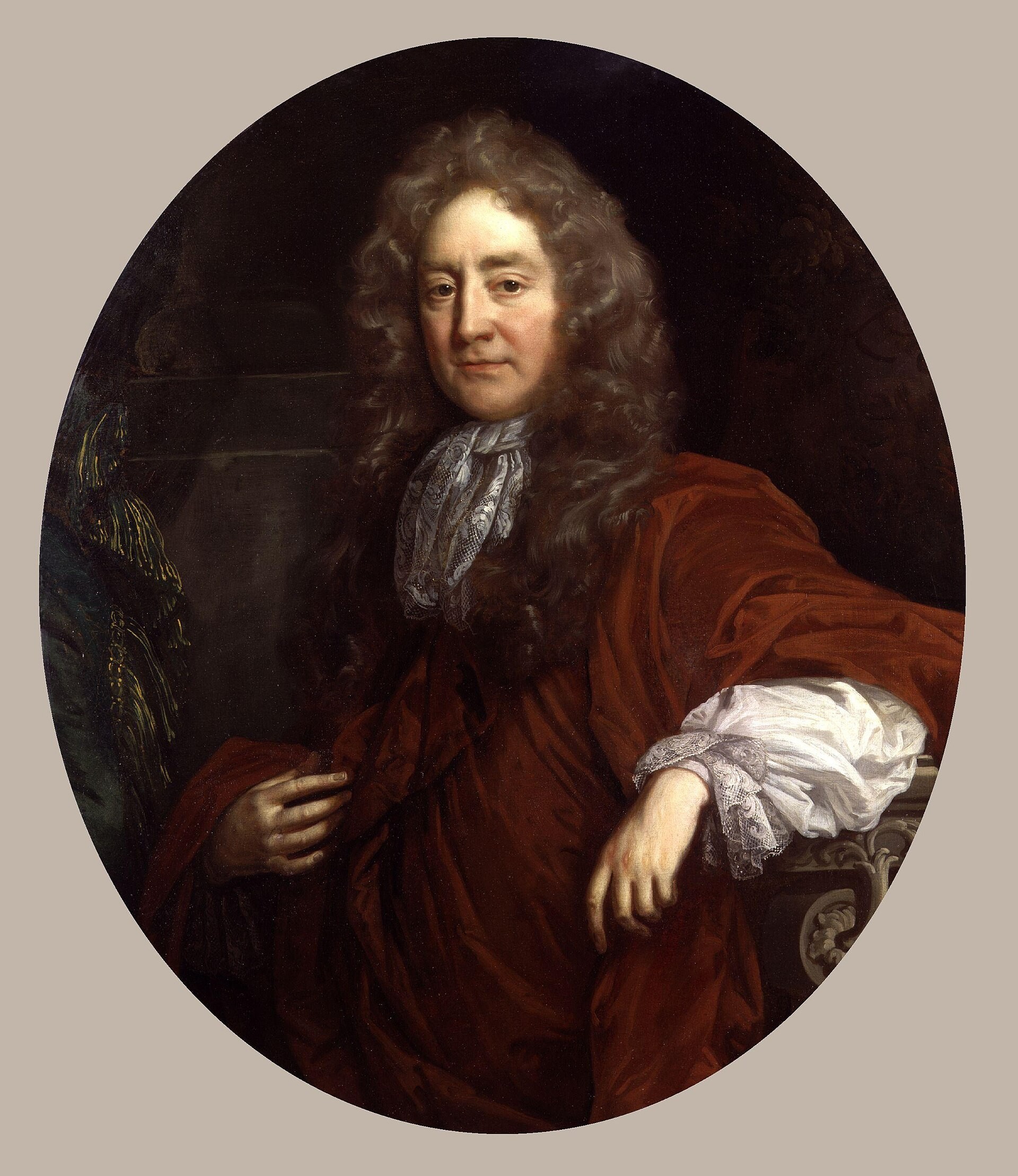
Josiah Child (1630–1699) was a London-born merchant, politician, and economic writer who rose from a naval victualler’s apprentice to become, by some contemporary accounts, the wealthiest man in Britain. His 1668 pamphlet on trade and interest rates drew a direct reply from the philosopher John Locke and lodged his arguments near the centre of late seventeenth-century economic debate.
Key facts
- Born: 1630
- Birthplace: London
- Died: 22 June 1699
- Place of death: London
- Country: Kingdom of England
- Occupation: economist; merchant; politician
- Awards: baronet
Early Life and Career
Child was baptised on 27 February 1631 at St Bartholomew-by-the-Exchange, Bartholomew Lane off Threadneedle Street, London. He was the second son of Richard Child, a merchant of Fleet Street, and Elizabeth Roycroft of Weston Wick, Shropshire. After completing an apprenticeship in the family business, he set up on his own account at Portsmouth around the age of 25, working as a victualler supplying the Royal Navy under the Commonwealth.
Between 1655 and 1660 he held the office of Deputy Treasurer of the Navy at Portsmouth. That post placed him at the intersection of government finance and maritime supply at a moment when England’s naval commitments were expanding rapidly, and it gave him both capital and connections he would exploit for the rest of his life. In 1659 he was elected Member of Parliament for Petersfield during the Third Protectorate Parliament; he later sat for Dartmouth from 1673 to 1678 and for Ludlow from 1685 to 1687.
The East India Company
By 1673, Child had become the single largest shareholder of the East India Company, having gradually converted his commercial fortune into the Company’s stock. His grip on the institution tightened over the following years. On 16 July 1678, he was created Baronet Child of Wanstead in the County of Essex, a title that reflected both his wealth and his political standing.
His control of the Company was not without controversy. The Dictionary of National Biography records that his despotic rule made him many enemies, who accused him of using his position to advance his own interests and of removing opposition through bribery. The accusation was well-founded in at least one documented instance: he had the Company distribute nearly £90,000 in bribes to sympathetic politicians to preserve its monopoly, which produced a parliamentary scandal and a formal inquiry in 1693.
The Glorious Revolution of 1688 damaged his position considerably. Because he was closely associated with the deposed Stuarts, his political cover weakened after William III came to power, and his rival Thomas Papillon led a movement to open the East Indies trade to competition. Child also served as High Sheriff of Essex in 1689, a year that bracketed both his political vulnerability and his continued local authority.
Economic Writing
In 1668 Child published Brief Observations Concerning Trade and Interest of Money, in which he argued that a low rate of interest was what he called the “causa causans” of Dutch commercial prosperity. His central policy proposal was a reduction in England’s maximum legal rate of interest from 6 percent to 4 percent. He contended that a high rate hindered trade, encouraged idleness, and discouraged navigation, industry, arts, and invention.
Those arguments directly prompted John Locke to engage with economics, producing Locke’s essay Some Considerations of the Consequences of the Lowering of Interest and Raising the Value of Money, published in 1692. Child is sometimes regarded as a moderate precursor to the free-trade doctrines of the 18th century. He departed from orthodox mercantilist thinking by abandoning the emphasis on a favourable balance of trade and by recognising the value of free trade even when it led to an outflow of precious metal.
Wanstead and Property
Child purchased Wanstead Manor in 1673 for £11,500. The house already had 40 hearths at the time of purchase, making it one of the largest residences in Essex. The estate became his principal seat and the basis for his baronetcy’s territorial designation.
The Anglo-Mughal War and Its Aftermath
The East India Company’s aggressive posture under Child extended to military confrontation with the Mughal Empire. Following the Anglo-Mughal War, the Company was fined 150,000 rupees, a sum approximately equivalent to £3.3 million in modern values, before having its trading privileges restored. The episode illustrated both the reach of the Company’s ambitions and the limits of what those ambitions could achieve against a power of the Mughal Empire’s scale.
Death and Memorial
Child died on 22 June 1699 in London. A large funerary monument attributed to the sculptor John Nost, dated 1699, stands in the chancel of St Mary the Virgin Church, Wanstead. It depicts Child in white marble standing under a triumphal arch.
Did you know
- When Child purchased Wanstead Manor for £11,500 in 1673, the house already had 40 hearths, making it one of the largest residences in Essex at the time. (british-history.ac.uk)
- Child was the wealthiest man in Great Britain by some contemporary accounts, with his fortune estimated at £200,000 at the time of Evelyn’s 1683 visit. (en.wikisource.org)
- By 1691, Child and just seven other investors together owned more than 25 percent of the Royal Africa Company’s stock, making them the dominant shareholders in a company that was one of the leading carriers of enslaved Africans across the Atlantic. (wansteadpark.org.uk)
- In his will, Child stated that his son Josiah and daughter Mary had “both of them behaved undutifully to me and broake many promises made to me in a high and ungratefull contempt of me their Father”. (london-now.co.uk)
Data sources
Where it appears
- Josiah Child’s War on the Mughal Empire Ended in Surrender November 6, 2026
Data updated: 2026-11-02