
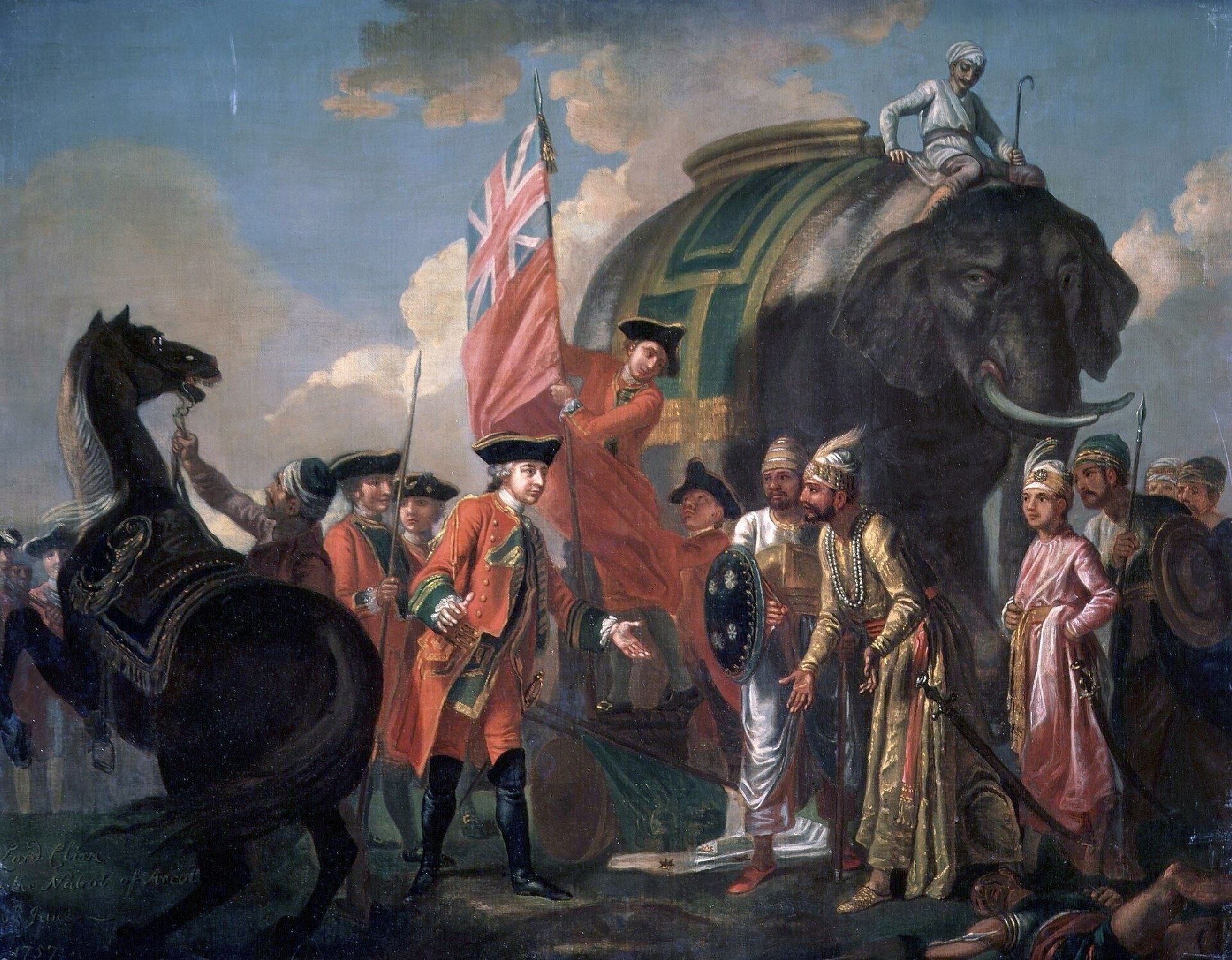
On 23 June 1757, at Palashi in present-day West Bengal, a force under Robert Clive defeated the army of Nawab Siraj-ud-Daulah, whose soldiers numbered approximately 35,000 infantry and 15,000 cavalry supported by 53 heavy guns. The victory was less a pitched battle than the controlled collapse of a conspiracy: a secret treaty, a forged signature, and a banking family’s withdrawal of credit had already shaped the outcome before the first cannon fired. The East India Company’s win at Plassey transferred control of Bengal, Bihar, and Orissa to British hands and set the legal and military framework that eventually became the British Raj.
Key facts
- Country: India
- Type: battle
- Date: 23 June 1757
- Location: Palashi
- Participants: Kingdom of Great Britain
Background and causes
Tension between the East India Company and Siraj-ud-Daulah built through several overlapping grievances. The Company had fortified Fort William at Calcutta without the Nawab’s authorisation, and its servants had systematically abused the duty-free trading privileges, known as dastaks, that the Mughal imperial grant was never meant to extend to private commerce. When the Company also sheltered Krishna Das, son of Raj Ballabh, a man the Nawab demanded be handed over, Siraj moved against Calcutta.
On 20 June 1756, Siraj-ud-Daulah captured Fort William and confined British prisoners in a dungeon measuring 14 by 18 feet (4.3 m x 5.5 m). The episode, remembered as the Black Hole of Calcutta, killed 123 of those held through dehydration and suffocation. The incident was used extensively as a justification for the Company’s subsequent military response, though the dungeon’s exact casualty figures have been disputed by modern historians.
Robert Clive and Admiral Charles Watson retook Calcutta in January 1757. On 9 February 1757, the Treaty of Alinagar restored the Company’s trading privileges. In March 1757, Clive struck pre-emptively at the French settlement of Chandernagore, eliminating the remaining French military presence in Bengal before turning to face the Nawab.
The conspiracy
The political manoeuvre that preceded the battle proved more decisive than the fighting itself. Mir Jafar, commanding the Nawab’s cavalry, agreed to hold his forces back. On 10 June 1757, he signed a secret treaty with the Company, committing to inaction in exchange for being installed as Nawab after Siraj’s removal. The Jagat Seth banking family, whose capital and credit networks ran through much of Bengal’s commerce, was central to this conspiracy: their refusal to fund Siraj’s resistance effectively cut the Nawab off from the financial resources he would have needed to sustain a prolonged campaign.
Clive also forged Admiral Watson’s signature on a related treaty document. Watson had refused to sign because the document rested on deception; Clive signed in his name anyway. The conspiracy that delivered Bengal to the Company was therefore partly founded on a fraudulent instrument.
The battle, 23 June 1757
The Company’s force at Plassey comprised approximately 950 European troops, including 250 men of His Majesty’s 39th Foot Regiment, alongside 2,100 Indian sepoys and topazes, 60 sailors, and 100 artillerymen operating eight 6-pounder guns and two howitzers. Against them, Siraj-ud-Daulah fielded approximately 35,000 infantry, 15,000 cavalry, and 53 cannon of 18, 24, and 32 pounds, with a small French contingent under St Frais supervising the artillery.
On the day, Mir Jafar’s cavalry stood off and did not engage, as agreed. The Nawab’s cannonade proved out of range, while British artillery killed Mir Madan, one of the few commanders in Siraj’s army who remained loyal to him. With Mir Madan dead and the bulk of his cavalry uncommitted, Siraj’s position disintegrated. He fled the battlefield on a camel. On 2 July 1757, he was captured and executed by Mohammad Ali Beg at Namak Haram Deorhi in Murshidabad, on orders from Miran, the son of Mir Jafar.
Immediate aftermath
On 29 June 1757, Clive installed Mir Jafar in Murshidabad as the new Nawab of Bengal, Bihar, and Orissa, making him the first British-installed client ruler in India. Under the post-battle agreement, the Company received approximately £2.5 million from the Nawab’s treasury. Clive collected £234,000 for himself personally and was also granted a jagir, a landed estate carrying an annual rental income of £30,000.
Clive was subsequently appointed Governor of Bengal, serving two terms from 1758 to 1760 and again from 1764 to 1767. In March 1762, he received an Irish peerage and the title Baron Clive of Plassey.
Consolidation of Company rule
Plassey opened the door; the Battle of Buxar in 1764 pushed it wider. In 1765, Mughal Emperor Shah Alam II granted the East India Company the Diwani, the formal right to collect revenues from Bengal, Bihar, and nominally Orissa. The grant formalised in administrative law what the victory at Plassey had established by force of arms.
The Jagat Seth family, whose financial support had made the conspiracy viable, did not share in the long-term gains. Within a generation of the battle, the East India Company no longer required Indian banking intermediaries and the family was ruined. The episode illustrates how the Company absorbed local power structures and then discarded them once they ceased to be useful.
Commemoration and legacy
During the Victorian era, statues of Clive were erected in London and Calcutta, and the Battle of Plassey featured prominently in British school textbooks as a canonical moment of imperial expansion. The battlefield site in the Nadia district of West Bengal is protected by the Archaeological Survey of India and is marked with shrines, obelisks, and memorials to the commanders and soldiers of Siraj-ud-Daulah’s army. A Plassey Monument was erected at the site in 1957 to mark the 200th anniversary of the battle.
Historians continue to debate the battle’s significance within broader discussions of colonialism, economic exploitation, and India’s subsequent struggle for independence. The conspiracy’s mechanics, particularly the roles of Mir Jafar and the Jagat Seth family, as well as Clive’s forgery, remain subjects of active scholarly attention.
Did you know
- Robert Clive personally collected £234,000 from the Nawab’s treasury after the battle. An average British nobleman at the time could live a life of luxury on an annual income of just £800, putting Clive’s personal windfall into striking perspective. (newworldencyclopedia.org)
- The Jagat Seth banking family financed the Plassey conspiracy against Siraj-ud-Daulah, but their reward was short-lived. Once the East India Company had consolidated power over Bengal, it no longer needed Indian bankers, and the family was ruined within a generation. (dev.to)
- Clive forged Admiral Watson’s signature on the secret treaty with Mir Jafar because Watson refused to put his name to a document founded on deception. The conspiracy that toppled one of Bengal’s last independent nawabs was therefore partly built on a fraudulent treaty. (translate.google.com)
- The Black Hole of Calcutta dungeon, which was used as a major propaganda pretext for Clive’s expedition, measured only 18 feet by 14 feet and reportedly held 146 British prisoners overnight on 20 June 1756. Modern historians dispute the exact casualty figures from that night. (ebsco.com)
Data sources
- Wikidata
- testbook.com
- worldhistory.org
- ebsco.com
- translate.google.com
- britishbattles.com
- nam.ac.uk
- ksgindia.com
- newworldencyclopedia.org
- anantamias.com
- pandaw.com
- studyguides.com
- iasexpress.net
Where it appears
- Josiah Child’s War on the Mughal Empire Ended in Surrender November 6, 2026
Data updated: 2026-11-02