
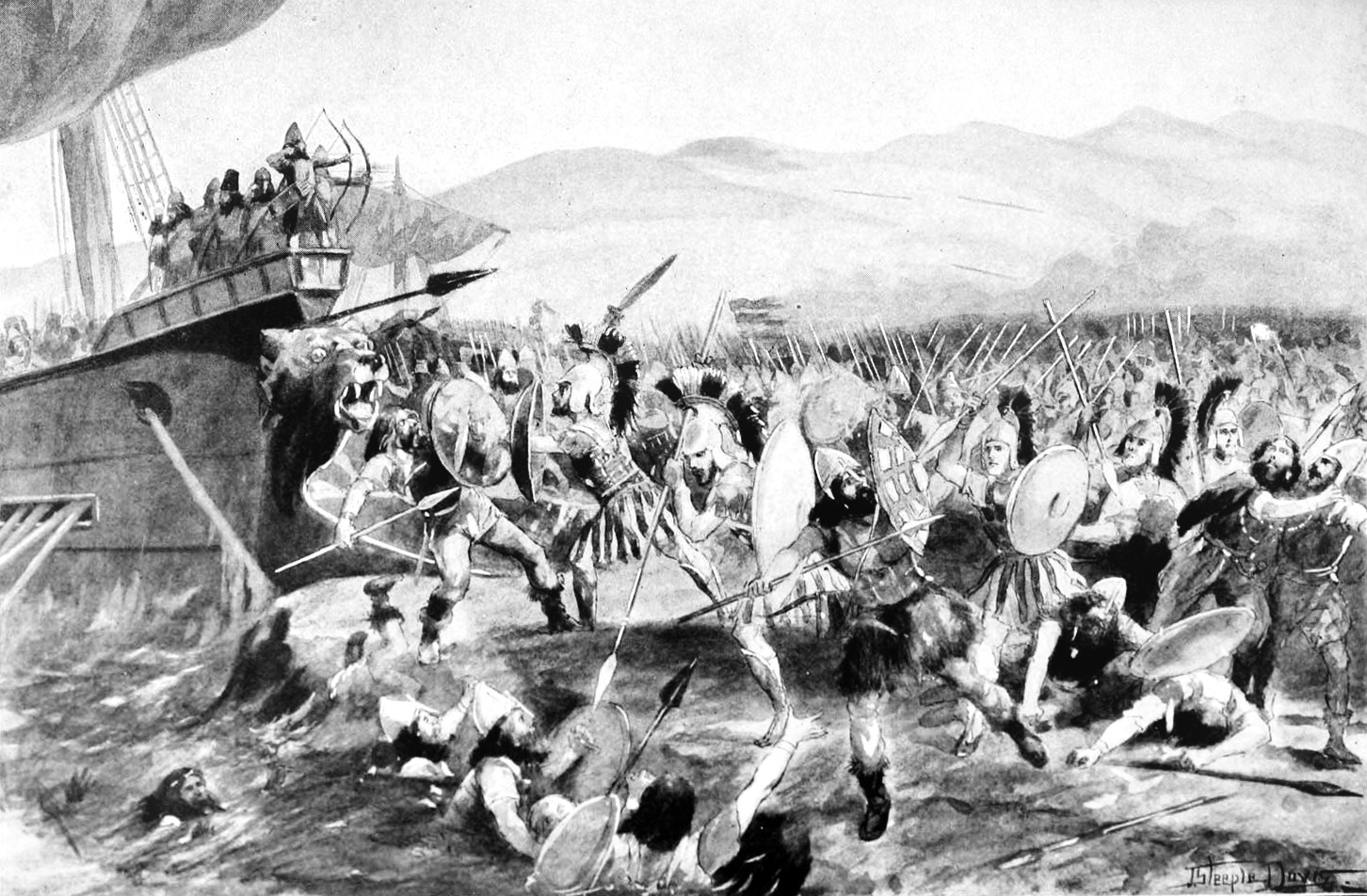
The Battle of Marathon was fought in September 490 BCE on a coastal plain in northeastern Attica, Greece, roughly 26 miles (42 kilometers) from Athens, where a combined Athenian and Plataean force confronted an invading Persian army under the command of Datis. The Persian force numbered roughly 25,000 soldiers transported aboard as many as 600 ships, yet the Greek defenders held the plain and drove the Persians back to their beached fleet.
Key facts
- Country: Greece
- Type: battle
- Date: -490-09-12
- Location: Marathon
- Participants: Achaemenid Empire; Classical Athens; Plataea
The Road to Marathon Bay
Eretria fell to the Persians before the fleet anchored at Marathon Bay, giving the invaders a secure landing point and a base from which to march toward Athens.
Athens turned for help, and a runner named Phidippides was sent to Sparta. The Plataeans joined the Athenian ranks, though Sparta did not arrive in time for the battle itself. Among the Greek commanders, Miltiades carried particular weight: he had earlier served under Persian command in Thrace, and that experience gave him a working knowledge of how Persian forces were organised and deployed.
The Charge across the Plain
The Persian army, estimated at roughly 25,000 men, occupied the Marathon plain. The Greek line, stretched to match the Persian front, held its position until Miltiades ordered an advance. At around 400 metres from the Persian lines, he ordered his men to run straight at the enemy. Datis had never encountered Greek hoplites charging in full armour and had no prepared answer for it.
The sprint closed the distance before Persian archers could do serious damage. The Greek forces broke through the Persian formation and then pursued the retreating army across the plain, covering 3 to 4 miles (5 to 6 kilometers) back to the Persian camp and the ships beached along the shore.
Aftermath and Commemoration
Athens marked its victory with lasting monuments. A treasury was built at Delphi to commemorate the defeat of the Persian force. On the Acropolis of Athens, a sculpture of Iris or Nike, standing 1.4 metres (4 ft 7 in) tall, was erected in memory of the Athenian war-archon Kallimachos, who was killed during the battle.
The victory ended the immediate Persian threat to Attica and stands as one of the defining engagements of the ancient Greek world.
Did you know
- One account says Phidippides completed the 26-mile run from Marathon to Athens in about three hours. (thenagain.info)
- Naxos alone could reportedly field “8,000 shields” around 500 BC and had successfully defended against a 200-ship Persian invasion a decade before Marathon. (dlab.epfl.ch)
- The Persian commander Datis had never witnessed or even heard of Greek hoplites running in full armor before Marathon and was caught completely off guard. (warfarehistorynetwork.com)
- Some Athenian traitors secretly opened a city gate for the Persians and received rewards of land from Datis in exchange. (warfarehistorynetwork.com)
- Ionians serving in the Persian army secretly sent messengers to warn the Athenians of Datis’s scheme to attack the undefended city. (warfarehistorynetwork.com)
Data sources
- Wikidata
- ebsco.com
- thenagain.info
- militaryhistorynow.com
- warfarehistorynetwork.com
- historyskills.com
- worldhistory.org
- history.com
Where it appears
- Marathon’s 26 Miles: An 1896 Olympic Invention, Not Ancient History November 25, 2026
Data updated: 2026-11-03