
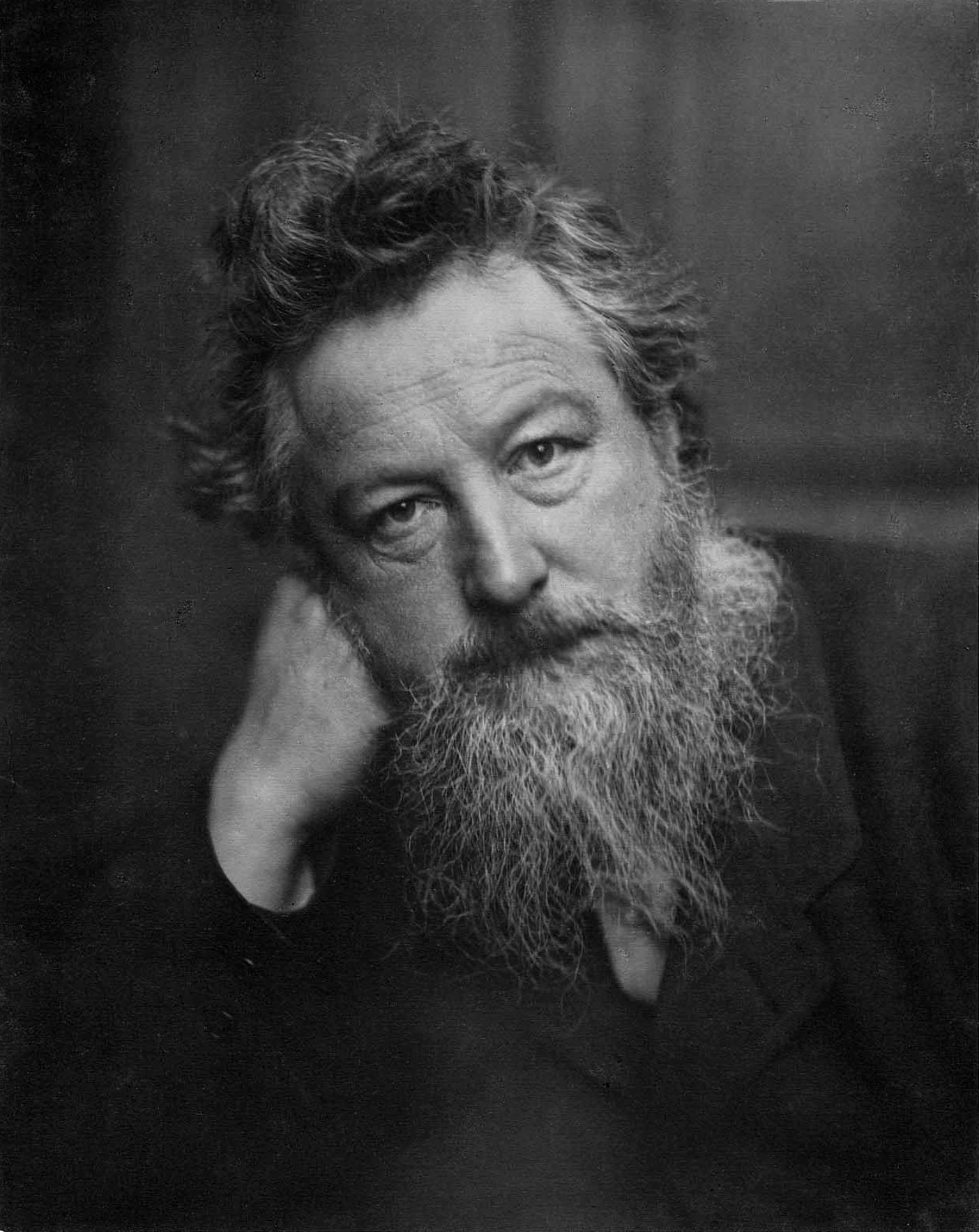
William Morris was a British designer, poet, printer and political organiser who shaped Victorian decorative art through the firm he founded in 1861. Born on 24 March 1834 in Walthamstow, he trained first as an architect before turning to painting and design under the influence of Dante Gabriel Rossetti and Edward Burne-Jones. His company, known from 1875 as Morris and Co. produced wallpapers, textiles, furniture, stained glass, tapestries and carpets. In later life he founded the Kelmscott Press, co-founded the Society for the Protection of Ancient Buildings, and became a leading figure in British socialism. He died at Kelmscott House on 3 October 1896.
Key facts
- Born: 24 March 1834
- Birthplace: Walthamstow
- Died: 3 October 1896
- Place of death: Hammersmith
- Country: United Kingdom of Great Britain and Ireland; United Kingdom
- Occupation: architect; poet; designer; graphic designer
- Education: Exeter College; Marlborough College
Early life and training
Morris was the third child and eldest son of Emma Shelton Morris and William Morris, a wealthy London bill broker who died when his son was fourteen. He was educated at Marlborough College and Exeter College. After university he briefly trained as an architect under G.E. Street.
Encouraged by Rossetti and Burne-Jones, Morris left architecture and began painting in the Pre-Raphaelite style. In 1857 he joined Burne-Jones, Rossetti and other friends in painting the Oxford Union frescoes, now largely destroyed. During that project he met Jane Burden, one of Rossetti’s models, whom he married in April 1859.
Red House and the founding of the Firm
Morris gave his friend Philip Webb his first independent commission: the design and supervision of Red House in Bexleyheath, built for Morris and his wife. It is the only house Morris ever commissioned, and it is now cared for by the National Trust.
In 1861 Morris and several friends founded Morris, Marshall, Faulkner and Co. known as the Firm, which designed and produced furniture, wallpapers, textiles, glassware, stained glass, tapestries and carpets. The company was dissolved and re-established in 1875 as Morris and Co. with Morris as sole proprietor.
Kelmscott, Iceland and the sagas
In 1869 Morris and his family moved into Kelmscott Manor, sharing the house with Dante Gabriel Rossetti. He made his first trip to Iceland in 1871. With the Icelander Eirikur Magnusson he co-translated the Volsunga Saga, and in 1876 he published his epic poem The Story of Sigurd the Volsung, drawing on that material.
Preservation and politics
Morris’s discovery of John Ruskin’s essay The Seven Lamps of Architecture led him, together with Philip Webb, to found the Society for the Protection of Ancient Buildings in 1877.
In 1883 Morris joined the Democratic Federation, soon renamed the Social Democratic Federation. In December 1884, with the support of Friedrich Engels, he and eight of the ten members of the S.D.F. executive resigned to set up the Socialist League. He edited the League’s journal, Commonweal, and was arrested in connection with free speech demonstrations in 1884. His Coach House at Kelmscott House became the meeting place of the Hammersmith Socialist League, where speakers including Peter Kropotkin and George Bernard Shaw lectured.
His utopian novel News from Nowhere was serialised in Commonweal between January and October 1890 and reprinted in book form by Reeves and Turner in 1891. It remains in print and is credited with making a lasting contribution to utopian thought.
Kelmscott Press
The Kelmscott Press, named after Morris’s Cotswold house, operated for seven years and produced 53 works comprising 66 volumes, in limited runs averaging 300 copies each.
Death and legacy
Morris died at Kelmscott House on 3 October 1896. His literary executor, Sydney Cockerell, closed the Press afterward to preserve the integrity of its publications.
The William Morris Society was founded in 1955 to make his life, work and ideas better known, and the William Morris Gallery, a public gallery dedicated to him, occupies his childhood home in Walthamstow.
Did you know
- Burne-Jones described Red House, Morris’s first and only commissioned home, as “the beautifullest place on earth.” (wmgallery.org.uk)
- Morris’s painting La Belle Iseult, on which he wrote “I cannot paint you, but I love you,” is believed to be the only oil painting he ever completed. (dailyartmagazine.com)
- Jane Morris, his wife, admitted after his death that she never loved him. (dailyartmagazine.com)
- Morris’s birthplace, Elm House, was demolished in 1898, two years after his death. (beyondthename.weebly.com)
- In News from Nowhere Morris named his narrator character “Guest,” a reference to a figure type in the Icelandic sagas he had translated. (victorianfboos.studio.uiowa.edu)
- Henry Halliday Sparling, the first secretary of the Kelmscott Press, was also the husband of Morris’s daughter May. (exhibitions.lib.umd.edu)
- The first Kelmscott Press publication, The Story of the Glittering Plain, sold out quickly along with his other titles. (connect.adelaide.edu.au)
Data sources
Data updated: 2026-11-24