
A General Without an Army
On the evening of June 18, 1940, Charles de Gaulle stood at a BBC microphone in London and read a statement into the French service. He was 49, a temporary brigadier general who had held the post of Under-Secretary of State for National Defence and War for eleven days. Marshal Philippe Pétain had announced the previous day that France would seek an armistice with Germany. De Gaulle had crossed to England rather than remain.
The broadcast, known as the Appeal of 18 June (L’Appel du 18 juin), was not widely heard; the BBC made no recording of it. Historians describe most later listener accounts as false memories. A manuscript survived in Swiss military intelligence archives and was published by Le Monde in 2023. The version that reached a meaningful audience was a second broadcast, delivered and recorded on June 22, 1940. That recording, together with the June 18 manuscript, was recognized by UNESCO’s Memory of the World Programme on June 18, 2005.
De Gaulle held no recognized authority, commanded no organized force, and had no mandate from any surviving French institution. Churchill, who had authorized the broadcast over Cabinet objections, was dealing with a man who had almost no following.
Ten Days in Which Nothing Was Settled
For ten days after June 18, de Gaulle’s legal position remained open. Vichy ordered him to return; he refused. On June 22, a decree stripped him of his rank and placed him in compulsory retirement, published formally on June 23.
Churchill met de Gaulle on June 27. According to a History Today account by Mathew Lyons, Churchill said something to the effect that de Gaulle stood entirely alone, and that he recognized him on that basis. The exact wording cannot be verified from primary sources. On June 28, the British government formally recognized de Gaulle as leader of the Free French. The Élysée website gives June 27; Britannica and History Today give June 28, a discrepancy likely reflecting the difference between Churchill’s verbal statement and the formal written recognition.
The Tribunal at Clermont-Ferrand
The first criminal proceeding was held in Toulouse on July 4, 1940. The military tribunal of the 17th Region tried de Gaulle in absentia on charges of refusing orders and inciting disobedience, returning a verdict of four years’ imprisonment and a fine of 100 francs.
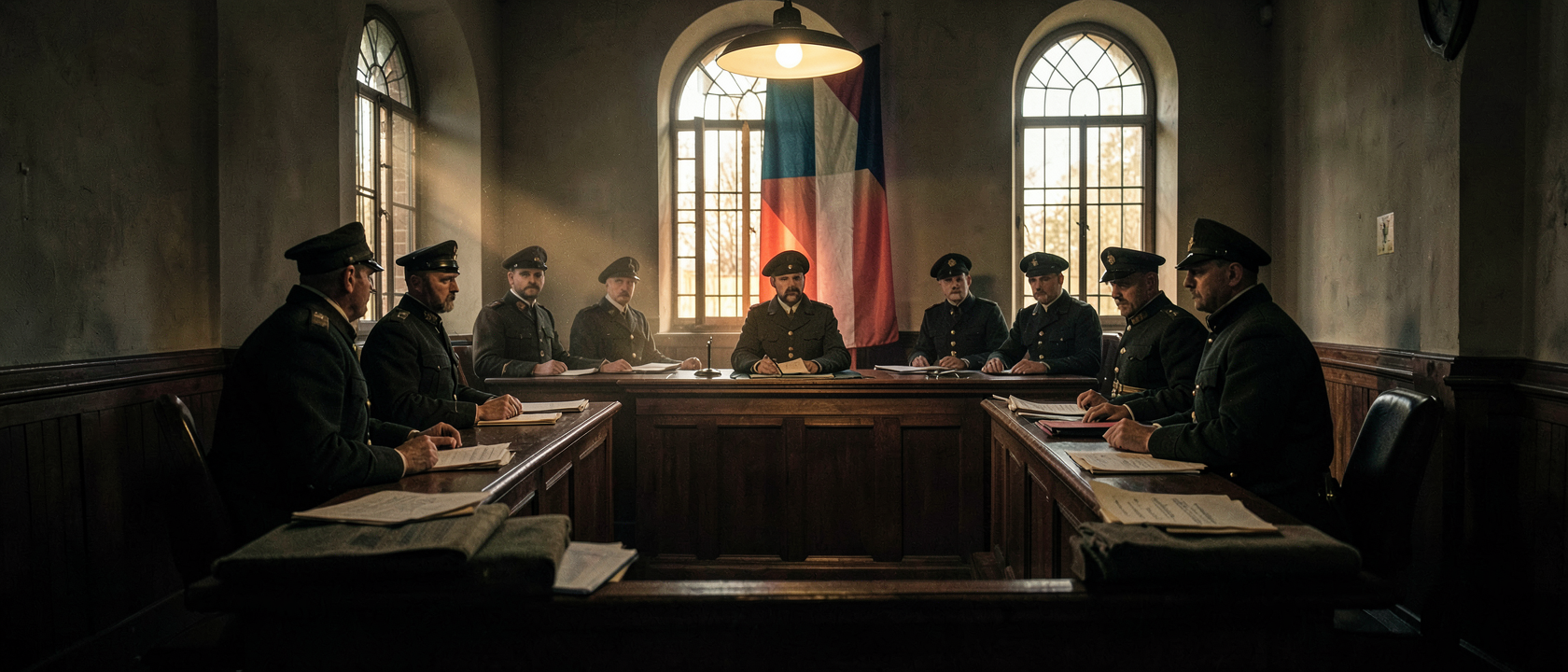
The second proceeding was of a different order. On August 2, 1940, the Permanent Military Tribunal of the 11th Region convened in Clermont-Ferrand, in the unoccupied zone of Vichy France. General Aubert Frère presided. The charges were treason (trahison), threat to external state security, and desertion abroad in wartime. The tribunal found de Gaulle guilty, sentenced him to death, ordered his military degradation, and confiscated all his movable and immovable property.
As a physical matter the sentence could not be carried out, de Gaulle was in London. But it placed him outside the protection of French law and closed any realistic possibility of a negotiated return. Whether Pétain privately vowed to ensure the sentence was never carried out, and what de Gaulle publicly said in response, both circulate in secondary literature without primary-source confirmation. The death sentence was eventually annulled by the Cour de cassation at Riom on January 11, 1945.
The Bill
All of de Gaulle’s property passed to the Vichy state. The sources do not specify what it consisted of or its value. Yvonne de Gaulle had moved from London to Shropshire, England; the sources give no reason for that choice. On August 7, 1940, five days after the death sentence, Britain and de Gaulle signed the Chequers agreement: Britain would fund the Free French, the account to be settled after the war.
The Rings
When news of the August 2 sentence reached Britain, ordinary civilians brought quantities of jewelry to de Gaulle’s London headquarters. Among them, according to the History Today account by Mathew Lyons, were unnamed widows who sent wedding rings to be melted down for the Free French cause. The sources record neither the number of items nor their combined value. No official appeal had preceded the gesture.
The court martial was a formal act by a state trying to extinguish a rival’s legitimacy. The people who surrendered their rings owed de Gaulle nothing, had no political stake in the outcome, and acted without being asked. What arrived at his headquarters was not a declaration but metal, given by strangers, for a cause that had, as of August 1940, very few soldiers.
What the Record Cannot Tell Us
Several questions have no answer in the surviving sources: the nature and value of de Gaulle’s confiscated property, the reason Yvonne chose Shropshire, and the total quantity and value of the jewelry donations. Pétain’s reported private comment and de Gaulle’s attributed public response both remain unverified.
What the record does establish: a man with no organized following, stripped of rank on June 22, condemned to death on August 2, and cut off from his property by his own government, received a British financial lifeline on August 7 and an unsolicited collection of jewelry from civilians who had read the news and responded with the most personal objects they owned.