
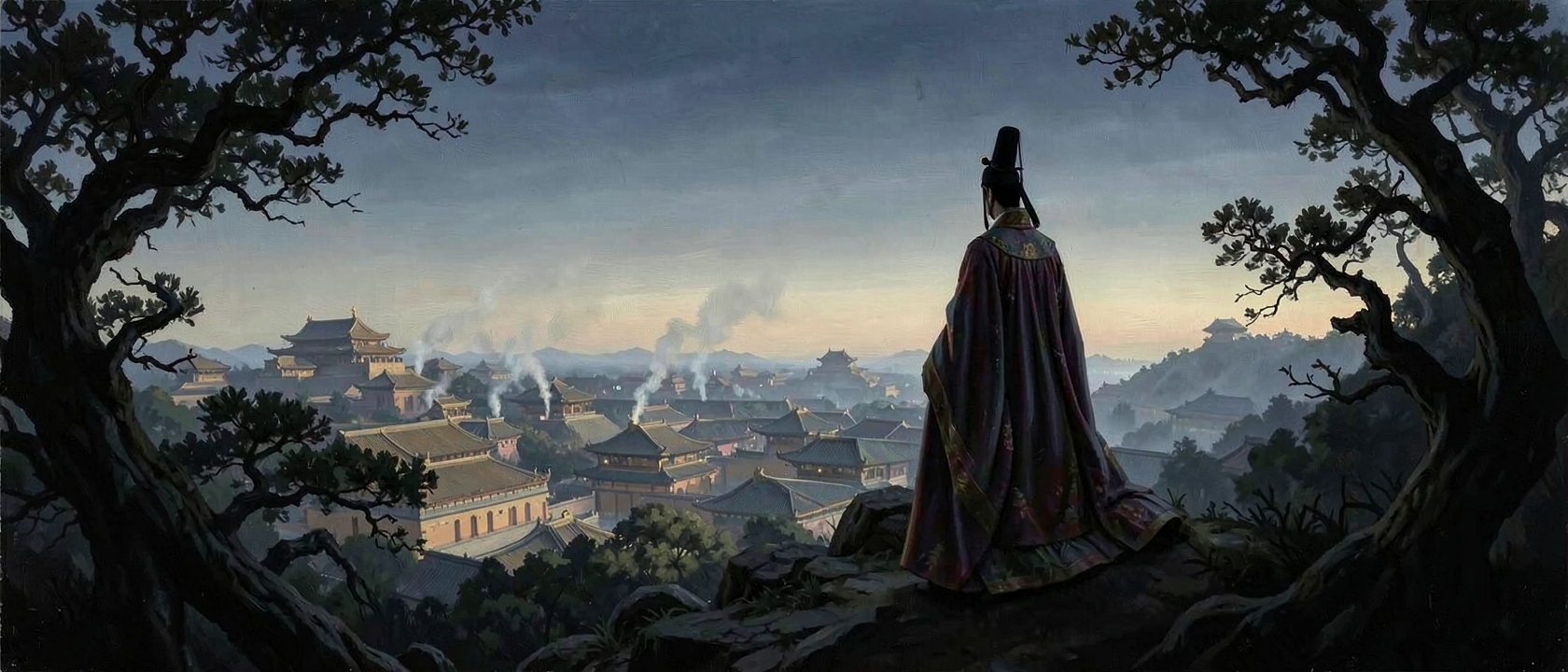
Coal Hill, Before Dawn
The hill north of the Forbidden City was not a natural feature. It had been built from earth excavated when the palace moat was dug, an artificial mound overlooking the northern wall. Its name was Wansui Hill, though it was also called Coal Hill and later Jingshan. On the morning of 25 April 1644, a man climbed it alone.
His name was Zhu Youjian. He was thirty-three years old and had reigned as the Chongzhen Emperor, sixteenth ruler of the Ming dynasty, since October 1627. He died on the hill. The dominant account holds that he hanged himself from a scholar tree; a secondary account, carried in some popular histories, describes self-strangulation with his own sash. Both appear in the record. Hanging is the mainstream scholarly consensus, but the question is not closed.
Two characters were reportedly found with the body, in his own hand: 天子 (tian zi), meaning “son of heaven.” Whether this rests on a contemporary document or a tradition that hardened after the dynasty’s fall is not established in peer-reviewed scholarship. His body lay where it fell for three days and was found on 28 April 1644.
The Ming dynasty, founded by Zhu Yuanzhang on 23 January 1368, had governed China from Beijing since the early fifteenth century. Its run, 276 or 277 years depending on how the count is calculated, was over.
What the Teenager Was Handed in 1627
Zhu Youjian came to the throne on 2 October 1627, aged sixteen. What he inherited was a dynasty already under simultaneous pressure from three directions. Successive crop failures across northern China had produced famine conditions the empire’s tax and granary systems could not absorb, swelling armed peasant rebellions that were fracturing provincial control. At the same time, the Manchu confederation to the northeast, then the Later Jin, soon to become the Qing, was pressing the frontier with increasing force. The rebellions drained troops that might have reinforced the northeast; the northeastern threat prevented any full redeployment against the rebellions. None of these crises originated with Chongzhen. All three were running before he reached the throne.
Li Zicheng Names Himself Emperor
On 8 February 1644, rebel commander Li Zicheng proclaimed the Shun dynasty in Xi’an and declared himself its emperor. Born around 1605–1606 in Shaanxi, he had joined the peasant rebellion in 1630 and built his insurgency into something with the form of a state: its own coinage, titles, and land distribution program.
On 10 February 1644, advisers in Beijing urged the Chongzhen Emperor to abandon the capital and withdraw south. He refused, and continued to refuse for more than two months while Li Zicheng’s army moved east. By March 1644, Shun forces had taken Taiyuan in Shanxi province. On 23 April 1644, Beijing was encircled. That same day, Chongzhen held his last formal audience with his ministers.
24–25 April 1644: Inside the Palace
The rebel attack on Beijing began the night of 24 April 1644. Inside the palace, Empress Zhou, born 10 May 1611, hanged herself in the Palace of Earthly Tranquility. That same night, the emperor killed Consort Yuan and Princess Kunyi, his first daughter. He killed Princess Zhaoren, born in 1639, a child still, who was the youngest of his daughters. He severed the left arm of his second daughter, Princess Changping (Zhu Meichuo, born 2 May 1630). She survived.
Chongzhen attempted to leave the palace disguised as a commoner; his own guards turned him back, several accounts recording that they mistook him for a spy trying to enter. He returned inside the gates. Before dawn on 25 April 1644, he left a second time and climbed Wansui Hill.
What 25 April 1644 Cost
By that morning, five people connected to the imperial household were dead: the emperor, Empress Zhou, Consort Yuan, Princess Kunyi, and Princess Zhaoren. Princess Changping survived into the Qing period, dying in Beijing on 26 September 1647, aged seventeen.
Later on 25 April 1644, Li Zicheng’s forces formally took the city. The acquisition was not stable. On 27 May 1644, at the Battle of Shanhai Pass, his army was defeated by a combined Qing force under Prince-Regent Dorgon and former Ming general Wu Sangui. On 3 June 1644, Li Zicheng proclaimed himself Yongchang Emperor in Beijing. On 4 and 5 June, he and his troops abandoned the city, setting the palace ablaze before leaving. On 5 June 1644, Beijing passed to Qing forces. Li Zicheng had held the capital for approximately six weeks. He died in 1645 in the Jiugong Mountains; sources disagree on whether villagers killed him or he took his own life. Ming loyalist states held on in the south until 1662.
Three Questions the Sources Leave Open
The inscription, 天子, “son of heaven”, appears consistently across narrative histories of the Ming collapse, but whether it reflects a documented contemporary record or a post-1644 tradition is unconfirmed in rigorous academic sources. The same applies to reported dying words blaming his ministers. Both details may be accurate; neither has been verified to that standard.
The method of death remains similarly uncertain. Hanging from a scholar tree is the mainstream consensus; self-strangulation with a sash appears in some popular histories. The evidence runs no further than that.
The third uncertainty is structural. Li Zicheng’s collapse, from taking Beijing on 25 April 1644 to abandoning it on 4–5 June, is striking, and the defeat at Shanhai Pass on 27 May was plainly the proximate blow. Why he could not consolidate a position he had spent years fighting to reach is a question historians have not resolved with a single sufficient answer.
What the record does settle: a dynasty 276 or 277 years old ended on a man-made hill outside its own palace. The man who took the capital in its place lasted six weeks before setting it on fire and walking away.