
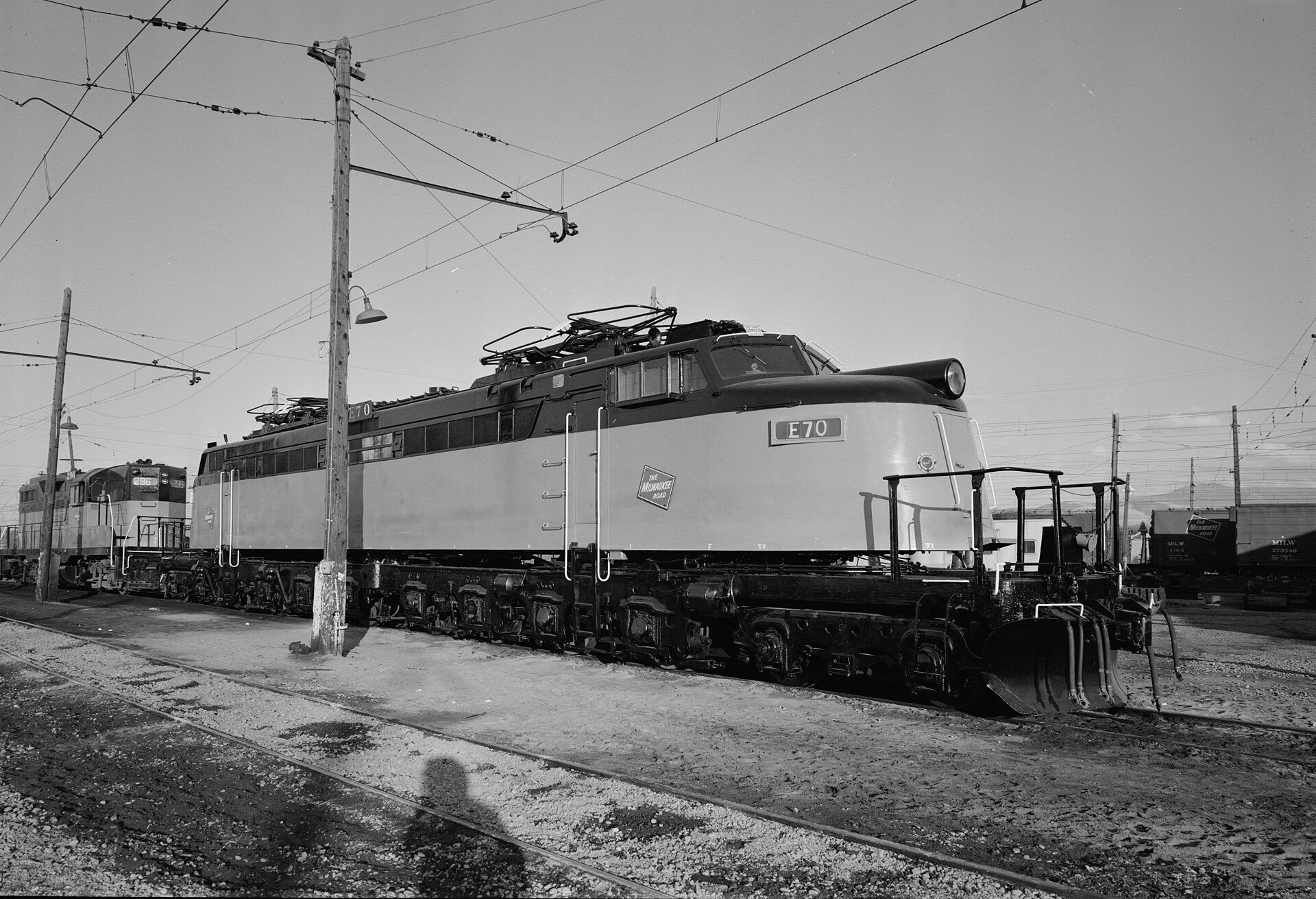
The Chicago, Milwaukee, St. Paul and Pacific Railroad, known to most as the Milwaukee Road, was a Class I freight and passenger carrier that linked the American Midwest and Northwest until its assets passed into the Soo Line on January 1, 1986. Its roots run to the Milwaukee & Waukesha Railroad, chartered in 1847, and the company that eventually bore the Pacific name took legal shape on January 13, 1928. At its peak the railroad electrified 656 miles of track on its Pacific Extension, making it the largest electrified railroad in the United States. Headquartered in Chicago, it spent its final decade fighting bankruptcy and shedding track before disappearing as an independent corporate name.
Key facts
- Country: United States
- Founded: 1847
- Dissolved: 1986
- Headquarters: Chicago
- Type: transport company; business; railway company
Origins and expansion
The railroad traced its beginning to the Milwaukee & Waukesha Railroad, chartered in 1847. Growth came through acquisition: the Milwaukee & St. Paul bought the St. Paul & Chicago in 1872, and in 1873 the company completed a line running from Milwaukee south to Chicago. A year later the company added “Chicago” to its corporate name, reflecting the new southern reach of its network.
The modern corporate entity was formed on January 13, 1928, when the railroad’s property was delivered to a newly organized company named the Chicago, Milwaukee, St. Paul and Pacific Railroad. That name, and the electrified Pacific Extension built under it, carried the railroad through the middle of the twentieth century.
Electrification and the Pacific Extension
The railroad’s defining engineering feature was its electrified Pacific Extension, which at its height covered 656 total miles, the largest such installation on any American railroad. The line later became a focus of financial controversy: ICC auditors discovered that the Extension’s expenses had been double-entered through most of the 1970s, and the Commission eventually found that the Extension had actually returned a profit through 1977 and 1978, contrary to the figures used to justify its abandonment.
Merger attempts and decline
Starting in 1964, the Milwaukee Road and the Chicago & North Western Railway discussed a merger, but regulators blocked it in 1969, judging that it would create too many parallel routes. In 1970, a separate merger combining the Northern Pacific, Great Northern, the Burlington, and the Spokane, Portland and Seattle Railroads into the Burlington Northern was approved, a combination that effectively surrounded the Milwaukee Road’s territory. Despite that, in 1974 the Milwaukee Road still carried 80% of outbound Seattle traffic, even though Burlington Northern itself owned two transcontinental lines into the region.
The company tried other paths to survival. It filed, unsuccessfully, to be included in the Union Pacific and Chicago, Rock Island & Pacific merger, and a later proposed merger with Burlington Northern was denied in 1977. Losses mounted: between 1974 and 1977 the railroad lost one hundred million dollars. On December 19, 1977, it filed for bankruptcy for the third time in forty-two years.
Bankruptcy and abandonment of the Pacific Extension
At the time of the 1977 bankruptcy filing, the Milwaukee Road still operated 10,074 miles of track, and its trustee moved to abandon or sell lines that were losing money. The bankruptcy court approved abandonment of all trackage west of Miles City, Montana, a stretch of more than 1,100 miles that stands as the largest railroad abandonment in American history. Operations on the Pacific Extension ended on February 29, 1980, and the final train passed through Montana on March 15, 1980.
Final years and merger into the Soo Line
The reduced company, renamed the Milwaukee Road, Inc. operated as a separate subsidiary of the Soo Line through 1985. On January 1, 1986, it was merged into the Soo Line in the same transaction that also absorbed the Minneapolis, Northfield & Southern. The Interstate Commerce Commission recorded the merger under Finance Docket 30761, decided January 10, 1986.
Surviving trackage
What remains of the former Milwaukee Road network operates largely as a Midwest railroad under Canadian Pacific Kansas City. Amtrak’s Hiawatha and Borealis trains run on the former Chicago, Milwaukee, St. Paul main line. The Borealis service, begun in May 2024, runs between Chicago and St. Paul over former Milwaukee Road track, while the Empire Builder uses the same company’s former line east of St. Paul.
Data sources
- Wikidata
- american-rails.com
- trains.com
- abandonedrails.com
- johnmarvigbridges.org
- mtsgreenway.org
- bigskytreasure.org
- frrandp.com
- harlowtonmuseum.org
Where it appears
- Pheasant Salad Sandwiches Fed Soldiers at Aberdeen’s WWII Canteen November 15, 2026
Data updated: 2026-11-11