
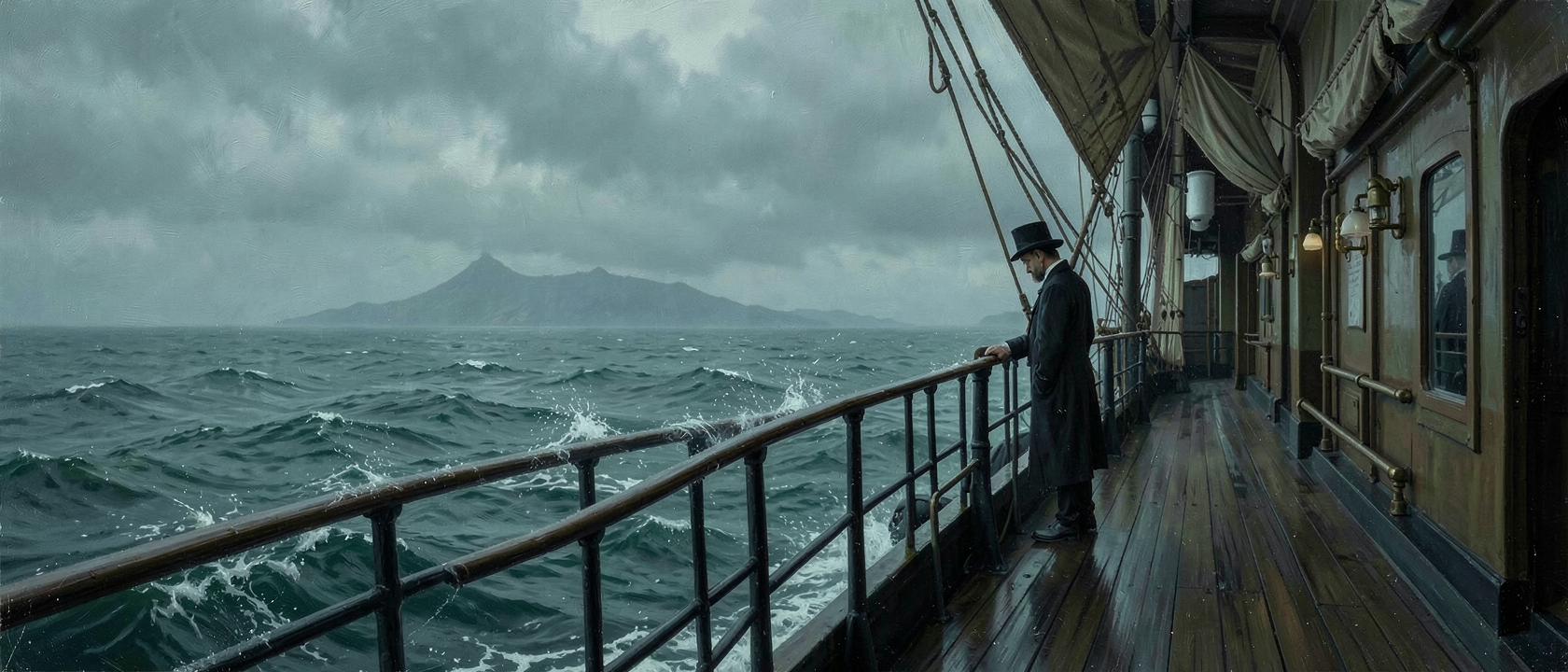
A Cry in the Dark
In the early hours of June 14, 1897, the Union Line steamer SS Scot was several days into the run from Cape Town to Southampton, out in open water near Madeira. A half gale was blowing. Fourth officer William Clifford woke to a single cry of “Murder!” and reached the deck in time to see a man go over the rail.
Clifford pulled off his coat and hat and went in after him. A boat was launched at once, the ship stopped her engines, and the crew threw lifebuoys over the side. But the sea was rough enough that the rescue effort failed. When Clifford reached the man, he found him swimming hard, not toward the officer who had jumped in to save him, but away.
From Whitechapel to Kimberley
The man was Barnett Isaacs, born in London’s East End on July 5, 1852, and raised in Whitechapel (other records give an earlier birth date, in February 1851; the family kept to the July date). As a young man he worked the music halls with his brother Harry, billed together under a stage name that fused their act into one word: Barnato.
In 1872, by the account most often repeated, Barnett sailed for the diamond fields at Kimberley carrying that stage name with him, and it stuck for the rest of his life. He traded cigars and diamonds and boxed for money before he had any capital of his own. By 1876, with roughly $15,000 to his name, he bought four claims in the Kimberley mine that were soon producing close to $9,000 a week. That business grew into the Barnato Diamond Mining Company by around 1880, which later merged into the Kimberley Central Diamond Mining Company, large enough to challenge Cecil Rhodes’s De Beers for control of the fields. De Beers bought Kimberley Central out in 1888. Barnato took a large stake in the consolidated company and was made a life governor of it. The same year he won a seat in the Cape Colony’s Legislative Assembly for Kimberley, and held it through reelection in 1894, despite having been burned in effigy not long before. His money also went into the Johannesburg Water Company and a seat on the Johannesburg Stock Exchange. By 1895 his fortune was estimated at £4 million, and by some accounts considerably more.
This was the man crossing the deck of the SS Scot two years later: a performer’s son from Whitechapel who had out-built men born to money.
Cracks Before Madeira
Weeks before the Scot sailed, in Johannesburg, Barnato woke a neighbor in the middle of the night shouting that men were coming for him. A Madeira newspaper dispatch filed the day after his death noted that he had been in poor health for some time, that he had seemed to improve once the ship left Cape Town, but that he was never left alone on board, with someone assigned to watch him. Some who knew him pointed to the collapse of the Jameson Raid, the failed uprising against the Transvaal government that had battered his Johannesburg business interests in 1895 and 1896. His family rejected that explanation.
None of this matched the public picture he had spent twenty-five years building. His new mansion on Park Lane stood unfinished when he died, its roofline carrying a row of gargoyles that some neighbors said were a private joke about his creditors. No one confirmed he had meant it that way. What is documented is the gap between the two Barnatos: one still adding grand gestures to a public life, the other waking a house in a panic a few miles away.
The Rail
The lifeboat crew searched the water, but Clifford’s dive had failed to bring Barnato in alive. His body was recovered only after what a contemporary newspaper called a prolonged search. He was dead by the time he was brought aboard the Scot, recorded at the inquest as forty-four years old, though other sources, using the earlier birth date, give him as forty-five or forty-six.
The Verdict and the Maxims
At the inquest in Southampton, the coroner recorded a short verdict: Barnett Isaacs Barnato, death by drowning while temporarily insane. That ruling closed the case without explaining it. It ruled out murder. It stopped short of calling the death a deliberate suicide, since English law did not treat a man found of unsound mind as capable of intending his own death. What was left was neither a crime nor a confession, just an official line drawn under a night no one could fully account for.
In the weeks that followed, the Daily Mail printed a list of Barnato’s favorite sayings, gathered from people who had known him. One friend recalled that Barnato never turned back in his life, in the street or anywhere else. Among the maxims attributed to him was a piece of advice for any kind of fight: always get in the first blow. The paper did not need to spell out the contrast. A man who built a fortune on never retreating had drowned swimming hard in the one direction that carried him away from the hand reaching for him.
What the Record Won’t Say
What the record does not settle is nearly everything that matters. Clifford heard one word in the dark and could not say for certain whose voice it was, on a ship carrying hundreds of passengers. Barnato had made enemies across twenty-five years of hard dealing in diamonds and mining stock, and some who knew him wondered afterward whether the Jameson Raid’s aftermath, money trouble, or plain delirium had put him over that rail. No account proves any one of those. What survives is a single, consistent detail from the one witness who was in the water with him: a man never known to back away from anything spent his last minutes swimming as hard as he could away from the man trying to save him. Whether that was flight from a threat he believed was real, or flight from nothing at all, is a question the sources were never able to answer.