
Three Islands Named for Breathing
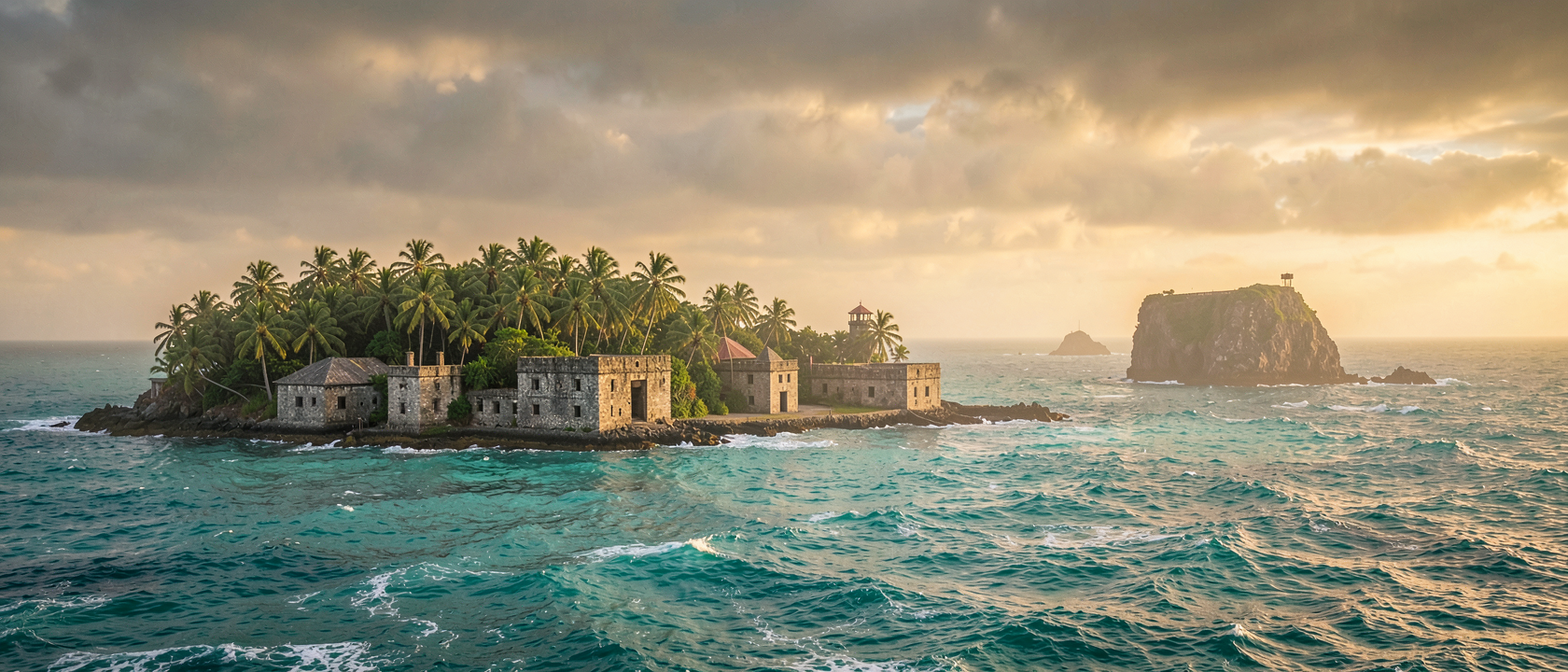
In the 1760s, France sent colonists to settle the swampy coast of Guyane, on South America’s northern shore. Fever and dysentery killed them in numbers the colonial office had not planned for, and the survivors withdrew to three small islands about 8 miles (13 km) off the coast near Kourou, where sea air gave them a better chance of living through the year. They named the group the Îles du Salut, the Salvation Islands: Île Royale, Île Saint-Joseph, and Île du Diable, Devil’s Island, for having survived, no more and no less. Guyane would carry that name for almost a century before anyone thought to put a prisoner there.
A Coastline Chosen for What Surrounds It
France kept this strip of coast for the same reason it had proved so hard to live on. Guyane sat wedged between Brazil to the south and Dutch and British Suriname, cut off from both by ocean on one side and jungle on the other. A person with no money and no papers had almost nowhere to run to. That made the territory useful for something that had nothing to do with farming or trade: France needed somewhere to put people it wanted gone, first failed colonists, later convicts transported by the thousand. The jungle and the current did the work a wall would have done anywhere closer to home.
1852: The Islands Become a Prison
In 1852, under Napoleon III, France converted the Salvation Islands and a stretch of the adjoining Guyane coast into a formal penal colony, a system historians call the bagne, the French term for the network of penal settlements across the territory. Each island had its own job. Île Saint-Joseph held the Reclusion, solitary cells of silence and darkness for escape attempts or offenses committed inside the colony. Île Royale, the largest of the three, ran the administration, while Île du Diable, which had first held a leper colony, was turned over to political prisoners.
In 1885, Parliament added another stream of arrivals, the relégués: anyone convicted more than three times for theft of over three months could be deported to Guyane for the fourth offense alone. Over the century that followed, an estimated 70,000 to 80,000 convicts made the crossing, common criminals and repeat offenders alongside political prisoners. Two of them are remembered today by name: Alfred Dreyfus, an army officer convicted of treason in 1894, and Henri Charrière, a convict whose later account of his escape made him famous.
Dreyfus on Devil’s Island
On January 5, 1895, Captain Alfred Dreyfus was stripped of his rank in a public ceremony at the École Militaire in Paris, convicted on fabricated evidence of treason in a case that would split French politics for over a decade as the Dreyfus Affair. He arrived on Île du Diable on April 13 (some records give the 14th), where he would spend more than four years. In September 1896, after a false report that he had escaped, guards shackled him to his bed each night with a wooden yoke and chains, from September 6 to October 20. His biographer Vincent Duclert has calculated that guarding one prisoner this closely cost France between 50,000 and 60,000 gold francs a year. He returned to France in 1899 after 1,517 days in custody; the exact release date is given as either June 5 or June 9 depending on the source. Retried, he was found guilty with extenuating circumstances, then pardoned by President Émile Loubet on September 19, 1899. Full exoneration did not arrive until July 21, 1906. Through it all he kept a journal and wrote more than 1,000 letters, the record that let historians reconstruct his treatment in such detail. His case left behind a documented record, public outcry, and eventual accountability, produced by a famous officer’s wrongful conviction rather than by any internal review of the colony.
Charrière and Papillon
Henri Charrière was transported to the Guyane penal colony and, by his own account, escaped. In 1969 he published that account as Papillon, and Steve McQueen played him in the 1974 film of the same title. Both made Charrière the public face of the entire system, better known to most readers than any of the 70,000 to 80,000 people who passed through it. Historians have since disputed how much of the book is Charrière’s own experience and how much he absorbed from other prisoners and folded into a single first-person story. The book was marketed and sold as autobiography. No independent record has ever confirmed all of it.
What Was Never Counted
No source gives an agreed death toll for the convicts transported to Guyane over the century the colony operated. For the relégués sentenced under the 1885 law, transportation amounted to a life sentence in practice as well as in law, since most died quickly of disease and malnutrition rather than ever seeing France again.
The Edges of the Record
Even the edges of the colony’s timeline are not fully settled. Most accounts give 1852 as the start and 1953 as the year the last prisoners left Devil’s Island, though transportation itself had already been abolished by decree in 1938, and some records put the formal closing year at 1952 instead. Charrière’s escape, the one story most people know, is retold constantly in print and on screen without ever being historically verified. And what the colony meant for the indigenous peoples of Guyane, or for its neighbors across the border in Brazil and Suriname, whose land and water made the whole system possible, goes almost entirely unaddressed in the record that survives. Tens of thousands of people passed through this system. Almost none of them left a name behind.