
By the 1750s, a handful of independent fur hunters were already working the fog-bound waters north of San Francisco Bay, decades before Spain had planted so much as a single mission on that stretch of coast, and decades more before the Russian government ever sent an official ship to claim what those hunters had found on their own.
Sewn Timber on the Pacific
These hunters were promyshlenniki, independent operators who answered to no government office and worked for whatever backer would supply them. Many had crossed Siberia generations earlier in pursuit of furs on land; by the middle of the eighteenth century their successors were following the Aleutian Islands south and east along the Pacific rim, trapping sea otters whose pelts sold for high prices in Chinese and Russian markets. Their vessels, called shitiki, were built without a single iron nail: pine planks lashed together with willow withies or rawhide cord, the seams packed tight with moss and pine pitch. In boats built this way, crews worked their way down to the waters around San Francisco Bay and pitched seasonal camps on beaches that Spain had claimed on paper but never occupied with so much as a soldier.
The Imperial Panic in Mexico City
Word of these landings reached New Spain slowly and in pieces, carried south through scattered reports rather than any formal Russian notice; Moscow itself had little direct hand in what its subjects were doing on an uncharted coast. The Spanish viceroys in Mexico City read those fragments differently than the men who had generated them. A trapping operation made up of private hunters, with no government behind it, looked from the viceregal palace like the leading edge of a rival empire rather than a loose commercial venture. Without accurate charts of the coastline north of Monterey, officials worried that scattered fur camps might harden into fortified claims that would cut Spain off from the northern Pacific entirely. One reading of that fear, repeated by later historians of the rivalry, goes further still, suggesting an unchecked Russian foothold might eventually push Spanish America’s effective border back toward the Isthmus of Panama. That specific claim says more about how the threat was later told than about any surviving Spanish order, but the underlying worry, that unclaimed ground might be lost before Spain ever garrisoned it, was real enough to move an empire.
The Race to the Edge
In 1769 Spain answered with a combined land and sea campaign that planted its first permanent post in Alta California at San Diego, founding a presidio and mission meant to anchor a chain of settlements up the coast. Historians of the Spanish-Russian rivalry tie that timing directly to the reports reaching Mexico City, though the precise chain of cause is argued more than it is documented; the 1769 founding date itself is not in dispute.
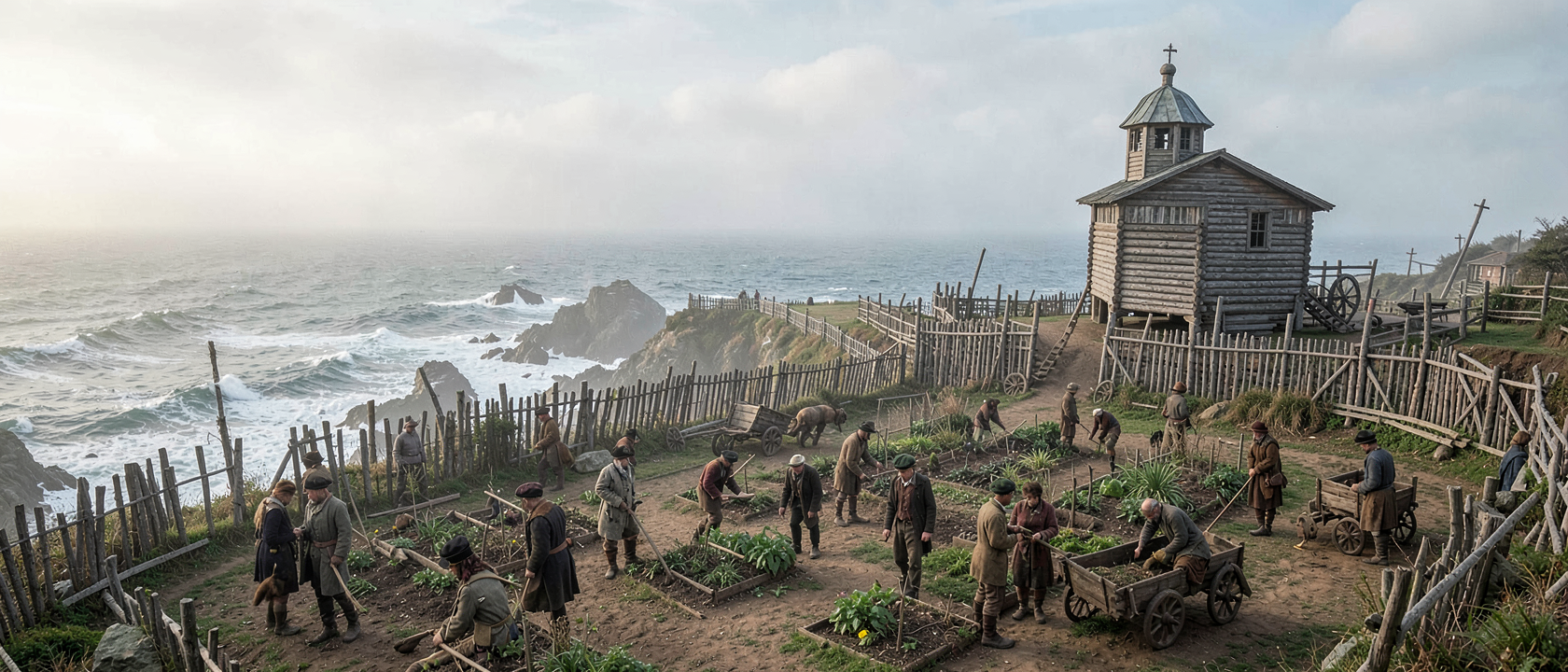
Russia’s own formal foothold took longer to arrive. The Russian-American Company, a state-chartered trading firm, first raised structures at Bodega Bay in 1809 and named the anchorage Port Rumyantsev, after the Russian foreign minister Nikolai Petrovich Rumyantsev. Three years later, in March 1812, the company’s agent Ivan Kuskov established a permanent post about eighteen miles north of Bodega Bay, beside the waterway the Russians named the Russian River. Construction began that April; the post, called Ross, was dedicated on September 10, the name day of Tsar Alexander I, with a founding population of twenty-five Russians and eighty Alaska Natives, later joined by local Kashaya people who worked for the company and in some cases intermarried with its Russian colonists. Built with log walls and blockhouses that gave it the look of a fortress, Ross, according to the Smithsonian Institution, was never actually drawn into combat. Both posts were meant to feed themselves off the land they occupied; neither found that easy.
Settlement and Liquidation
Ross had been built as a commercial venture: trapping sea otters for pelts and farming to help supply Russia’s colonies in Alaska. The arrangement did not hold. Sea otters were hunted toward depletion along that stretch of coast, and by the late 1830s the company was recording a string of unprofitable years, worsened by colonists reluctant to commit fully to farming, by coastal fog, and by gophers and mice that ate into what crops were planted. Growing Mexican and American settlement in California was also eroding Russia’s already shaky claim to the land. Faced with a post that cost more to keep than it earned, the Russian-American Company decided in the late 1830s to give it up, and in 1841 it sold the settlement, buildings and equipment included, to John Sutter, a Swiss-born entrepreneur who had already built a ranching operation at the meeting point of the San Joaquin and Sacramento rivers. Within two years, Sutter had hauled off to his own ranch everything from Ross that he judged worth moving.
Spain’s own investment fared no better over time. By the year Russia sold out, California answered to independent Mexico rather than to Madrid, and the presidios and missions raised at such cost to block a rival power had already outlived the empire that built them.
The Unwritten Ledger
Much about the 1841 sale is not settled. Two figures appear in different accounts of the price: $30,000, said to have been agreed in December 1841, and $200,000. No archival deed has surfaced to confirm either one. The terms are disputed too: by one account, Sutter agreed to buy the buildings and equipment at Ross but not the land itself, which Mexico claimed as its own and which the Mexican government chose not to recognize as part of any sale at all. Whatever the exact arrangement, the paperwork that survives tracks company property and company money. It has far less to say about the people whose labor had kept the post running, the Kashaya who worked for the Russian-American Company and the Alaska Natives brought from company colonies to hunt sea otters along that coast. What that arrangement cost those communities in daily terms does not appear in the records that tracked flags, deeds, and ledgers. What is recorded, plainly, is the name left on the map. Fort Ross operated as a Russian colony for roughly three decades, from 1812 to 1841, and the river beside it, in Sonoma County, is still called the Russian River.