
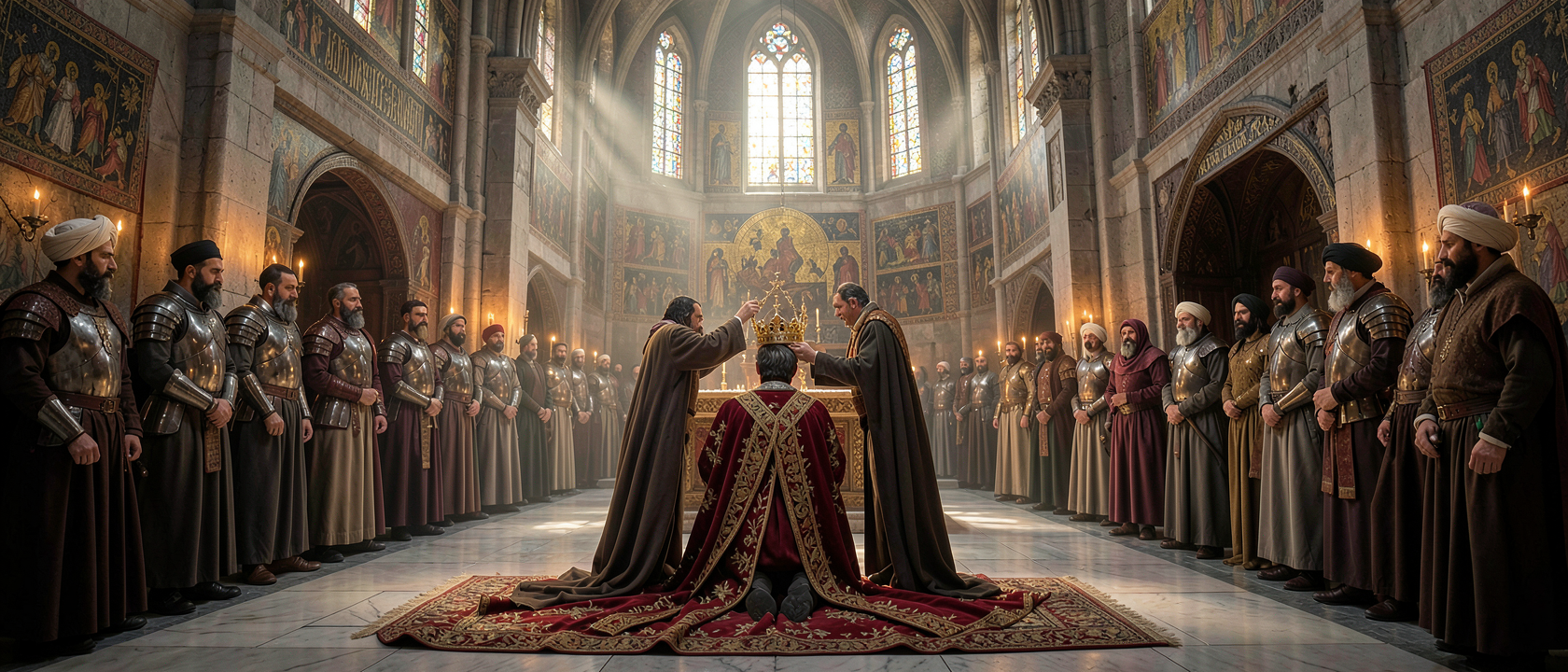
Benevento, September 1130
Two men met that month in Benevento, a city in Campania. Roger II, in his mid-thirties, was heir to a dynasty of Norman adventurers who had carved out a state in southern Italy over the previous generation. He had ruled Sicily as its count since 1105, and during the 1120s had folded the mainland duchies of Apulia and Calabria into his own hands. By 1130 no other lord in southern Italy could match his army.
Anacletus II held a very different kind of power. Born into the Pierleoni, a wealthy Roman noble family, he had risen through the College of Cardinals and been elected pope by one faction of it earlier that year. He held Rome, and little else.
No minutes or eyewitness account of their negotiation survive. What is known is the outcome: an agreement that reshaped the political map of the Mediterranean.
A Church Split in Two
The deal only makes sense once you know why Anacletus needed Roger. Pope Honorius II died in February 1130, and the cardinals split into two camps. One elected Innocent II, the other Anacletus. Both claims looked valid on paper, and for years Western Christendom had two rival popes.
The balance of power did not favor Anacletus. Innocent had the backing of the Holy Roman Empire, the strongest bloc in Latin Christendom. Anacletus held a city he could occupy but not easily defend against such a rival, and Roger, already holding Sicily, Apulia, and Calabria, was the only ally within reach.
Roger wanted something in return that no pope at peace with the rest of Europe would have granted him: a royal crown, lifting him above every other Norman and Lombard lord in Italy. Anacletus could give him that, though a title from a pope who might lose his own office could become worthless the moment the schism broke the other way.
The Bull of September 27, 1130
On September 27, 1130, Anacletus issued a papal bull granting Roger II the royal title, framing it not as a political favor but as the will of heaven: “Divine providence,” it declared, had given Roger “greater wisdom and power than the rest of the Italian princes.” It named Palermo the capital of a new Kingdom of Sicily, made the crown hereditary in Roger’s line, and gave him authority over Naples, backed by a pledge of military help from Benevento in wartime.
The formal coronation followed on Christmas Day, in Palermo Cathedral. What had come into being was no conventional Latin Christian kingdom. Roger’s army was made up mostly of Muslim soldiers; his court conducted business in Greek and Arabic as much as Latin, staffed largely by Greek and Muslim officials. Roger himself, a Latin Christian by faith, spoke both Greek and Arabic and, by preference, used Greek over his native Latin whenever he could. He had just been crowned king of a multi-faith power built where three worlds met.
How the Kingdom Got There
Roll the story back two generations, into the eleventh century, and the reason Roger had so much to offer Anacletus becomes clear. Roger’s father and uncle were Norman adventurers who seized large parts of southern Italy, including Apulia and Calabria, the last western territories the Byzantine Empire still held. Separately, the same family conquered the Islamic emirate ruling Sicily. The record gives no exact dates, only that both happened “towards the end” of that century.
These were two wars against two opponents, fought by two branches of one Norman family, and for decades the mainland and the island stayed under separate rulers. It was the union forged in 1130, when Roger brought the county of Sicily together with the duchy of Apulia and Calabria under one crown, that joined the two conquests for the first time.
What It Cost
The schism that made Roger’s crown possible also made it fragile. Anacletus died on January 25, 1138, and Innocent II emerged as the undisputed pope. The papacy opposed Roger’s kingdom whenever it dared, as did the Holy Roman Empire, Innocent’s longtime backer. So did the Byzantine Empire, which had lost Apulia and Calabria to Roger’s family and had no wish to see that loss made permanent. Venice and Genoa, with the most to lose from a rich new power astride the central Mediterranean trade routes, went further and declared war outright.
The language used about Roger was not mild. The theologian Bernard of Clairvaux called him “the Sicilian usurper.” The Byzantine writer Theodore Prodromos dismissed him as “tyrant of a small toparchy of apes.” An anonymous Saxon chronicler labeled him “a semi-pagan”, a bishop’s advisor, an imperial court poet, and a monastic record-keeper, writing from three corners of the world Roger had unsettled.
Palermo prospered through all of it. Trade and plunder flowed into the city, and the Arab geographer Al-Idrisi called it “the greatest and finest metropolis in the world.” The hostility did not break the kingdom; it meant the kingdom had to survive on its own terms until 1139, when the Treaty of Mignano closed out years of war in the Mezzogiorno, and Innocent II finally recognized the crown he had spent nearly a decade refusing to acknowledge.
What We Don’t Know
Several points in this story are thinner than the dates suggest. The conquests that gave Roger’s family its original foothold in Apulia, Calabria, and Sicily carry no firm dates, only the vague marker of “towards the end” of the eleventh century. The meeting at Benevento that produced the September bull is even less documented: nothing survives of what was said, argued, or promised between the two men.
There is also a later, more flattering description of Roger’s court as a kind of cultural “work of art.” That phrase deserves caution, it is unclear who first used it or when, and it sits oddly against the contemporary record, which was overwhelmingly hostile rather than admiring. Whatever reputation for tolerance and sophistication the Kingdom of Sicily later acquired, it was not the reputation it had while Roger was alive to hear it.