
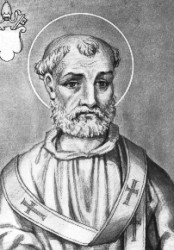
Pietro Pierleoni, who took the name Anacletus II upon his election in February 1130, held the papal throne in Rome for eight years in direct opposition to the canonically recognised Innocent II, producing one of the most fiercely contested schisms of the medieval Latin church. Born in Rome around 1091 into the wealthy Pierleoni banking dynasty, he had studied in Paris and at the Benedictine Abbey of Cluny before rising through the cardinalate under successive popes. His election was backed by the majority of cardinals and by the people of Rome, yet he died on January 25, 1138, with the schism still unresolved, and the Catholic Church has since counted him among the antipopes rather than the legitimate successors of Peter.
Key facts
- Born: 1091
- Birthplace: Rome
- Died: 25 January 1138
- Place of death: Rome
- Occupation: Catholic priest; writer; Catholic bishop
Family origins and early life
The Pierleoni traced their origins to a Roman Jew named Baruch who appeared in Rome shortly after the year 1000. Baruch lent large sums of money to church dignitaries, securing their protection, and later converted to Christianity. The family grew into one of Rome’s most powerful dynasties, and their tower house in Trastevere became a landmark of the city.
Pietro Pierleoni was a second son with clerical ambitions. He studied in Paris before entering the Benedictine Abbey of Cluny, where he came under the tutelage of Abbot Pontius. Pope Paschal II created him cardinal deacon of Santi Cosma e Damiano in 1111 or 1112, an appointment that almost certainly reflected his family’s considerable influence at the curia. Paschal II recalled him to Rome and elevated him further in 1116 to the full rank of cardinal.
Career as cardinal and legate
Pietro played a decisive part in the election of Callistus II at Cluny in February 1119, an act that placed him at the centre of papal politics. In December 1120 he was promoted to cardinal priest of Santa Maria in Trastevere, one of the senior Roman titulary churches.
Between 1121 and 1123 he served as papal legate to England and twice to France, roles that gave him direct experience of the church’s relationships with the major northern kingdoms. After 1123 he disappears almost entirely from the historical record until the events of 1130.
The disputed election of 1130
In February 1130, two factions within the college of cardinals held separate elections. One faction elected Innocent II; the majority of cardinals and the people of Rome elected Pietro Pierleoni, who took the name Anacletus II. He was consecrated bishop on February 23, 1130, at St. Peter’s Basilica in Rome.
Anacletus controlled Rome and commanded majority support within the city, while Innocent II was forced to seek backing abroad. The question of which election was canonical has never been settled to universal satisfaction. The authors of the Oxford Dictionary of Popes have argued that it is ‘at least arguable that Anacletus rather than Innocent was the legitimately elected pontiff,’ given that the majority of cardinals and the Roman populace supported him. Mary Stroll’s 1987 monograph, ‘The Jewish Pope: Ideology and Politics in the Papal Schism of 1130,’ published by Brill, contends that the schism was fundamentally political rather than ideological, and that Anacletus’s family background was weaponised to delegitimise him.
Bernard of Clairvaux and the campaign against Anacletus
Bernard of Clairvaux was Anacletus’s most prominent opponent north of the Alps. Through tireless advocacy he won recognition for Innocent II from Emperor Lothar III and from other major European rulers, leaving Anacletus with almost no patrons outside Rome and Sicily.
Bernard also wrote directly to Emperor Lothar, stating that it was a disgrace for a man of Jewish origin to occupy the throne of St. Peter. Anacletus’s opponents circulated additional accusations: rumours of incest and of robbing churches with the aid of Jews. Whether these charges reflected reality or were instruments of political warfare cannot be established from the surviving sources; contemporaries noted the difficulty themselves.
Alliance with Roger II of Sicily
Anacletus’s most consequential political act was a bull issued on September 27, 1130, granting Roger II the royal title of King of Sicily in exchange for Roger’s political and military support. Roger was crowned King of Sicily in Palermo on December 25, 1130, making Anacletus the authority behind the creation of Sicily’s first royal title. The alliance gave Anacletus a powerful southern patron but did nothing to recover the ground he had lost in France, Germany, and England.
During his pontificate Anacletus also created 8 pseudocardinals across 3 consistories, the first of which was held on Holy Saturday 1130, building a parallel ecclesiastical structure centred on Rome.
Death and aftermath
Anacletus II died in Rome on January 25, 1138, with the schism unresolved. Only after his death did Innocent II return to Rome and rule without opposition.
The eight-year contest left Anacletus’s reputation heavily coloured by the vilification campaign his opponents had prosecuted. Because Innocent II’s line prevailed, it was Innocent’s partisans who wrote most of the surviving accounts, a circumstance that shapes what can be known about Anacletus’s actual conduct and character.
Did you know
- Voltaire ironically dubbed Anacletus II “the Jewish Pope” because of his partial Jewish descent. The label spread widely, even though only one of his eight great-great grandparents had been Jewish. (jewishencyclopedia.com)
- The Pierleoni family’s tower house in Trastevere was so well known that a turreted mansion near what later became the Rome ghetto still bears the family name. (jewishvirtuallibrary.org)
- Anacletus II’s partial Jewish ancestry is the probable historical kernel behind a widespread medieval Jewish legend about a “Jewish pope” named Andreas or Elchanan, said to be the son of the rabbi Simeon bar Isaac. (jewishencyclopedia.com)
- Roger II of Sicily was crowned King of Sicily in Palermo on December 25, 1130, after receiving his royal title through Anacletus II’s bull of September 27, 1130, making Anacletus the kingmaker of Sicily’s first monarch. (1066.co.nz)
Data sources
- Wikidata
- jewishvirtuallibrary.org
- oxfordreference.com
- ccel.org
- en.wikisource.org
- cambridge.org
- gcatholic.org
- catholic-hierarchy.org
- jewishencyclopedia.com
- books.google.com
Data updated: 2026-10-29