
A Delivery at Lincoln’s Inn Fields
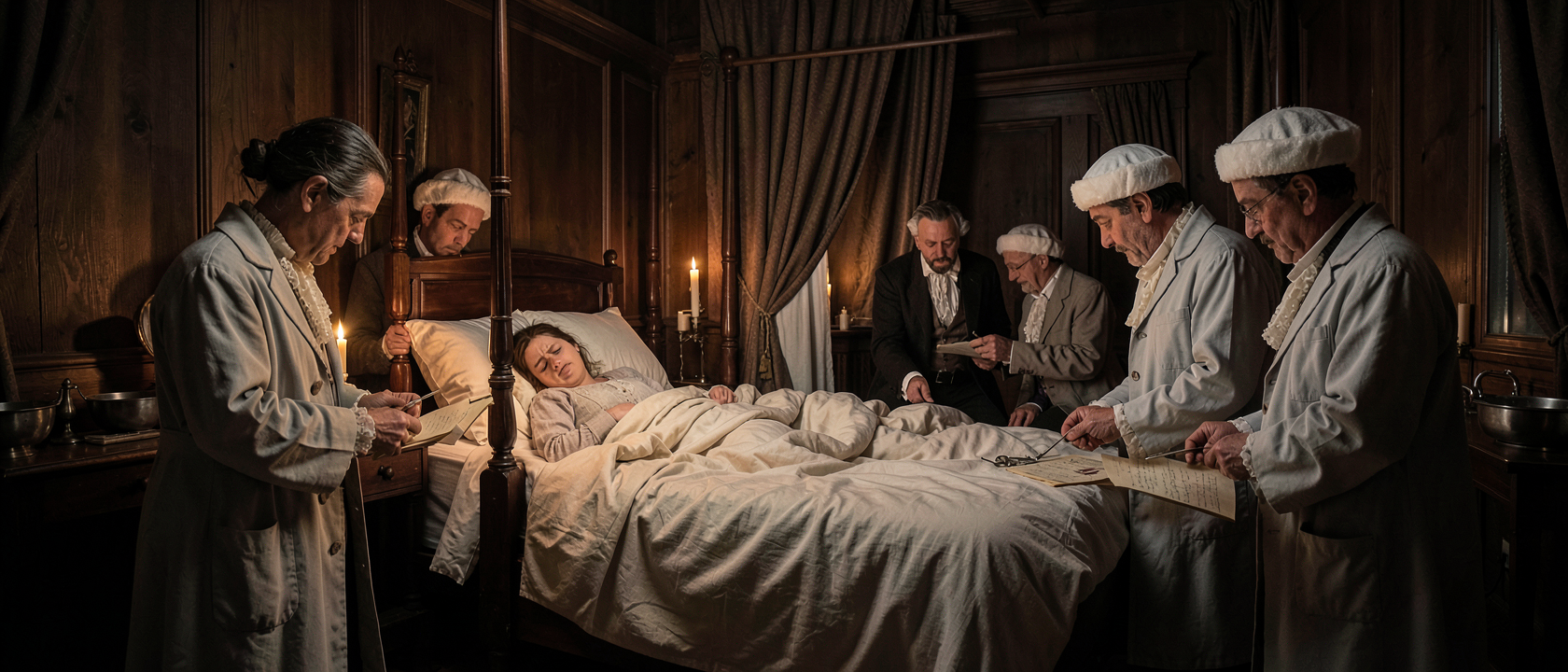
On the night of December 10, 1726, the playhouse at Lincoln’s Inn Fields in London staged its advertised bill: the pantomime Harlequin a Sorcerer (also reported elsewhere as Harlequin the Sorcerer), first produced in January 1725 by the theater’s manager, John Rich, who played the title role under his stage name, Lun. After the scheduled performance ended, the company added something printed on no playbill. It was an afterpiece described at the time as “a Representation ridiculing the aforesaid Imposture.” In it, Harlequin, attended by an actor playing a man-midwife, was delivered of four rabbits, which then ran loose across the stage. Whether those four animals were live rabbits, stuffed skins, or some kind of puppet was not made clear even by the people reporting on it at the time. What was recorded plainly was the audience’s response: laughter that a report reaching Exeter, on the Friday roughly two weeks before Christmas, called perhaps the loudest ever heard inside a London theater. The joke needed no explanation in the capital. Reports of a woman in Surrey said to be giving birth to rabbits had already been circulating in London since late October.
The Authority of the Accoucheur
By the autumn of 1726, a newer kind of medical practitioner was trying to establish itself in England: the man-midwife, sometimes called an accoucheur, a term borrowed from the French. Such men argued that trained medical judgment, not the experience of the female midwives who had delivered babies for generations, was best placed to handle a difficult birth. The claim rested on the idea that careful physical examination could explain anything nature produced, however strange. A case like Mary Toft‘s put that claim to an immediate test. John Howard, a surgeon practicing near her home in Godalming, Surrey, was the first called to attend her. Nathanael St André, surgeon and anatomist to King George I, came down from London to see the case himself, lending it the weight of royal medicine. If a woman in a Surrey cottage could fool two credentialed practitioners with nothing more than animal remains, the argument that trained observation deserved more trust than old belief was at risk of collapsing in public.
The Godalming Deliveries
Toft had miscarried in August 1726 but continued to appear pregnant. On September 27 she went into what looked like labor and delivered what onlookers described as a “monster.” Howard was sent for and, by early November, recorded her producing what he counted as a rabbit a day. After the ninth rabbit he moved her into Guildford to watch her more closely, and on November 15, with St André now present, she delivered a fifteenth. Convinced, St André put his name to it: on December 3, 1726, he published A Short Narrative of an Extraordinary Delivery of Rabbets, Perform’d by Mr. John Howard, Surgeon at Guildford, declaring the case genuine. By then Toft had already been brought to London, lodged since November 29 at Mr. Lacy’s bagnio, a bathhouse that also took lodgers, in Leicester Fields, where the capital’s physicians could study her directly.
The pamphlet was already behind events. One account places the public unraveling of the fraud on December 5; the date more commonly given for Toft’s own confession is December 7, when she admitted to manually inserting dead rabbits and letting them be drawn out as though she were giving birth. She was arrested and held on suspicion of fraud. In the end no formal charge was brought against her, and she was released and returned home to Godalming.
The Cost in Reputation
St André’s pamphlet, printed days before the confession, stood afterward as an embarrassing record of royal credulity. William Hogarth captured the moment in his 1726 satirical print Cunicularii, mocking the duped surgeons. As the historian Russell observed, the affair was “the media sensation of 1726 to 1727” and “certainly helped to tarnish the reputation of doctors as a profession.”
Props, Pantomime, and the Surrey Chase
Eyewitnesses never resolved how the animals were presented on stage: whether the theater used costumed actors, mechanical props, or actual creatures dashing across the boards. There is also a question about which production the afterpiece was attached to. One dance-history record notes that Harlequin a Sorcerer, with the subtitle The Loves of Pluto and Proserpine, had already been running at the theater since its premiere on January 21, 1725, under Rich’s management. That points to the rabbit satire being slipped into an existing show rather than written from scratch, though the identification is not settled beyond doubt. Reports also reached London in late October 1726 describing some incident in the Surrey countryside involving a rabbit, but the surviving record does not spell out how that incident connected to Toft’s own account of her pregnancy.
Historians still argue over how much agency Toft had in her own fraud: whether she was a laborer drawn into the scheme by her own family, among them her husband Joshua Toft, a journeyman clothier, or someone who took a more active hand in arranging it herself. What is not in dispute is how the story ended for her. When she died in January 1763, thirty-seven years after the Godalming deliveries began, the parish register recorded her simply as “Mary Toft, Widow, the Impostress Rabbitt.”