
The Uneasy Centennial in Philadelphia
On July 4, 1876, the United States turned one hundred years old. The anniversary of the Declaration of Independence fell in the middle of a presidential election year, and the country marked it while federal troops remained stationed in parts of the states that had fought to leave the Union a decade earlier. Soldiers were still posted in South Carolina and Louisiana, two states that would soon sit at the center of a fight over who had actually won the presidency.
That occupation was what remained of Reconstruction, the federal program meant to rebuild the defeated South and secure the civil rights of formerly enslaved Americans. In the summer of 1876, the program was still unfinished, and the troops were still there because no one in Washington or the South had found a way to end it peacefully.
A Presidency Under Siege
President Ulysses S. Grant was finishing his second term, weighed down by a run of corruption scandals that had damaged his administration’s standing. Northern voters, after a decade of enforcing Reconstruction by force, had grown tired of the cost and the controversy of continued federal intervention in the South.
Republicans turned to Rutherford B. Hayes, the governor of Ohio, hoping a cleaner name could carry the party past Grant’s record. Democrats nominated Samuel J. Tilden, the governor of New York. The campaign that followed turned less on personality than on which party voters trusted to run the government and settle the unfinished business of the war.
The November 7 Count
Americans voted on November 7, 1876, in numbers never matched before or since: turnout reached 81.8 percent of the voting-age population, the highest ever recorded in an American presidential election. Samuel J. Tilden won the popular vote, 4,300,590 to 4,036,298, a margin of about 264,000 ballots, or 50.9 percent to 47.9 percent.
By the time the early returns were in, Tilden held 184 uncontested electoral votes, one short of the 185 needed to win outright. Hayes stood at 165. Twenty electoral votes remained unresolved: nineteen split across South Carolina, Florida, and Louisiana, and one from Oregon. Whoever took those twenty votes would take the presidency, and in all four states the count was immediately contested.
The Double Returns and the Charge of Fraud
In South Carolina, Florida, and Louisiana, each party controlled its own state election board, and each board duly certified its own candidate as the winner, amid accusations from both sides of fraud, ballot-box stuffing, and voter intimidation. In South Carolina the discrepancy was especially stark: the reported vote count exceeded the number of registered voters, amounting, by some tallies, to a turnout of about 101 percent.
Oregon’s single disputed vote turned on a narrower question. One of its Republican electors was challenged as ineligible because he held a federal job, as a postmaster, and was removed and replaced. By December 1876, rival slates of electors in all three southern states had each cast their own electoral votes for their own candidate, and Congress received two competing certificates from each. Nothing in the Constitution said which set Congress was supposed to count.
A Deadlocked Nation
Through December 1876 and into January 1877, the dispute sat unresolved, and with it sat the question of who would run the country once the new term began. The Constitution said the president of the Senate would open the electoral certificates before Congress, but it said nothing about who had the authority to decide which certificates were genuine when a state sent in two. With the deadlock unbroken and no process to break it, the risk was that the country would reach its change of government with no president either side agreed on.
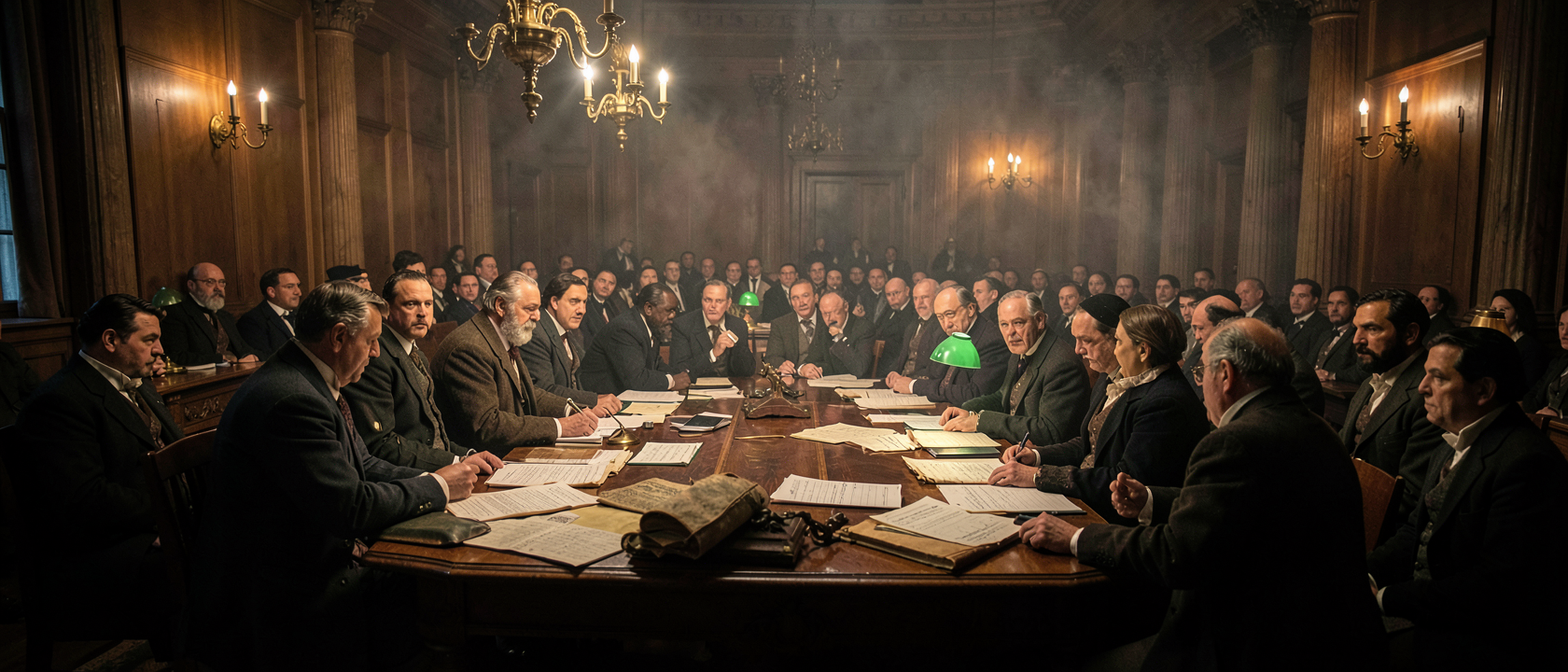
Congress moved to settle the question by creating a process the Constitution did not provide. On January 29, 1877, lawmakers established an Electoral Commission to rule on each disputed state. Its members, like the country that had sent them to Washington, split along party lines.
The Unsettled Record
The Commission ruled on the four contested states through February 1877. Each time it split eight to seven along party lines, and each time the disputed votes went to Hayes: Florida, then Louisiana, then Oregon, then South Carolina, in the order recorded by Hayes’s own presidential library. According to one near-contemporary account, the Senate confirmed the final certificate at around four in the morning on Friday, March 2, 1877. The tally gave Hayes 185 electoral votes to Tilden’s 184, a one-vote margin that remains, as of modern record-keeping, the narrowest in the history of the Electoral College. Both Hayes and Tilden publicly questioned whether the Commission had any constitutional standing to settle the election at all, and both, in the end, accepted its verdict.
The settlement that followed is remembered as the Compromise of 1877, though historians still argue over how explicit a bargain it actually was. Less disputed is what came after: federal troops left South Carolina and Louisiana, the last states still holding Reconstruction governments, and Reconstruction ended in practical terms. Historians trace the spread of Jim Crow segregation laws across the South to this settlement. They still rank 1876 alongside the disputed election of 2000 as the two closest calls in the country’s presidential history.