
“No Punishment at All to Kill Him”
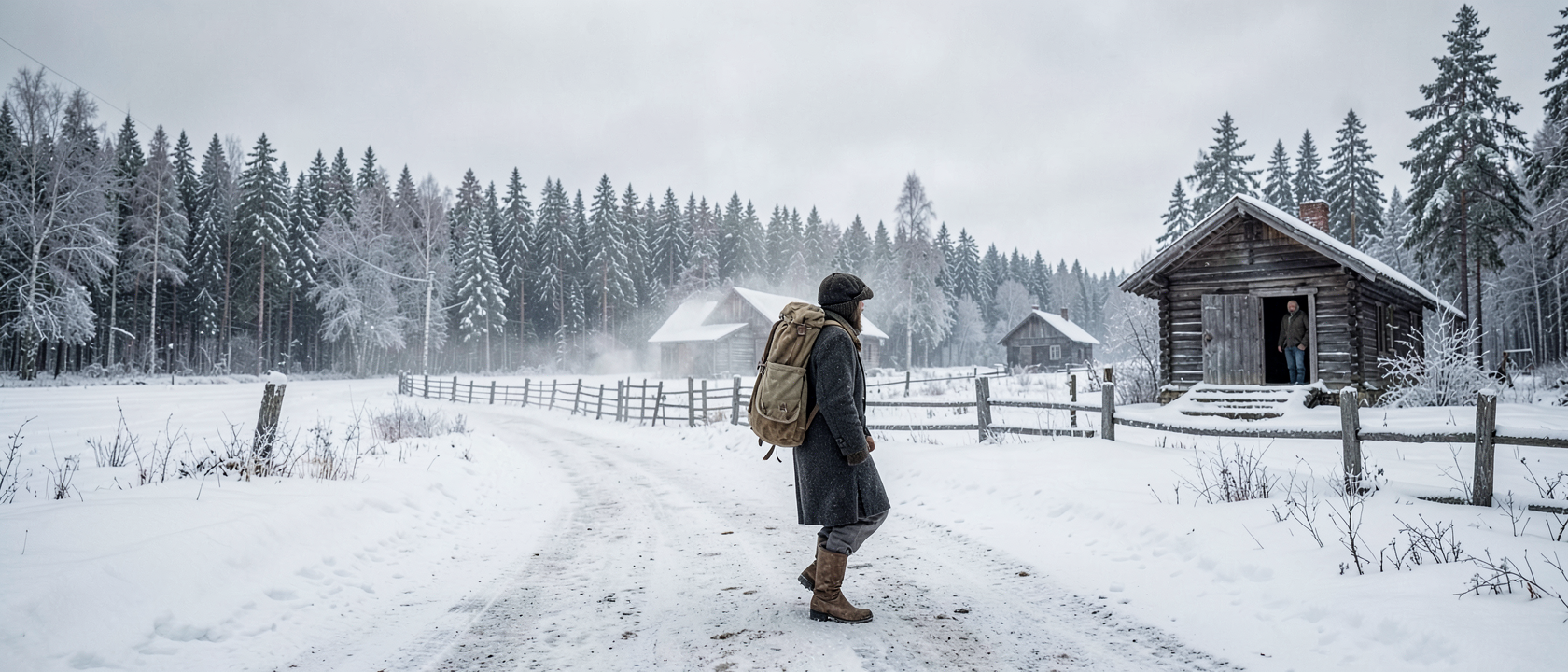
Around 1900, in the Grand Duchy of Finland, a Russian peddler named Juho Arhippainen packed up the trade he had worked for years and did not come back. He sold alone, moving farmhouse to farmhouse with cloth and ready-made clothing on his back, the kind of itinerant trader rural Finns called a laukkuryssä or reppuryssä, literally a “bag Russian” or “rucksack Russian.” The Finnish word carried a pejorative edge, even though the Swedish and German terms it borrowed from were neutral. Arhippainen had no shop and no license that Finnish law recognized, only the goodwill of households that bought from him season after season. That goodwill collapsed. He later reported receiving threats that killing him would go unpunished. He fled back toward his home region in Russian Karelia.
The Route Before the Trouble
Men like Arhippainen had been walking those roads for decades. Most came from White Sea Karelia, in the Arkhangelsk Governorate, or from the northern part of the neighboring Olonets Governorate. Permanent shops were banned in the Finnish countryside until 1842, which left rural households with almost no other way to buy cloth or finished garments except from men who carried it to the door. By the late 19th century, an estimated 1,400 to 1,500 such peddlers made the trip into Finland every year, 300 to 400 of them from the Vuokkiniemi area alone; by the first decade of the 20th century the number had grown to nearly 2,000. None of them traded under a license Finnish law actually acknowledged. An 1879 trade decree reserved commerce in Finland for subjects of the Grand Duchy, and under the separate citizenship rules Finland had developed, Russian Karelians counted as foreigners there. The whole trade ran on tolerance, nothing more.
Welcome Turns to Warning
At some point before 1900, that tolerance broke. Peddlers who had sold to the same families for years began describing organized boycotts, not scattered rudeness but a collective refusal to buy from them at all. The record does not fix a date or name a single incident that set it off in any particular village. What it does show is timing: the change came in the years after Russia’s February Manifesto of 1899, a decree Finns read as an attack on the Grand Duchy’s autonomy, during what Finnish history remembers as the years of oppression. The peddlers could describe the shift. Nothing in what survives explains why their customers chose that moment to act on it.
A Complaint to Helsinki
Arhippainen did not file alone. He and other peddlers sent a formal complaint to the Russian Governor-General’s Office in Helsinki, then headed by Nikolay Bobrikov, accusing Finnish authorities and the public of organized persecution. He was one voice among several. A separate group of peddlers from White Karelia petitioned the same administration around the same period, arguing that their livelihood was under threat and asking that the legal status of their trade finally be secured. What survives is the pattern, not the full paper trail: no exact date for Arhippainen’s complaint, no total count of how many peddlers filed similar ones, and no record of how the Governor-General’s Office answered him.
Scapegoats for an Empire
Russians of any kind were a small minority in the Grand Duchy, an estimated 8,000 people out of 2.7 million in 1900, and the peddlers were the Russians most Finns actually met. A Finnish press campaign, driven in part by the journalist and political agitator Konni Zilliacus through an underground newspaper, had started portraying them as political agents rather than ordinary traders. Russian nationalist papers answered by pointing to the peddlers’ precarious legal footing in Finland as proof that Finns treated Russians unjustly, and a separate petition from Russian industrialists urged the administration to defend Russian trading rights there outright. Some Finns at the time suspected Bobrikov’s own administration of stirring the rumors to build support for Russification, though that charge was never confirmed, and it should be read as a contemporary suspicion rather than an established fact. Men like Arhippainen had no stake in any of it; they sold cloth. That they ended up absorbing a political fight that was not theirs is a reading drawn from the pattern of complaints and petitions, not a line the peddlers themselves put in writing.
What the Record Doesn’t Say
Much of this comes from the work of historian Johanna Wassholm, piecing the Arhippainen case together from the surviving complaints. Arhippainen’s own story rests on a single surviving account, and no independent record has confirmed the man or his words beyond it; the wider pattern of petitions and press campaigns around him is better documented. A good deal still falls outside what the papers can tell us. There is no firm date for when the hostility began, no total figure for how many peddlers were affected or how many complaints reached Helsinki, and no surviving account of what the Governor-General’s Office did in response. Nothing explains, beyond the general political climate, why the turn against these particular traders came when it did, and nothing says what became of Arhippainen once he crossed back into Russian Karelia.
One outcome is documented. The weight of the complaints and the press campaigns around them gave the Russian administration grounds to act: in 1900, a decree made peddling in Finland legal for all Russian subjects, closing the gap these men had worked in for decades on tolerance alone. The trade itself outlasted the crisis, continuing until Finland’s independence in 1917 shut the border to it, and a later version of it, run by Karelian refugees, kept going through the countryside into the 1950s.