
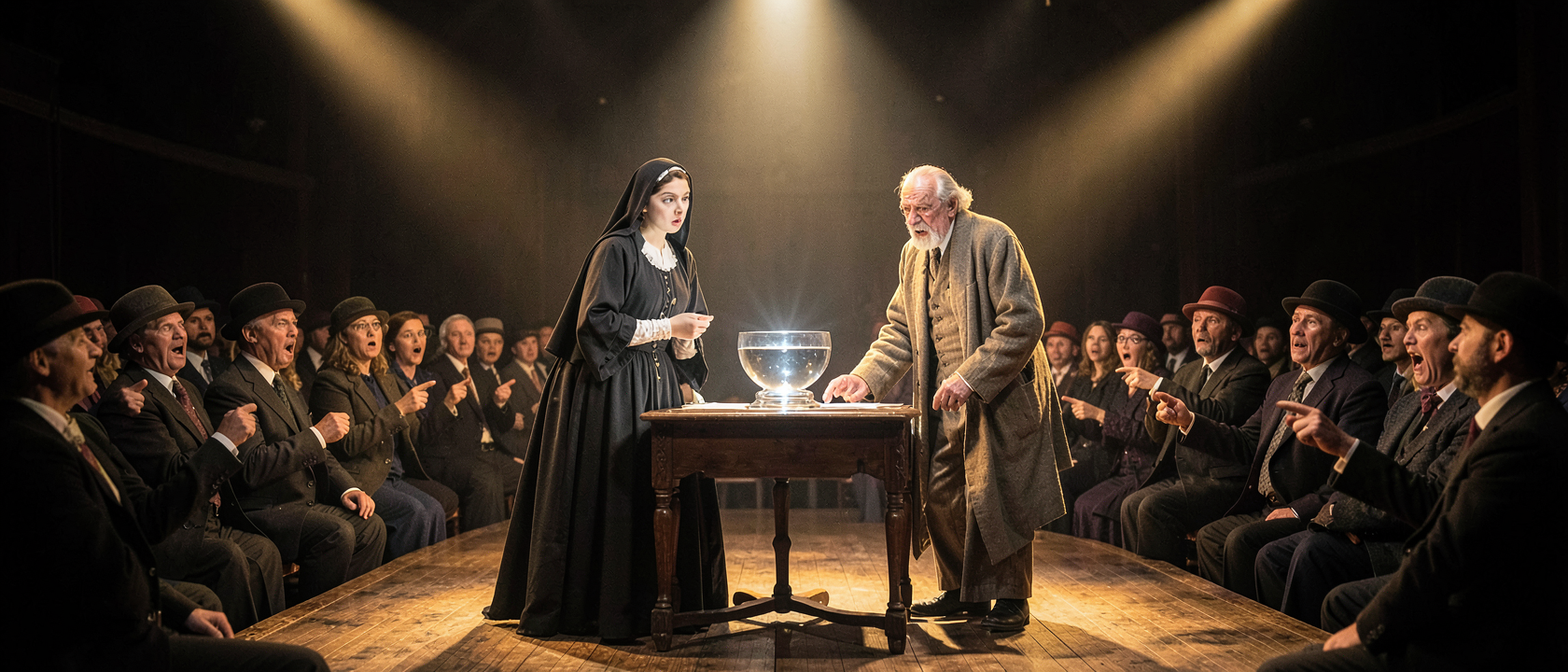
In Indianapolis, sometime in the mid-1920s, a grieving mother paid twenty-five dollars to a medium named Charles Gunsolas so he could reach the dead for her through a bowl of water. Partway into the session, Gunsolas told her that her clothing was blocking the spirits and urged her to undress to improve the line of communication.
Out of context, that demand sounds like a seedy parlor scandal: a lone woman trapped in a darkened room, pressured into taking off her clothes, looking like the target of a vice ring or caught up in some disreputable private racket. But the client sitting across that table had no intention of undressing. She was an undercover investigator working for Harry Houdini, and her assignment was gathering evidence on predatory charlatans. Her name was Rose Mackenberg.
The Green Crayon Mark
Mackenberg refused to strip. Instead, she kept her clothes on, noted every word of Gunsolas’s claims, and secured the proof she needed. On her way out, she left a quiet calling card: a seven-pointed star drawn in green crayon on his wallpaper. It was a secret mark she used across the country to prove in public that she had physically stood inside a given parlor. When Houdini brought his stage tour through Indianapolis, Gunsolas was called up before the crowd. Houdini exposed the medium’s methods, including the demand that a grieving mother take off her clothes to talk to the dead, and the audience booed Gunsolas straight out of the hall.
How Houdini Ran His Secret Service
The encounter in Indianapolis was part of a planned, nationwide operation. The grief following the First World War and the 1918 influenza outbreak, which together killed nearly 800,000 Americans, had created an immense commercial market for Spiritualists claiming contact with the departed. Houdini had his own grievance against the trade. About a decade earlier, his mother, Cecelia Weisz, had died, and at a subsequent séance a psychic handed him a purported message from her written in English, a language she never spoke. Houdini offered a standing reward of ten thousand dollars to any medium who could produce a spirit phenomenon he could not duplicate by stagecraft.
Mackenberg joined him after working as a law stenographer and private investigator in New York, where she cracked a case involving a psychic who tricked a banker into buying worthless stock. Houdini hired her (sources dispute whether the year was 1924 or 1925) and placed her at the head of a team of roughly twenty undercover operatives he called his own secret service. She traveled up to ten days ahead of his performance schedule, assuming roles like a country vamp, a domestic maid, or a mourning widow. She had herself ordained as a Spiritualist minister six times under names like Allicia Bunck and F. Raud. In Chicago, posing as a widow named Rosalind Richards, she let pastor Herman Parker advise her to put funds into a bogus enterprise called the Wilcox Transportation Company. She gave the evidence to the Investors Protective Bureau, and Parker went to prison.
The Congressional Hearings of 1926
By 1926, Mackenberg had personally investigated roughly 300 mediums. She took those findings to Washington, D.C. testifying under oath before a House Judiciary subcommittee considering House Resolution 8989, known as the Capper bill and later referenced as the Copeland-Bloom bill, to outlaw commercial fortune-telling in the capital. The hearings began on February 26, 1926, though one secondary account places her specific appearance on May 18. Mackenberg testified that she had spent at least five thousand dollars paying psychics fees ranging from five to twenty-five dollars per reading, calling Washington the worst city she had encountered.
Her testimony caused an uproar when she reported that a practitioner called Madame Marcia claimed senators and nearly everyone in the White House believed in Spiritualism. Mackenberg named four sitting senators, Capper of Kansas, Watson of Indiana, Dill of Washington, and Fletcher of Florida, as clients of mediums. The Calvin Coolidge administration denied that any séances occurred in the White House, while older traditions about Mary Todd Lincoln hosting mediums remained unverified. Spiritualist supporters packed the hearing room, and after four contentious days the bill stalled and never passed.
Four Decades of Investigation
On October 31, 1926, Houdini died at age 52 from complications tied to a ruptured appendix. Before his death, he had arranged a secret message with an intimate circle that included his wife, Bess, and Mackenberg, intending to communicate from beyond the grave if it were possible. Mackenberg continued to investigate psychics for banks, insurance companies, and police departments, but the code never arrived. She told the St. Louis Post-Dispatch in 1937 that she remained willing to accept genuine communication if convinced, but found none. Mackenberg died in 1968 at age 75, with sources recording her death on either March 31 or April 10, having investigated roughly 1,500 mediums over a lifetime in the field.