
The Room Next Door
In 1773, a group of prominent men from Berkshire County met in the upstairs study of Colonel John Ashley’s house in Sheffield, Massachusetts. Among them was the lawyer Theodore Sedgwick, who helped write the Sheffield Resolves, a petition whose opening words declared that “mankind in a state of nature are equal, free, and independent.” Ashley, a wealthy farmer, held at least five people in bondage on his own property. One of them was a woman called Bett, given to him years earlier by a Dutch farmer named Pieter Hogeboom when Hogeboom’s daughter Hannah married Ashley. Accounts describe Bett as likely within earshot of the men upstairs, hearing colonial landowners argue for natural liberty inside the same house where she was held as property.
The Walk to Stockbridge
By the 1770s, Massachusetts counted roughly 250,000 residents, and historians estimate that about 2 percent of them were enslaved. In 1780, the state ratified a new constitution whose language held that people are born free and equal. That spring of 1781, Hannah Ashley struck at Bett with a heated hearth shovel in the kitchen; accounts differ on whether the blow was meant for Bett herself, injuring her arm, or for a young girl, possibly Bett’s own daughter, whom Bett stepped in to shield, and some versions hold that Bett fled the household immediately rather than staying to fight the matter in court. Whatever the exact sequence, she walked to Stockbridge by May 1781 and asked Sedgwick whether the new constitution’s promise of freedom and equality might cover her too.
Brom and Bett v. Ashley
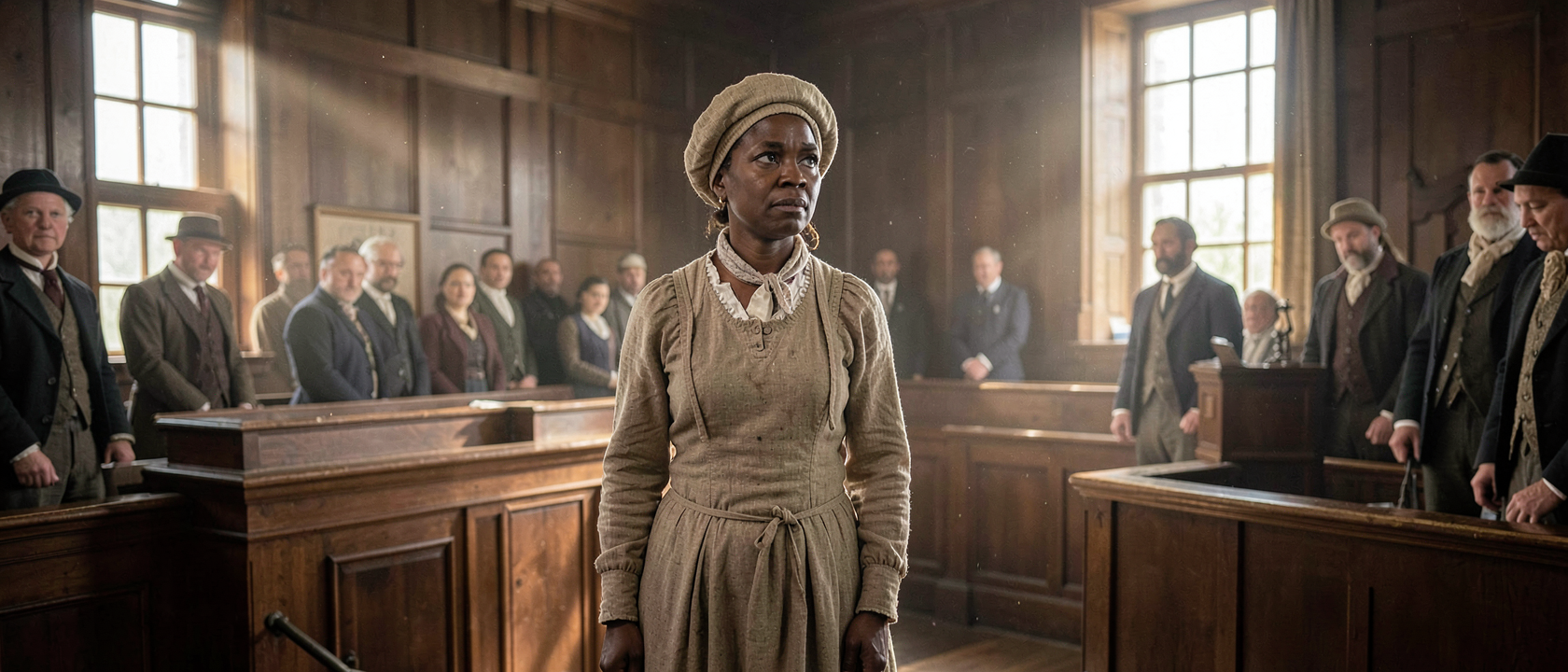
Sedgwick paired Bett’s case with that of Brom, another man enslaved by Ashley, and on May 28, 1781, filed a writ of replevin at the Berkshire County Court of Common Pleas in Great Barrington. Though a writ of replevin normally recovered stolen property, this one demanded Ashley release Brom and Bett as persons unlawfully detained. The case was styled Brom and Bett v. Ashley. When Ashley refused to let them go, the matter went before a jury of local freeholders. On August 21, 1781, by one account, or August 22, by another, the jury found that “Brom & Bett are not, nor were they at the time of the purchase of the original writ the legal Negro of the said John Ashley,” and ordered their discharge.
The verdict made Freeman, as she would soon call herself, the first African American woman freed specifically under the state’s new constitution. The Berkshire ruling also became precedent two years later, when the Massachusetts Supreme Judicial Court reviewed the freedom suit of Quock Walker, an enslaved man from Worcester County who had run from his enslaver, Nathaniel Jennison, in April 1781. After a series of three related cases, Chief Justice William Cushing told the court in April 1783, in Commonwealth v. Jennison, that there could be no such thing as perpetual servitude of a rational creature. The ruling marked the end of slavery as a legal practice in Massachusetts, though it did not free anyone automatically; by the state census of 1790, no enslaved people remained on record in the commonwealth.
The Cost of a Free Name
The court ordered Ashley to pay 30 shillings in damages to each of Bett and Brom, plus almost six pounds in court costs, according to the National Park Service. Ashley then offered to keep Freeman on as a paid servant on his own estate. She refused him and took paid work instead as housekeeper and nanny for the Sedgwick household in Stockbridge, where the Sedgwick children came to call her “Mum Bett.” By 1803, she had saved enough from her wages to buy her own house and farm in Stockbridge, where she lived surrounded by her daughter, son-in-law, grandchildren, and extended family.
Freeman later told Catharine Maria Sedgwick, Theodore’s daughter and a novelist, what the case had meant to her: “Any time while I was a slave, if one minute’s freedom had been offered to me & I had been told I must die at the end of that minute I would have taken it, just to stand one minute on God’s earth a free woman.” She died in Stockbridge on December 28, 1829. Her gravestone records her “supposed age” as 85 years, an estimate, since no record of her birth survives.
What the Archives Kept and Lost
Her birth is usually placed around 1744, in Claverack, New York, about 20 miles (32 km) south of Albany, though some accounts give only “sometime in the 1740s.” No document records Brom’s life after the 1781 verdict freed him; his name does not reappear in any deed, record, or account. Freeman, by contrast, was buried in the Sedgwick family plot in Stockbridge, the only person outside the family laid to rest within its inner circle, and Catharine Maria Sedgwick published a short biography of her roughly two decades after her death, around 1849.
In August 2022, Sheffield unveiled a 7.5-foot (2.3 m) bronze statue of Freeman in the town center. Sculptor Brian Hanlon cast the piece using about $200,000 raised by state Representative Smitty Pignatelli and the Sheffield Historical Society. The unveiling included a staged telling of her life performed by Wanda Houston at the First Congregational Church.