A Town That Already Had a History
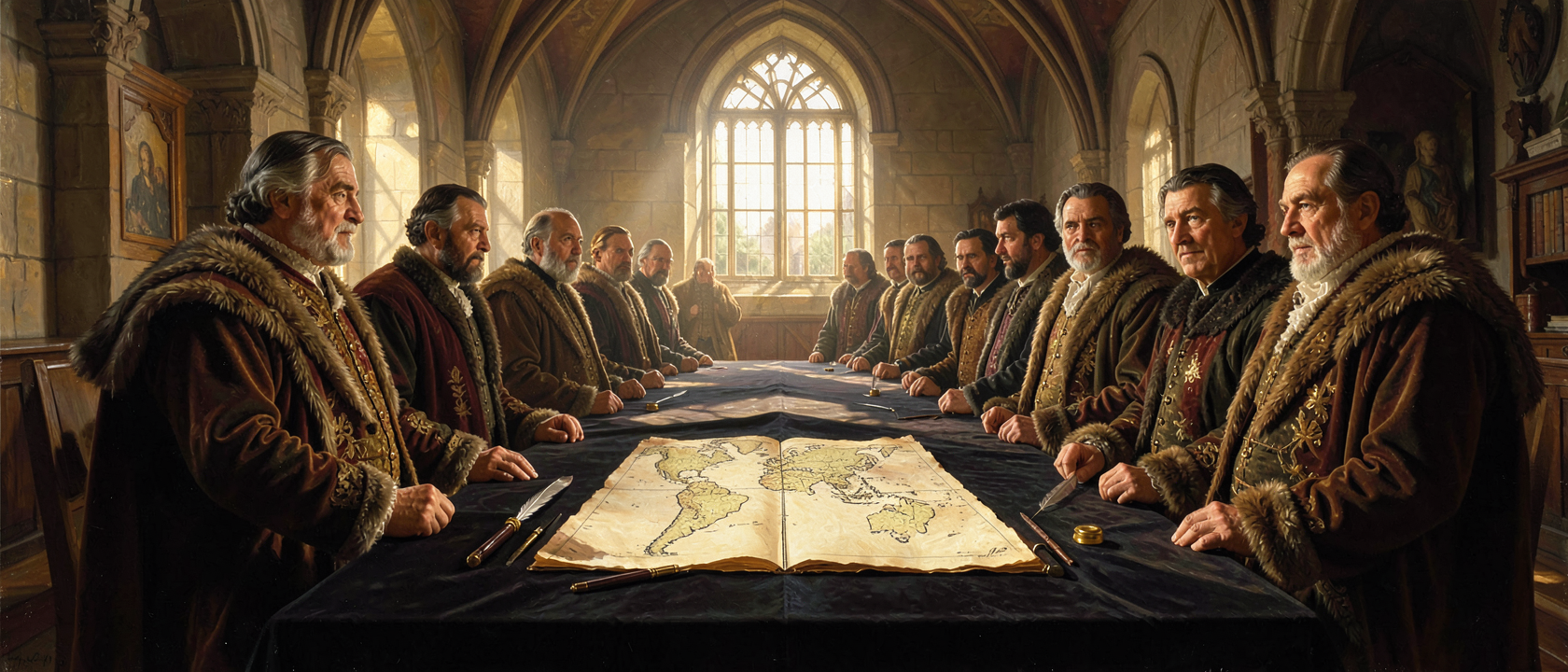
Tordesillas sits on the Duero River in the province of Valladolid, about 15 miles (25 km) southwest of the provincial capital. By the time Spanish and Portuguese negotiators arrived in June 1494, the town had been carrying political weight for roughly five centuries. It had served as a defensive outpost during the Reconquista; Alfonso X granted it a royal charter in 1262; Alfonso XI built a palace there (sources place construction at either 1325 or 1350), later converted by Pedro I into the Royal Convent of Santa Clara. By the 15th century the building hosted sessions of the Castilian Cortes. The 1494 negotiations took place not at the convent but in two adjoining palaces on Calle San Antolín, known afterward as the Casas del Tratado. Tordesillas was chosen because it already understood what formal power looked like.
One Line, Two Oceans, Every Continent
The immediate cause was Christopher Columbus. He crossed the Atlantic under a Castilian commission and returned to Europe on March 3, 1493. Portugal held its own Atlantic claims, confirmed by the 1481 papal bull Aeterni Regis. Two expanding maritime powers now occupied the same ocean with no mechanism to keep their claims from colliding.
Pope Alexander VI issued the Inter Caetera bull on May 4, 1493, drawing a north-to-south line 100 leagues (roughly 345 miles / 556 km) west of the Cape Verde Islands and assigning Spain exclusive rights westward. King John II of Portugal found this inadequate and took the dispute to direct negotiation with Isabella of Castile and Ferdinand of Aragon rather than accepting Rome’s version as final.
The agreement moved the line 270 leagues further west than Inter Caetera. The Tordesillas line ran pole to pole, 370 leagues (approximately 1,277 miles / 2,056 km) west of the Cape Verde Islands: everything east went to Portugal, everything west to Spain, covering all non-European lands “newly discovered and to be discovered.” One concrete and lasting consequence: the eastern extension of South America fell within the Portuguese zone, forming the territorial foundation for Brazil’s Portuguese character.
Three Signatures, Three Cities, One Instrument
The treaty was signed at Tordesillas on June 7, 1494. The Spanish negotiators were Enrique Enríquez de Guzmán, Gutierre de Cárdenas, and Francisco Maldonado; the Portuguese were Ruy de Sousa, Juan de Sousa, and Arias de Almadana. Isabella and Ferdinand ratified the document on July 2, 1494, at Arévalo. King John II added his ratification at Setúbal on September 5, 1494. Papal sanction followed later: Pope Julius II ratified the treaty on January 24, 1506.
A companion instrument signed on June 7, 1494, the Fisheries Treaty (Tratado de Pesquerías), established boundaries for the Kingdom of Fez and regulated fishing rights off the West African coast. Together the two agreements covered the full range of what the two crowns were contesting.
Who Was Not in the Room
The partition assigned coastlines, interiors, and entire populations to one crown or the other. No representative of any affected people was party to the negotiations, consulted before the line was drawn, or notified afterward through any channel the surviving record documents. That silence is a fact the record does not obscure; measuring the full human cost falls to historians working from a much wider archive than the treaty documents alone.
The originals survive on parchment: the Spanish copy is held at the Archivo General de Indias in Seville; the Portuguese copy at the Arquivo Nacional da Torre do Tombo in Lisbon. Both were inscribed on the UNESCO Memory of the World Register in 2007. England, France, and the Netherlands never accepted the arrangement as binding, treating it as a private Iberian compact rather than a rule of international order.
What the Line Left Unresolved
Two questions remain open. The first is whether the treaty extended papal authority or challenged it: Spain and Portugal produced a line different from Alexander VI’s, yet Julius II’s ratification in 1506 suggests it operated within the existing framework of papal grants. Both readings have scholarly support.
The second is where the line actually sat. No 15th-century method could measure longitude at sea with precision. When the two crowns convened the Junta de Badajoz-Elvas in 1524, each side’s pilots and cartographers produced figures serving their own government. The position stayed contested. The Treaty of Zaragoza, signed April 22, 1529, addressed the parallel Pacific dispute by establishing a companion meridian east of the Moluccas (present-day Indonesia), with Portugal paying Spain 350,000 ducats for recognition of Portuguese sovereignty there.
Tordesillas bore one further consequence. In 1509, Joanna I of Castile, daughter of Ferdinand and Isabella, queen of Castile from November 26, 1504, was confined to the palace there by her father’s order. She remained until her death on April 12, 1555, approximately 46 years, holding her royal title throughout while exercising no real power. The palace the treaty-makers had used in June 1494 became, fifteen years later, the place where the queen of Castile would spend the rest of her life.