
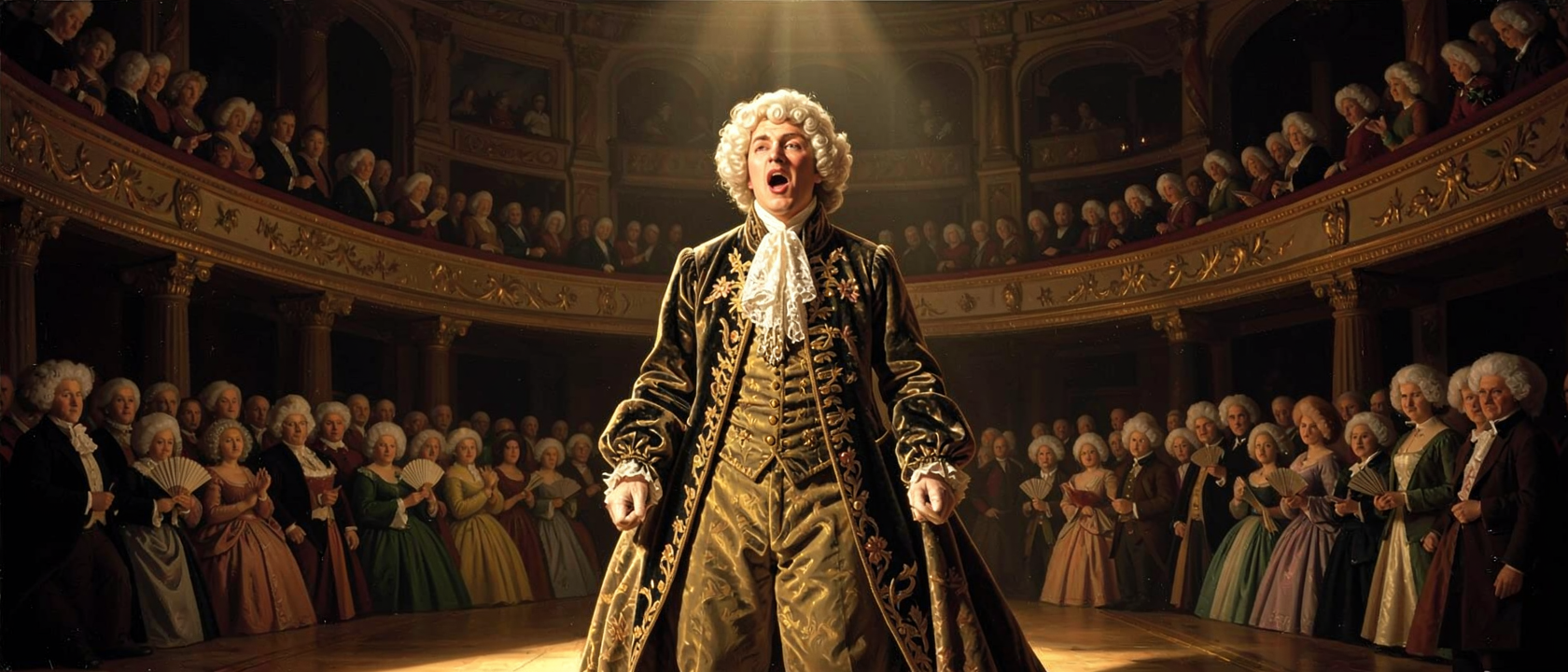
The First Name in the Register
The exact moment the practice took hold in the West is disputed. Records from the 1550s show castrated male singers beginning to appear in western European sacred music, but the Sistine Chapel is where the institutional history sharpens. One reading of the choir’s records identifies an unnamed Spaniard entering the Chapel in 1562; a second identifies Jacomo Vásquez, admitted on May 27, 1588, as the first castrato formally named in the rolls. Neither reading has been definitively confirmed against the original documents.
What is not disputed is what happened in 1589. Pope Sixtus V reorganized the Cappella Giulia of St. Peter’s Basilica and specified that among its twenty voices there should be “four soprano eunuchs, if skilled ones can be found.” The conditional clause matters: the papacy was not inventing a practice but codifying one it had already found useful. When Pope Clement VIII, who reigned from 1592 to 1605, described the creation of castrati as being “to the honor of God,” the institutional framework was complete. By 1599, the first homegrown Italian castrato had joined the Sistine Chapel choir; by 1640, castrati held places in all the principal Italian choirs.
What the Operation Actually Was
Castration before puberty interrupted the testosterone surge that causes the male larynx to grow and the voice to drop. A boy who underwent the operation retained the shorter vocal cords of a child inside the larger chest and lung capacity of a man, a combination no adult female or unaltered male could replicate at equivalent volume. That was the acoustic argument.
The legal argument ran in the opposite direction. Castrating a healthy child was technically illegal in Catholic Europe and, by 1770, punishable by excommunication. The gap between institutional demand and legal prohibition was bridged by a durable fiction: parish records routinely attributed surgery to accidents, a fall from a horse, a pig bite, a childhood illness. Families supplied the story, local surgeons performed the operation, and the Church received the result. No party was seriously prosecuted. Italy finally banned the practice outright in 1870, but the fiction had been operating for three centuries before that.
The Mathematics of Selection
The operation did not guarantee a voice worth having. Many boys who underwent the procedure never achieved professional standing, meaning the personal cost was frequently paid without any compensating career. The boys making that transaction were children, with no legal standing to refuse and no basis on which to evaluate the odds. The economic logic for their families, many of them poor, was straightforward: a successful castrato could earn at a level no other accessible profession could approach. The rarity of that success did not dissolve the logic; it only clarified, in retrospect, who had been carrying the risk.
Farinelli’s Ledger
Carlo Broschi, who performed under the name Farinelli, was born in Andria, in the Kingdom of Naples, on January 24, 1705. His soprano voice ranged from approximately F3 to D6, and by the middle of the 18th century he was regarded as among the foremost singers of his era. By 1737, his English engagements were generating an estimated £5,000 a year, a base salary of £1,500 per season, with gifts from patrons making up the rest, as confirmed by a 1777 account in the Westminster Magazine.
On August 7, 1737, Farinelli arrived in Madrid and entered the service of Philip V of Spain at 1,500 guineas a year, not for public performances but for private nightly concerts, reportedly to relieve the king’s debilitating depression. He sang the same repertoire to Philip V for nearly ten years. After the king died in 1746, Farinelli remained in Spain under Ferdinand VI until 1759. His earnings represent not the typical outcome but the outer limit against which almost every other career in the tradition was measured and found wanting.
Denial as a Stage Direction
In 1770, the English music historian Charles Burney traveled through Italy gathering material for his Present State of Music in France and Italy, published in 1771. He wanted to know where the castration operations were performed. His documented conclusion was that no community would tell him, each town and region pointed elsewhere. The practice was still occurring; the willingness to own it had already ended. Between Burney’s deflections in 1770 and the Church’s formal institutional closure in 1903, the tradition continued in its choirs while the cultural readiness to defend it collapsed in public.
November 22, 1903
On November 22, 1903, Pope Pius X issued Tra le sollecitudini, a motu proprio on sacred music specifying that high parts in church performance should henceforth be taken by boys “according to the most ancient usage of the Church.” The language was indirect; the effect was not. The institutional framework that had recruited, trained, and employed castrati since 1589 was formally closed.
The document addressed the institution. It did not address the men already inside it. Alessandro Moreschi, born November 1, 1858, held the position of primo soprano at the Sistine Chapel, a role he had earned in 1883. He remained an official member of the choir until 1913, when thirty years of service made him eligible for his pension. He died on April 21, 1922, in his apartment in Rome, a few minutes’ walk from the Vatican. The 1903 decree offered no compensation for what had made that career possible, and no acknowledgment of the accident records that had licensed the surgery in the first place.
What the Records Cannot Settle
Between the spring of 1902 and 1904, Moreschi recorded seventeen tracks for the Gramophone and Typewriter Company of London, including Ave Maria and Crucifixus. He was in his early-to-mid forties at the time, and the gramophone technology of that period had severe limitations in capturing the upper frequency range. Whether the gap between those recordings and contemporary written accounts of younger castrati reflects his age, the equipment’s limits, or simply what he was individually cannot now be determined. He is the only castrato whose voice was recorded at all. The tradition ran from roughly the 1560s to 1903, generated international careers, and sustained major institutions across three and a half centuries, resting throughout on an artistic claim that is now substantially beyond verification. The seventeen recordings survive. What they prove about the tradition of which they are the sole audible remnant is a question the recordings themselves cannot answer.