
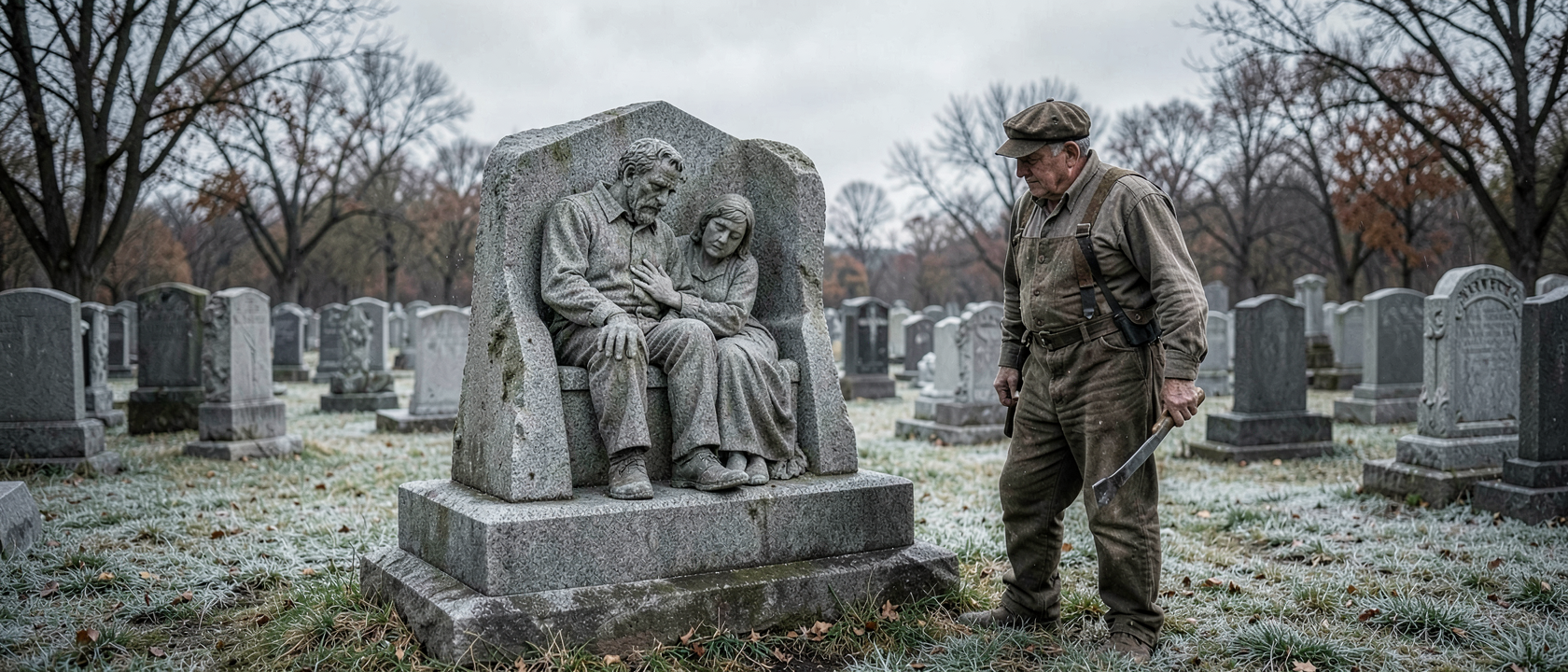
What Stands in Hope Cemetery
Hope Cemetery occupies 65 acres on the edge of Barre, Vermont, a granite-cutting city 45 miles southeast of Burlington that has carried the informal title “Granite Capital of the World” for more than a century. Established in 1895, the cemetery holds more than 10,000 memorials, nearly all cut from Barre Gray granite, and an estimated three-quarters were designed by the people eventually buried beneath them.
One monument stops visitors: a man slumped in a stone seat, arms limp, chest sunken, a woman beside him with her hand pressed to his sternum. Both figures are life-scale with individual facial features. The stone is called “The Dying Man,” and its subject had not yet died when Donato “Don” Coletti finished carving it.
Luigi Giovanni Brusa was born in Lombardy, northern Italy, on October 20, 1886, into a family already working stone. He commissioned “The Dying Man” from Coletti while still living; Coletti completed it before the scene it depicted came true. On December 13, 1937, Brusa died of silicosis. He was 51 years old.
Rock of Ages and the Dust That Came With It
Rock of Ages Quarry opened in Barre in 1885. Within a decade it was drawing skilled carvers from northern Italy, particularly Lombardy and Veneto. Vermont’s winters moved cutting work indoors into heated sheds, trapping silica dust at concentrations open Italian workshops had never produced. Then, in the 1890s, compressed-air pneumatic tools arrived: hand tools cut stone; pneumatic tools pulverized it, releasing far finer particles into air workers breathed at close range for hours. The United States Public Health Service conducted its first major study of silicosis in Vermont’s granite sheds in 1924. By then the pattern had been visible for years.
Silicosis results from inhaled crystalline silica particles that lodge in lung tissue and cause irreversible scarring. The disease also opens the body to tuberculosis and lung cancer and is associated with autoimmune conditions including lupus and rheumatoid arthritis. There is no stage at which the damage reverses. By the turn of the century, silicosis was not a statistical risk in Barre’s sheds; it was a near-certainty for any man who worked in them long enough.
Brusa Brothers: A Stonecutting Dynasty and Its Losses
Luigi Brusa co-founded Brusa Brothers Manufacturers and established himself as a master of the trade. He carved the family memorial himself: a winged female figure seated cross-legged, chin in hand, a trumpet draped across one leg, her expression resigned rather than mournful. Known as “The Bored Angel,” it marks the graves of his parents, Ernesto (1851–1920) and Maria (1856–1934), and his eldest brother, Cesare.
Cesare Brusa died in 1927 at 43 of silicosis. Luigi, then 40, had worked in the same sheds and knew from professional experience what a silicosis death in the family foretold. At some point before his own death he commissioned Coletti to carve “The Dying Man”; the exact date is not recorded, but the stone was finished while Brusa still lived.
In 1937, Vermont put a dust-reduction program in place, shaped by pressure from workers and unions and by the state Division of Industrial Hygiene, which was also established that year. Whether the primary mechanism was legislation, industry agreement, or state regulation is disputed; that 1937 was when the controls arrived is not. Brusa died in December of that year.
Coletti, Cecchinelli, and the Long Tail of the Hazard
Donato Coletti was regarded as one of the most skilled carvers of his generation in Barre. He died at 53, officially of cardiac causes, after at least a year of deteriorating health; his exact death year is not in the verified record. He is buried at Hope Cemetery among the craftsmen he had worked alongside.
The hazard did not end with his generation. Giuliano Cecchinelli, a native of Carrara, Italy, comes from a family that claims more than 20 generations in the stone trade. He arrived in Barre in the mid-1960s, sources give either 1961 or 1965, and began cutting granite at Buttura & Sons, later renamed Buttura & Gherardi Granite Artisans. As of 2023, Cecchinelli was still at work in his eighties and had been diagnosed with silicosis, describing his survival to that age not as the norm but as the exception. His career spans the period before and well after the regulatory changes of the 1930s; his diagnosis makes clear that the exposure problem outlasted those changes by decades.
Two Open Questions
Two things about “The Dying Man” remain unsettled. The first concerns the woman in the stone. Official accounts identify her as Mary Brusa, Luigi’s wife, who lived until 1957. Local tradition holds that the female figure’s features more closely resemble a mistress. No documentary evidence has resolved the question either way.
The second concerns the composition’s origins. Cecchinelli has suggested that Coletti may have drawn on “The Last Kiss” (“Ultimo Bacio”), completed by Emilio Quadrelli in 1889 and located at the Cimitero Monumentale in Milan. Scott McLaughlin, executive director of the Vermont Granite Museum in Barre, characterizes “The Dying Man” as an original work and describes Quadrelli’s piece as a possible influence rather than a direct model. Cecchinelli’s view is a minority interpretation, not a settled finding.
Brusa commissioned a stone to leave something fixed: his face, his condition, the cost his trade had extracted from his body. In two respects the granite has not complied. Who the woman is and where the image came from remain open questions, folded into a monument that was meant, above all, to be a record.