
What the Camera Caught at Stromboli, 1987
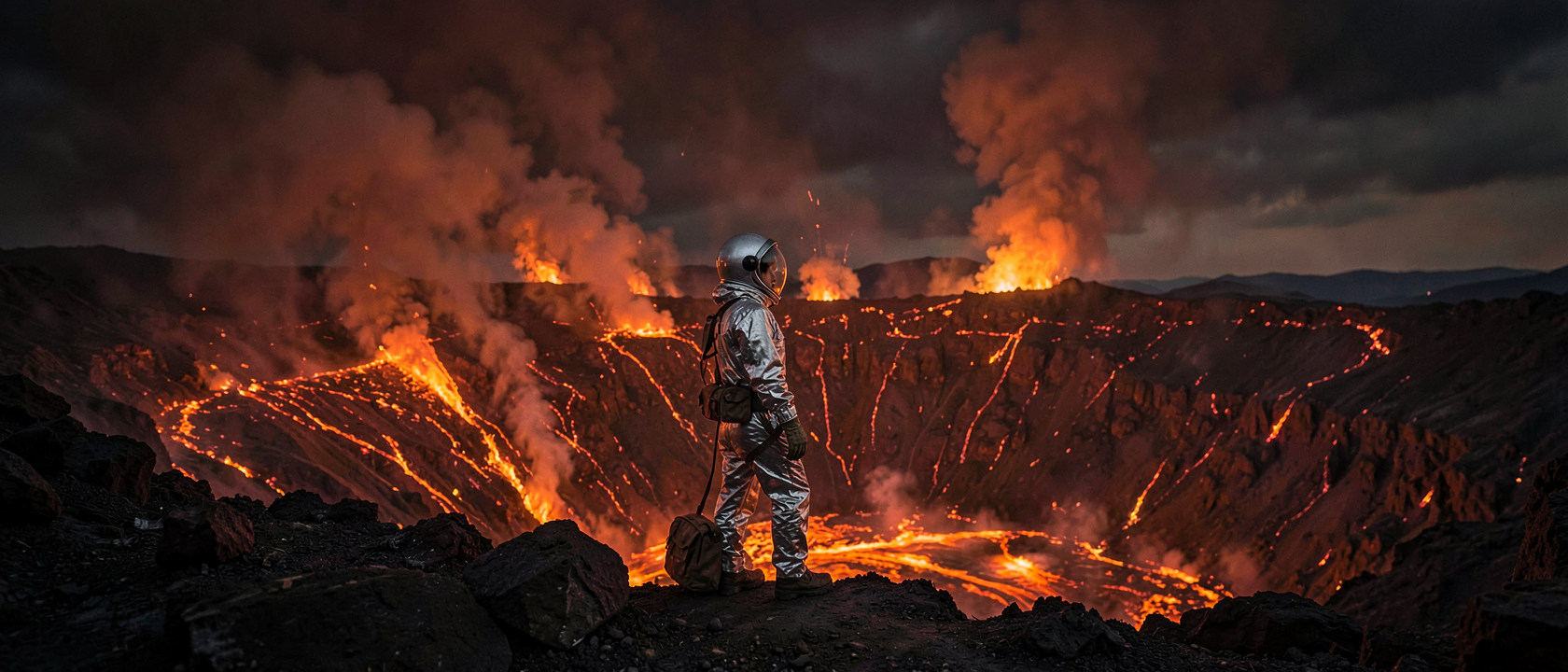
In 1987, the PBS Nature series broadcast The Volcano Watchers, showing two French scientists at work on Italian volcanic sites: two figures in metallic heat-reflective suits and astronaut-style helmets, standing at crater rims where volcanic gases were corrosive enough to dissolve ordinary fabric. Chlorine, carbon dioxide, and sulfuric compounds were the occupational hazards. The evidence was not theoretical. It was the eaten clothing.
One of those figures was Katia Krafft, born Catherine Joséphine Conrad on April 17, 1942, in the Haut-Rhin department of Upper Alsace, northeastern France. She had been at this work long enough to receive the Prix de la Fondation de la Vocation in 1969 for her fieldwork at active volcanic sites. The other figure was her husband, Maurice Krafft, whom she had met as a student, most likely at the University of Strasbourg. They married in 1970 and honeymooned at Stromboli, photographing its near-continuous eruption.
How the Kraffts Calculated Risk, 1969–1991
Across more than two decades, the Kraffts operated without a formal institutional safety structure. Their stated principle was that risk should be calculated and minimized, not avoided. What the record shows is the physical reality they had to account for: lava flows can move faster than a person can run; pyroclastic flows move far faster than lava; volcanic gases at their sites destroyed equipment, meaning the barrier between the scientists and the hazard was itself subject to degradation.
The output was considerable in volume. The Kraffts jointly authored approximately 20 books and contributed numerous papers to scientific literature. Jörg Keller, writing their obituary in the Bulletin of Volcanology in 1992, noted that they routinely worked around the clock while remaining outgoing and personable. Their archive was a body of work cited in volcanological literature, built by two people who had made proximity to active eruptions the method.
The Pinatubo Pivot, Early 1991
In early 1991, signs of imminent eruption appeared at Mount Pinatubo on the island of Luzon in the Philippines. Before June of that year, the Kraffts screened footage of the 1985 Nevado del Ruiz disaster in Colombia for Philippine officials, including President Corazon “Cory” Aquino. The Nevado del Ruiz eruption had killed an estimated 23,000 to 25,000 people, and the footage showed what such an event looked like in the communities below. The screening prompted mass evacuation orders. Mount Pinatubo erupted on June 15, 1991, in one of the largest volcanic events of the twentieth century. What the sources do not supply is a precise count of how many people the evacuation spared. The mechanism is documented; the arithmetic of the outcome is not.
That screening was arguably the most consequential single deployment of their archive within their lifetimes. They did not live to see Pinatubo erupt.
June 3, 1991: The Pyroclastic Flow at Mount Unzen
On June 3, 1991, a pyroclastic flow descended Mount Unzen in Nagasaki Prefecture, Japan, traveling at more than 100 miles per hour (161 km/h) and at a temperature exceeding 800 degrees Fahrenheit (427°C), reaching approximately 2.8 miles (4.5 km) from the crater. Katia Krafft, age 49, and Maurice Krafft, age 45, were in the field on that date and in the flow’s path. Forty-three people in total were killed or went missing, including the Kraffts and American volcanologist Harry Glicken.
What the record carries, without editorial assistance, is the timing: Mount Pinatubo erupted 12 days later. The Kraffts had helped set an evacuation in motion for an event they did not see.
Tributes, Medals, and the Documentary, 1992 Onward
The International Association of Volcanology and Chemistry of the Earth’s Interior established the Krafft Medal, awarded on a four-year cycle at the IAVCEI General Assembly and co-sponsored through a family trust called Volcan et Images. First awarded in 2004, it recognizes contributions to understanding and communicating volcanic hazards. In 2021, a Katia and Maurice Krafft Award went to volcanologist Annie Ockelford, though the awarding body is disputed: the European Geosciences Union confirms it gave Ockelford its own Katia and Maurice Krafft Award that year, while the primary source attributes the prize to the IAVCEI, whose records do not confirm a 2021 recipient. The discrepancy has not been resolved in available sources.
In 2022, the documentary Fire of Love returned their story to broad public attention using footage from their archive. Werner Herzog released a separate film the same year, The Fire Within: A Requiem for Katia and Maurice Krafft. Each of these acts of preservation happened at a desk or in an editing suite. The archive they required existed because two people had spent decades building it somewhere else entirely.
The Gaps the Sources Leave
Three gaps in the record deserve explicit acknowledgment. The sources do not document what originally drew Katia Krafft to volcanology. Beyond the stated principle of calculated risk minimization, the sources describe no formal criteria the Kraffts used to decide when a position was too dangerous, meaning the most consequential question their careers raise cannot be answered from available evidence. And the number of lives the Pinatubo evacuation saved remains an estimate. The screening happened, the evacuation orders followed, the eruption came. The connection is documented. The scale of the outcome is not.