
The City and the Mountain
In the spring of 1902, Saint-Pierre was the commercial and cultural capital of Martinique, the “Paris of the Antilles”, with a population of 28,000 to 30,000. Mount Pelée, a stratovolcano reaching 4,583 feet (1,397 m), stood roughly 4 to 6 miles (7 to 10 km) to the north.
The volcano had been restless since April 23, 1902, producing phreatic eruptions, ash emissions, tremors, and a lahar on May 5 that destroyed the Guérin sugar mill on the Rivière Blanche. Residents from the surrounding countryside moved into the city for weeks, bringing accounts of mass animal movements from the highland slopes. Before the main eruption, an estimated 50 people, most of them children, and approximately 200 animals died from snake bites attributed to those migrations.
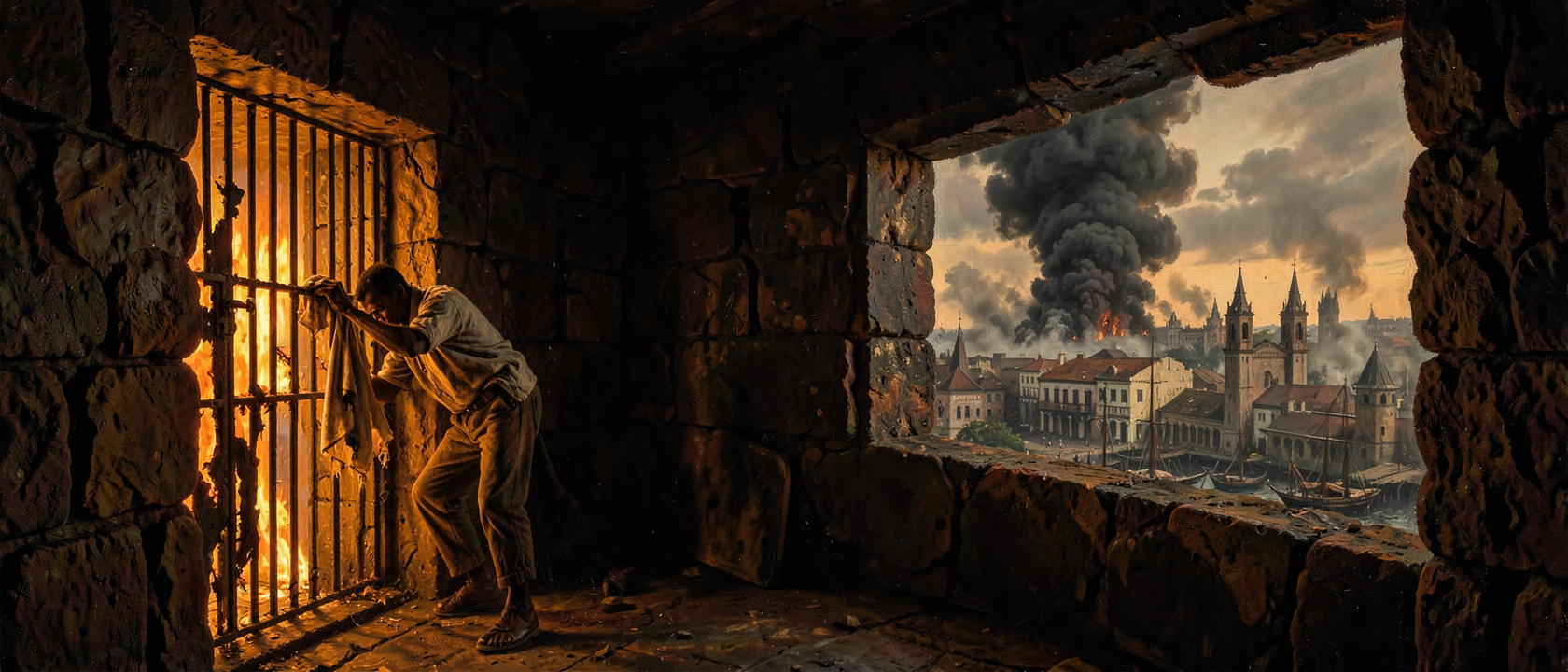
Local authorities and a scientific commission concluded that Saint-Pierre was not in danger and told the population to stay. On the evening of May 7, a laborer and sailor named Louis-Auguste Cyparis, known locally as “Samson”, was placed in solitary confinement at Saint-Pierre Prison. Arrested in early April for wounding a friend, he was serving an eight-day solitary stint for a subsequent infraction: he had slipped out overnight to attend a celebration and returned the following morning. His cell was cut from stone, set partially into a hillside, with no windows. Its only air opening was a narrow grating at the base of a door that faced toward the sea, away from the volcano.
The Stakes
Why the population remained is not simple. Authorities had decided the disruption of evacuation was not warranted; some unverified accounts suggest a legislative election campaign made officials reluctant to disperse their voters. Whatever the reasoning, between 28,000 and 30,000 people spent the night of May 7 within 4 to 6 miles of a volcano that had already killed dozens.
The same properties that made it an isolation space, heavy construction, minimal ventilation, partial burial, had no designed purpose beyond confinement.
The Eruption
At approximately 7:52 a.m. on May 8, 1902, Mount Pelée released a pyroclastic density current, a superheated mass of gas, ash, and fragmented rock traveling along the ground rather than rising into the air, giving volcanology the concept of the “nuée ardente,” or glowing cloud. The current moved at an estimated 93 to 124 miles per hour (150 to 200 km/h) and reached temperatures of 572 to 932 °F (300 to 500 °C). Within approximately one to two minutes, Saint-Pierre was destroyed.
Inside the cell, superheated air forced through the door grating. Cyparis reportedly stuffed his clothing into the gap and urinated on them to reduce his thermal exposure. The stone mass absorbed a portion of the heat. He sustained severe burns on his arms, back, and legs but remained alive.
Discovery and What Followed
Around May 12, 1902, rescue workers moving through the ruins heard sounds from a buried structure, excavated it, and found Cyparis barely alive. Because all records of his offenses and every witness to them had died in the eruption, he was formally pardoned.
Barnum & Bailey Circus recruited him for an American tour. (P.T. Barnum had died in 1891; by 1902 the circus operated under James Bailey’s management.) Cyparis performed under the name Ludger Sylbaris, the name by which the historical record generally knows him, next to a replica of his cell, billed as “The Man Who Lived Through Doomsday.” Secondary sources consistently describe him as the first Black person to tour nationally with the segregated Barnum & Bailey operation, though this has not been confirmed against primary circus records.
The Bill
Between 28,000 and 30,000 people died in Saint-Pierre on May 8, 1902; a peer-reviewed study in Frontiers in Earth Science places the minimum at 29,000. A secondary eruption on May 20 killed an estimated 2,000 additional rescuers and mariners who had entered the zone. Another eruption on August 30 killed more than 800. The 1902 events remain the deadliest volcanic disaster of the twentieth century and the third deadliest in recorded history, after Tambora in 1815 and Krakatoa in 1883.
Saint-Pierre was eventually rebuilt but never recovered its scale; its 2023 census population was 3,961. The original solitary cell survives and is accessible to visitors. Mount Pelée’s alert level was raised to Yellow (Restless) in December 2020 in response to increased seismicity, and the volcano was inscribed as a UNESCO World Heritage Site on September 17, 2023. Ludger Sylbaris died around 1929 in Panama, at approximately 54 or 55 years of age.
The Gaps
The record cannot settle three things. First, Sylbaris is routinely described as the sole survivor, but the historical record identifies at least two or three others, including Léon Compère-Léandre, whose house stood at the edge of the destruction zone. Sylbaris’s specific distinction is that he was the only survivor found on land inside the city proper, within the destruction zone itself. Second, the precise infraction that put him in solitary on May 7 is permanently unrecoverable; prison records do establish he was not, as some popular accounts claim, awaiting execution for murder. Third, what became of him after the Barnum & Bailey tour is undocumented beyond the approximate death date and location.
Those gaps are a direct consequence of what happened. An entire city’s institutional memory, its records, its witnesses, its courts, ceased to exist in one to two minutes on a May morning in 1902.