Robert Falcon Scott and four companions died returning from the South Pole in 1912, and the story that reached Britain was one of heroic sacrifice. A new book, “Widows of the Ice” by historian Anne Fletcher, follows the three wives left behind and how each one learned, long after the fact, that her husband was already dead.
London, 1907
Kathleen Bruce was a sculptor in London when she met Robert Falcon Scott in October 1907, at a friend’s teatime, according to Fletcher’s account, drawn largely from a single interview and not independently confirmed elsewhere. Scott had already commanded one Antarctic expedition, the Discovery. Within a year the two married, and four months later Kathleen was pregnant with their son, Peter. For the moment, it was an ordinary marriage between a naval officer and an artist.
Southampton, November 1910
In November 1910, the Terra Nova sailed for Antarctica, carrying Scott back south for a second attempt at the Pole. Three of the men aboard were married, and their wives started from very different places.
Kathleen Scott was the newest wife, with an infant son and a marriage not yet two years old. Oriana Wilson had done this before: she had married Edward “Ted” Wilson, the expedition’s chief scientist, just before his first Antarctic voyage with Scott, then spent roughly two and a half years apart from him before they reunited in New Zealand. Lois Evans’s marriage had survived something else. Her husband, Edgar Evans, a career Navy seaman, had had an affair that produced twins, and the couple had reconciled before he sailed again in 1910.
None of that private history reached the newspapers covering the send-off.
Antarctica, 1911–1912
The shore party left its base at Cape Evans on November 1, 1911, with Scott, Wilson, Edgar Evans, Lawrence Oates, and Henry Bowers making the final push. They reached the Pole on January 17, 1912, and found a marker left by a Norwegian party under Roald Amundsen, who had arrived first, somewhere between 34 and 35 days earlier, depending on the account.
The return march covered roughly 800 to 900 miles (1,300 to 1,450 km). Edgar Evans died on February 17, apparently from a head injury after a fall. Lawrence Oates, badly frostbitten, walked out of the tent on March 17 and did not return; he is reported to have said, “I am just going outside and may be some time.” Scott, Wilson, and Bowers were stopped by a blizzard on March 20, short of their next supply depot. Scott’s final diary entry, presumed to mark their deaths, is dated March 29; in it he had written, “For God’s sake look after our people.”
A search party found the tent, and the bodies of the three men, on November 12, 1912.
The Long Wait
None of the three wives learned the news as intended. Word did not reach Britain for close to a year, and once it did, the plan to tell the families quietly, before the public, failed for each of them differently.
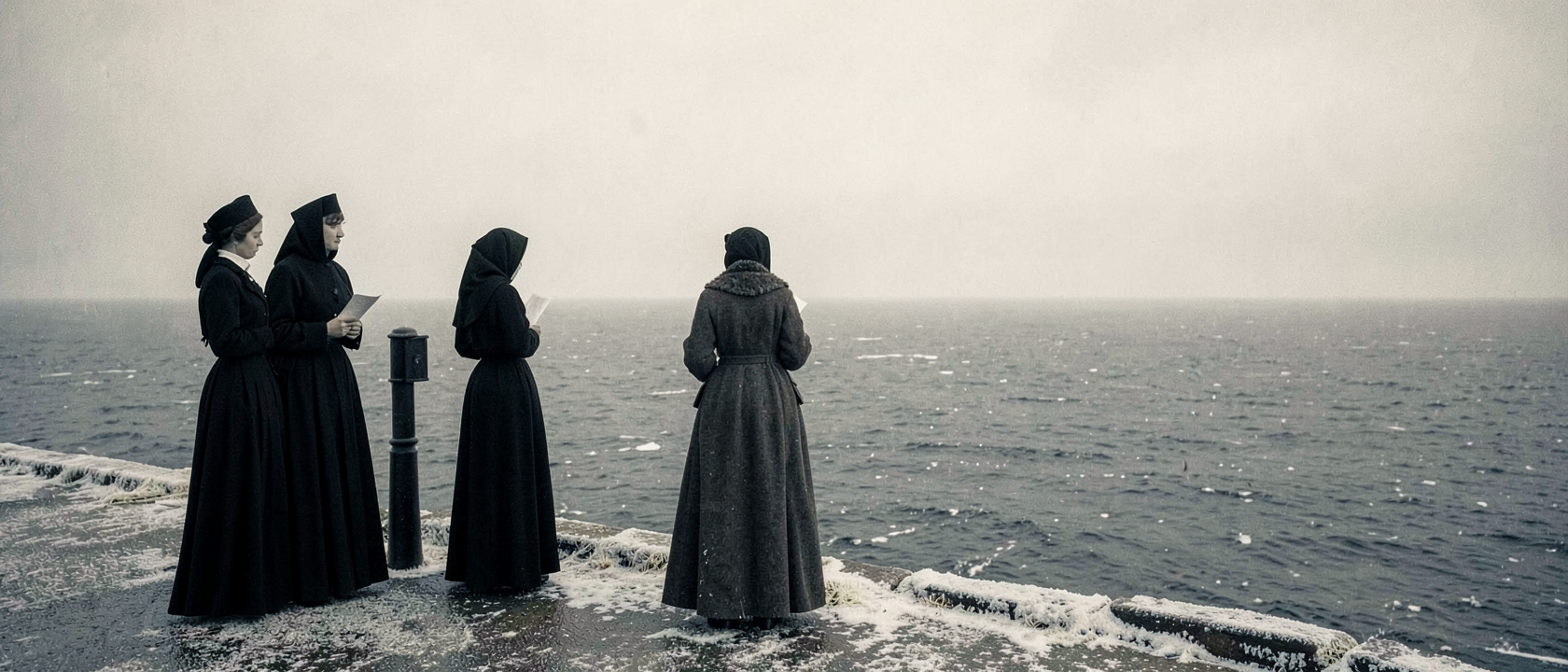
Oriana Wilson had traveled to Christchurch, New Zealand, to meet Ted when the ship returned. She learned he was dead from a newspaper seller on the street.
Kathleen Scott was aboard a ship on her way to meet her husband when the captain told her, without details of what had happened.
Lois Evans, the only one still in England, was confronted on her own doorstep by reporters, including one from the Daily Telegraph, before her telegram arrived. On February 15, 1913, the Daily Mirror ran a page of photographs of the bereaved family: Scott’s mother at the center, the three widows and Bowers’s mother around her, and below them the children, Peter Scott and Lois’s three, Muriel, Ralph, and Norman.
What Came After
After the news settled, the three women’s lives split apart.
Lois Evans went home to Wales. With no Admiralty pension for a petty officer’s widow, she sold Edgar’s polar medal, and when a public relief fund was divided among the families, she received the smallest share despite having the greatest need, with three children to raise.
Oriana Wilson resurfaced from time to time, usually to promote Ted’s paintings and his scientific work, without becoming a public figure herself.
Kathleen Scott stayed in public life for decades, in a role Fletcher compares to the one Jacqueline Kennedy held after 1963: the permanent widow of a national hero, expected to carry the loss in public for the rest of her life.
A Dispute Worth Naming
Some of this cannot be pinned down further than what is given here. The exact date each widow learned of the deaths, the precise date of Kathleen and Scott’s wedding, and the exact day the story broke in each case are not established in the record this account draws on. Only the sequence, and a span of close to a year, are documented.
There is also a question of interpretation. Fletcher argues that once the widows are placed at the center of the story, the expedition looks less like uncomplicated heroism and more like a private catastrophe that happened to unfold on the ice. That is her reading, not a settled conclusion among historians. Her own view of the men shifted in the writing: more sympathy for Scott, based on his affectionate letters to Kathleen, and less for Wilson, whom she found self-centered in his marriage.