
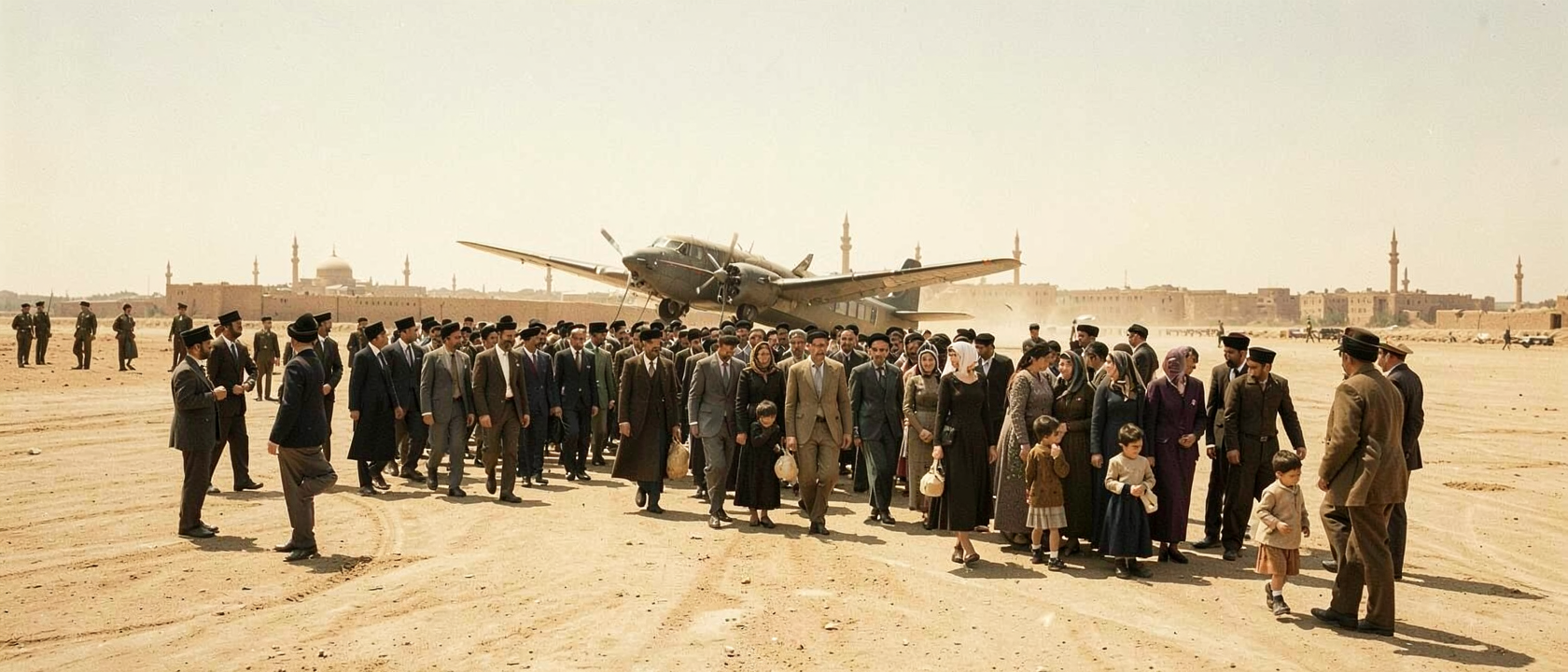
Two Days in Baghdad, June 1941
On April 2, 1941, a group of pro-Axis army officers known as the Golden Square, backed by nationalist politician Rashid Ali al-Gaylani, seized power in Baghdad from the pro-British government. Britain, at war with Germany, moved against the new regime, and by early June al-Gaylani had fled. On June 1, the Regent returned to Baghdad and British troops ringed the city but had not yet entered it. Baghdad’s Jews, believing the danger had passed, went out to mark Shavuot, the Jewish harvest festival.
In that gap, a mob went through Jewish neighborhoods. Iraqi soldiers and police who had backed the failed coup took part alongside civilians and youth militia sympathetic to the Axis. By the time the violence ended on June 2, 179 Jews had been killed, a figure some historians put considerably higher, citing unidentified dead in a mass grave. More than 500 shops were destroyed and nearly 1,000 homes looted. Iraqis called those two days the Farhud, a word usually translated as “violent dispossession.”
A Community Older Than Islam
That mob did not rise out of nothing. Iraq’s Jews traced an unbroken presence in Mesopotamia to the Babylonian exile of the sixth century BCE. By the early twentieth century the community was heavily urban, concentrated above all in Baghdad, and prominent in commerce, law, the civil service and music. Jewish schools operated openly, and Baghdad had its own Jewish-owned press. This was a community woven into the professional life of a young state that had come together after the First World War out of Sunni and Shia Arabs, Kurds, Turkmens, Assyrians and Yazidis, under British oversight.
The Laws Before the Mob
From 1934, that position was dismantled piece by piece. Jews were dismissed from government posts, a quota capped their university enrollment, a special tax was levied on Jews leaving the country, and the Jewish Chronicle was banned. There was already a precedent for how little protection a minority could count on: in 1932, the year Iraq gained formal independence, the army under commander Bakr Sidqi massacred Assyrian Christians at Simele; British authorities kept the killings out of the press, and Sidqi later became prime minister himself. In 1936, Baghdad’s Chief Rabbi, Sassoon Khadduri, an opponent of Zionism, publicly declared Iraqi Jews’ loyalty to the Arab cause in Palestine. It changed nothing in official policy, and the pressure kept building for five more years, until it broke into the street in June 1941.
A Trial, Then a Law
Six years after the Farhud, persecution moved from the street into the courtroom. In September 1947, prominent Baghdadi Jewish businessman Shafiq Ades was hanged outside his own home after a trial accusing him of arming Israel and supporting communism, widely read at the time as a warning aimed well past the man in the dock. Ten months later, in July 1948, with Iraq now a combatant in the war following Israel’s founding, its parliament passed a law making Zionist sympathy a capital offense. A mob had killed 179 people over two days in 1941; now the state had written a death penalty for an opinion into its own law books.
The Exodus
The final rupture arrived dressed as a concession. On March 2, 1950, Iraq’s parliament took up a law letting Jews leave the country on one condition: they had to give up their Iraqi citizenship for good. Prime Minister Salih Jabr told parliament it was not in the public interest to force people to stay if they had no wish to. At that point an estimated 135,000 Jews still lived in Iraq, about 90,000 in Baghdad and 10,000 in Basra, close to three percent of the population. Within a month, 50,000 had registered to leave; within two months, the list held 90,000 names.
Israel and Iraq arranged an airlift, Operation Ezra and Nehemiah, also known as Operation Ali Baba, flown largely by the Near East Transport Company with help from El Al, starting May 18, 1951. By the end of that year, 107,603 Jews had been flown out and an estimated 16,000 more had left by other routes; broader counts running into 1952 put the full total nearer 120,000 to 130,000, though the figure most commonly cited is around 110,000. Property that could not be carried, and that Jews could no longer legally hold, was frozen by the state. Whichever count is used, the result is not in question: by the start of 1952, no more than 6,000 Jews remained in Iraq, out of a community of roughly 135,000 two years before. A presence dating to the sixth century BCE had become a remnant within about two years.
Bombs and Gallows
Even as Jews were leaving, the violence did not stop. Baghdad saw a series of bomb attacks in the early 1950s that struck near or among Jews awaiting the airlift, pushing the pace of emigration faster still. In January 1952, two Iraqi Jews, Yusuf Basri and Shalom Salih Shalom, were hanged for the bombings. Their confessions had come after torture, and both men had retracted them before their execution.
An Unresolved Question
Who planted those bombs is still argued over. Historian Avi Shlaim, whose own family left Iraq in this wave, has written that he believes at least some of the attacks, by his own count three of the five, were the work of Zionist agents trying to speed Jewish emigration toward Israel. Shlomo Hillel and Mordechai Ben-Porat, who led the Zionist emigration effort on the ground in Iraq, have rejected the claim as absurd. No evidence has settled the question for historians generally, and more than seventy years on, it remains an open dispute rather than a closed footnote.
One Family’s Ledger
Avi Shlaim was five years old when his family left Baghdad in that wave. In Israel they were placed in a ma’abara, a transit camp of tents and tin shacks built for new arrivals, and there they lived in poverty, one household among many Iraqi Jewish families who met prejudice from an Ashkenazi-led establishment that ranked them below European Jewish arrivals. His parents’ marriage did not survive the strain, and they later divorced. Shlaim grew up in Israel and eventually became a historian in Britain. His household is one documented case, but it stands for a wider pattern: prosperity, standing and family stability, built up in Iraq over generations, undone within about two years for tens of thousands who arrived with little more than what they carried.