
Two Bands, One Afternoon
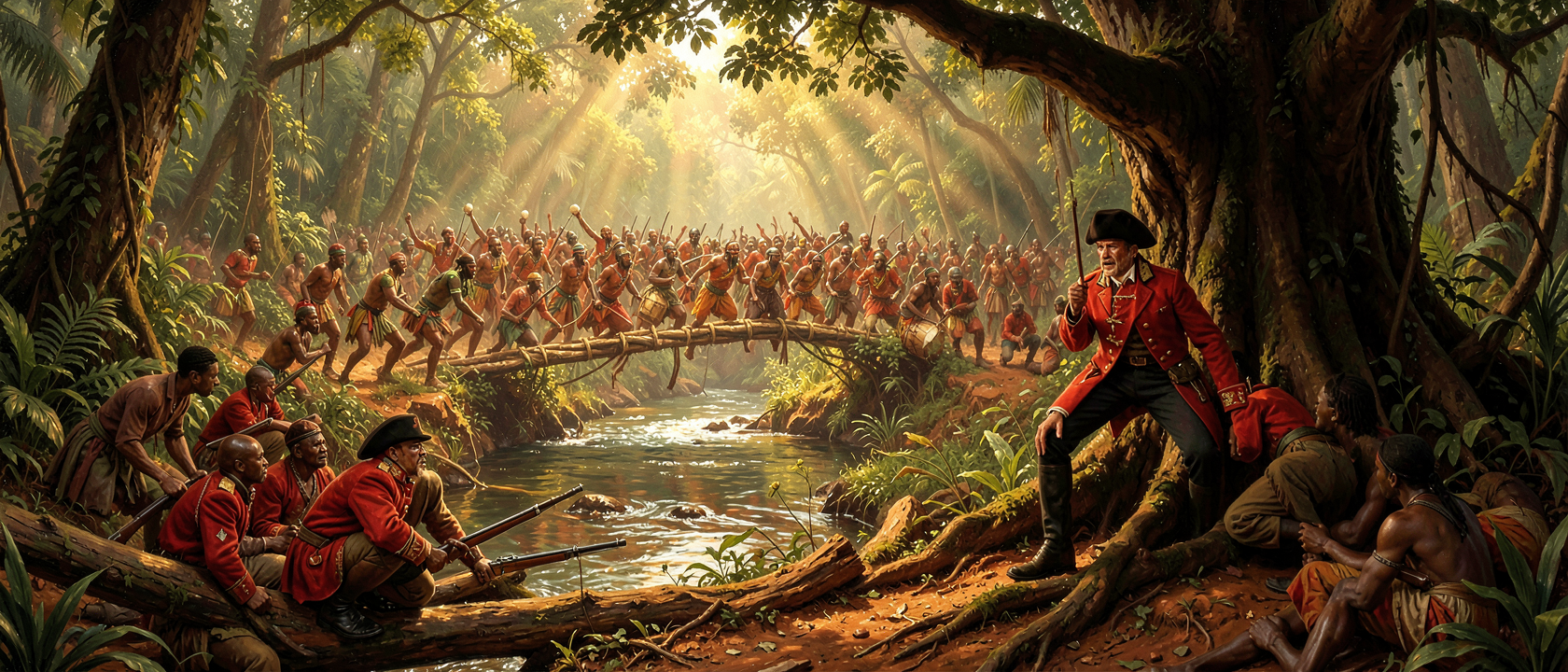
By around two in the afternoon on January 21, 1824, the British-led column camped near Nsamankow, close to present-day Bonsaso in what is now Ghana, could hear the Ashanti army moving through the forest before it could see it. Thousands of men were closing on a position held by a few hundred. Between the two sides ran a stream about 60 feet (18 m) wide, and Ashanti soldiers were already felling trees to bridge it.
Sir Charles M’Carthy, governor of the Gold Coast and Sierra Leone, gave an order that only made sense if he believed part of the Ashanti army might turn on its own commanders: he had his regimental band strike up “God Save the King.” The Ashanti answered with war drums and horns, and kept coming. Whatever M’Carthy had hoped for, it did not happen. The estimated size of the force in front of him, put at over 10,000 fighters, did not change either.
The March Nobody Asked For
The story behind that afternoon starts thirteen days earlier. On January 8, 1824, word reached the British base at Cape Coast that an Ashanti army was advancing. M’Carthy, a colonial governor holding military rank rather than a career soldier, split his limited garrison and pushed a detachment inland to meet the threat before it reached the coast.
The column he led came to close to 500 men: about 80 soldiers of the Royal African Colonial Corps, 170 of the Cape Coast Militia, and roughly 240 Fanti allies, along with a small staff of aides and a surgeon. It was meant to be one of four British-allied groups converging on the Ashanti together, the other three carrying thousands of local levies between them. M’Carthy’s column reached the ground first, and alone.
Getting there had already cost something before a shot was fired. The men marched through mud described as waist-high and slept through nights of heavy rain. M’Carthy was warned more than once that the Ashanti force nearby was larger and closer than his own reports suggested. He is recorded as dismissing those warnings and expressing confidence that his column would win the encounter. On the night of January 20, still without the other three columns, he camped by a tributary of the Pra River. The next afternoon, the Ashanti found him first.
Four Crates, Three Wrong
Fighting opened at the stream, with the British firing on Ashanti soldiers trying to cross the felled tree trunks. It held for a while. By around four in the afternoon, roughly two hours after the armies had first heard each other, the British ran out of ammunition.
An ordnance keeper named Mr. Brandon reached the camp in the middle of the fighting with four crates of supplies, arriving without the men who were supposed to carry the rest of the load. Three of the four crates, it was reported afterward, held macaroni instead of cartridges. That detail comes from a single account and is not confirmed elsewhere; it belongs in this story as reported, not as settled fact. What is not in dispute is that the ammunition failed to arrive in time, and that the British guns fell silent while the Ashanti did not. Accounts describe M’Carthy’s fury as the line broke apart around him.
Under the Tree
With no ammunition and no way back through the Ashanti lines, M’Carthy and two of his officers, among them Ensign Wetherell of the 2nd West India Regiment, were cut off. They made their stand under a tree and were killed there. Accounts differ on the final moments: some say M’Carthy died fighting, others that he took his own life rather than be captured. Both versions agree that he did not leave that ground.
The Ashanti took the heads of the three men. A British soldier captured in the battle was held overnight near where the heads were kept, and later gave an account of it, recalling that M’Carthy’s looked much as it had in life.
What the Record Doesn’t Say
Several gaps sit inside this story, and they are worth naming rather than smoothing over. No source gives a combined casualty count for both sides on that single afternoon. Later tallies of British losses across the engagement disagree sharply: figures range from about 176 to 187 killed, and from 92 to as many as 677 wounded, depending on which account is used. Ashanti losses at Nsamankow itself were never recorded in any source consulted for this piece.
The macaroni detail rests on a single account and has not been corroborated elsewhere. M’Carthy’s own reasoning for ignoring the warnings he received is never given in his own words, only reported secondhand as a boast of coming victory. None of this means the episode is invented. It means one vivid detail, three crates of pasta where powder should have been, can travel through history faster than the evidence behind it. The story is worth telling, and parts of it were never nailed down. Both are true.
After Nsamankow
The defeat came in the first major clash of the First Anglo-Ashanti War, a conflict already underway since 1823 that would not end until 1831. Nsamankow was the opening battle, not the whole war, and what followed it belongs to a longer account.
In British colonial memory, M’Carthy’s death became a cautionary story told for its details: the boast before the battle, the band answering the drums, the heads kept overnight near a captured soldier. Those are the parts that got repeated. The plainer explanation is less dramatic and more accurate. A colonial governor split an undersized force, marched it into contact with an army several times its size, and ran out of supplies before the fight was decided. The macaroni made the story memorable. The math is what made it a defeat.
**Summary of fixes:**, “Mr Brandon” → “Mr. Brandon” (American punctuation style for abbreviations). No relative-to-today date violations were found; all time references are either absolute calendar dates or event-to-event references (e.g. “thirteen days earlier,” “the next afternoon”), which are acceptable since they relate to other dates within the narrative, not to the publication date. No subject–verb agreement, article, tense, pronoun/homophone, or capitalization errors were found beyond the fix above. Spelling is consistently American throughout; no mixed variants detected.