
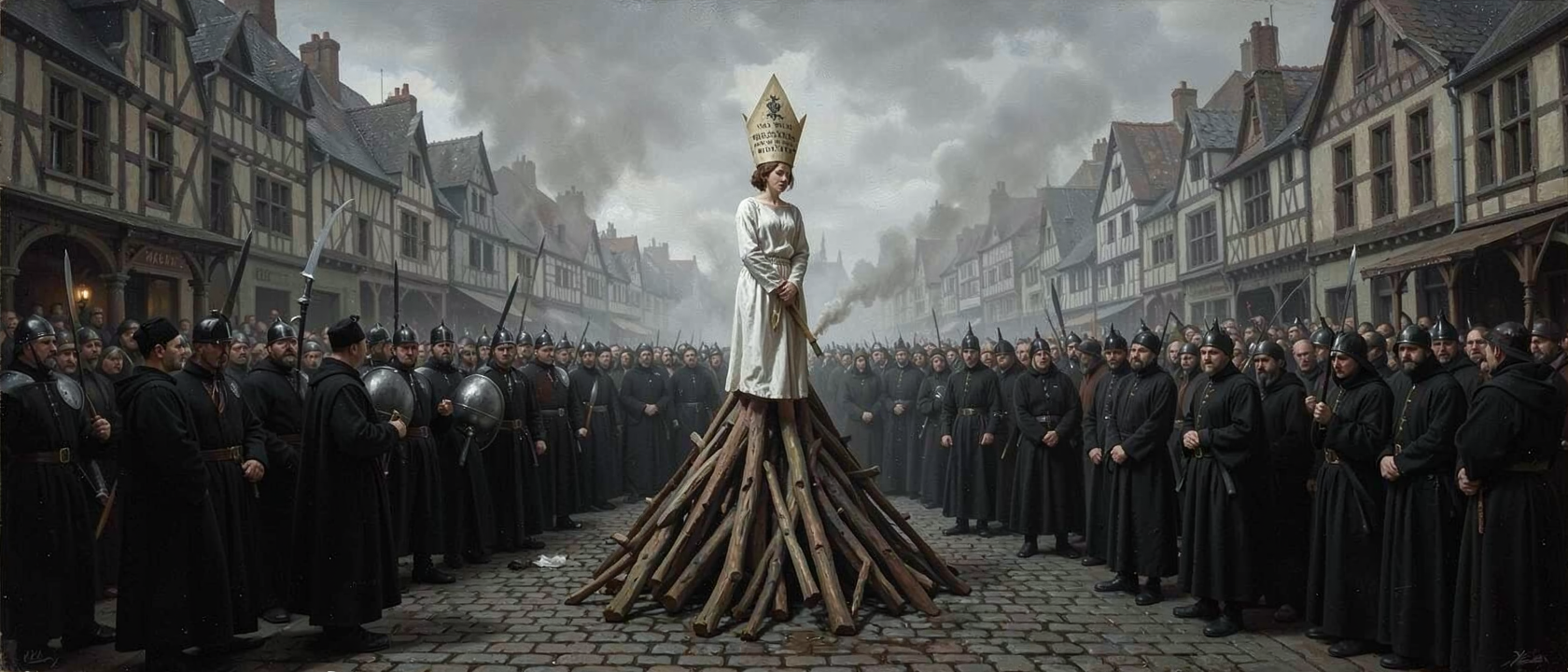
Everything we know of Joan of Arc’s own words comes from two church trials, a generation apart, run by people who each needed a particular answer from her. The first, in 1431, convicted her of heresy and sent her to the stake. The second, closed in 1456, declared her innocent. What survives between them is not her voice, but two courts’ competing versions of it.
The Tribunal of February 21, 1431
The case against Joan of Arc opened on paper on January 9, 1431, but she was not brought before her judges until February 21, when she stood at Rouen, in English-held Normandy, before 43 churchmen chaired by Pierre Cauchon, Bishop of Beauvais, a French cleric working for the English crown. Henry VI, the English-declared king of France, had written to Cauchon demanding the investigation, arguing Joan had been “reputed, charged, and defamed by many people for superstitions, false dogmas, and other crimes of divine treason.” She had been captured in the spring of 1430, and the trial had been requested by the side that held her.
Before Rouen: Poitiers and the Battle Over Her Words
Two years earlier, in 1429, theologians at Poitiers had already examined the young woman who said she had been sent to raise the siege of Orléans and see Charles VII crowned. Their findings, known as the Poitiers Conclusions, split the difference: she should be tested in the field, with no ruling on whether her guidance was divine. Public opinion moved faster than the theologians did. According to the record, the poet Christine de Pizan wrote a poem, the Ditié de Jehanne d’Arc, casting her as heaven-sent, while the University of Paris, aligned with the English, issued a tract known as On Good and Bad Spirits, arguing her guidance came from the devil. Neither side had new evidence; both were reading the same young woman into an argument that predated her.
Spring 1431: Visions, Dress, and a Verdict
The Rouen interrogation ran through winter into spring 1431, returning often to physical detail: what her voices looked like, what they wore, whether the crowns she described were solid or painted, even whether the archangel Michael appeared clothed or naked. Another recurring line of questioning was why she kept wearing men’s clothing, treated by the court as a real charge, not incidental color.
In late May 1431, the court found her guilty of heresy. She submitted, signed an abjuration, and was sentenced to life in prison instead of death. Within days, officials found she had put men’s clothing back on and that she no longer stood by what she had signed, admitting she’d agreed only out of fear of the fire. That reversal made her a relapsed heretic. On May 30, 1431, she was brought before a crowd at the Old Market in Rouen, declared relapsed and excommunicated, handed over to secular officials representing Henry VI, and burned at the stake that day.
A Translation of a Translation
What survives from 1431 is not a stenographer’s word-for-word record. The original French notes, the Minute française, are lost; only a partial copy remains. Around 1435, two men who had sat on the tribunal, Thomas de Courcelles and the notary Guillaume Manchon, turned those notes into a formal Latin report, with five copies authenticated by notaries, by Cauchon, and by the vice-inquisitor. So every passage historians can read from the condemnation trial has already passed through translation and years of editing by men who worked for the court that convicted her. Direct quotations, like the exchange about Michael’s clothing, are rare; mostly what survives is a summary filtered through the record-keepers of the side that tried her.
1449-1456: The Long Undoing
Charles VII retook Rouen from the English in November 1449, 18 years after Joan’s execution there. Guillaume Bouillé, a University of Paris professor, is credited in one account with petitioning the king to open an inquiry into the trial that had condemned her, with a preliminary investigation dated by one source to February 13, 1450. The full case took longer to assemble. Joan’s mother, Isabelle Romée, and two of her sons, Jean and Pierre, formally petitioned for a retrial, and the case opened at Notre Dame in Paris on November 7, 1455. Pope Callixtus III authorized the investigation and named the Archbishop of Reims, the Bishop of Paris, and the Bishop of Coutances as commissioners, later joined by the Inquisitor Jean Bréhal. Between 1452 and 1456 they gathered testimony that one account puts at 135 depositions, several times the volume of paperwork the 1431 tribunal produced, along with a list of 101 objections to the original proceeding.
On July 7, 1456, the court ruled the 1431 trial had rested on improper procedure, deceit, and fraud, and nullified the charges against Joan. Sources differ on whether the process took five or six years, but agree on when it ended. Convicting her in 1431 had taken a few months; undoing the verdict took years, prompted by her own family’s petition.
The Same Childhood, Read Twice
No new evidence turned up between 1431 and 1456. Both courts worked from the same material: the visions, the mission to Charles VII, the months in the field, the same conduct already argued over at Poitiers in 1429. At Rouen, that record was read as proof of a woman led astray, evidence of the “superstitions” and “false dogmas” Henry VI had alleged. Before the 1456 commissioners, testimony about the same conduct was read as evidence of piety. Nothing about Joan of Arc changed between the two verdicts; what changed was who was asking, and what answer they needed from her.
Why Did Charles VII Wait?
One question the record does not settle is why Charles VII acted when he did. He made no recorded move to help Joan during her capture in 1430 or her trial in 1431, even though she had helped bring him to his throne. Yet within a year of retaking Rouen in November 1449, an inquiry into her conviction was already moving, and through the 1450s he backed a papally sanctioned case that ran for years. Historians differ on why. One reading treats it as self-interest: a king crowned with the help of a woman the Church had condemned as a heretic carried a weak point in his own claim, and clearing her name closed it. That is offered as the leading explanation, not a settled one. The record tells us what two church courts decided, twenty-five years apart. It does not tell us what Charles VII was weighing in the years he waited.