
The Studio on Gower Street
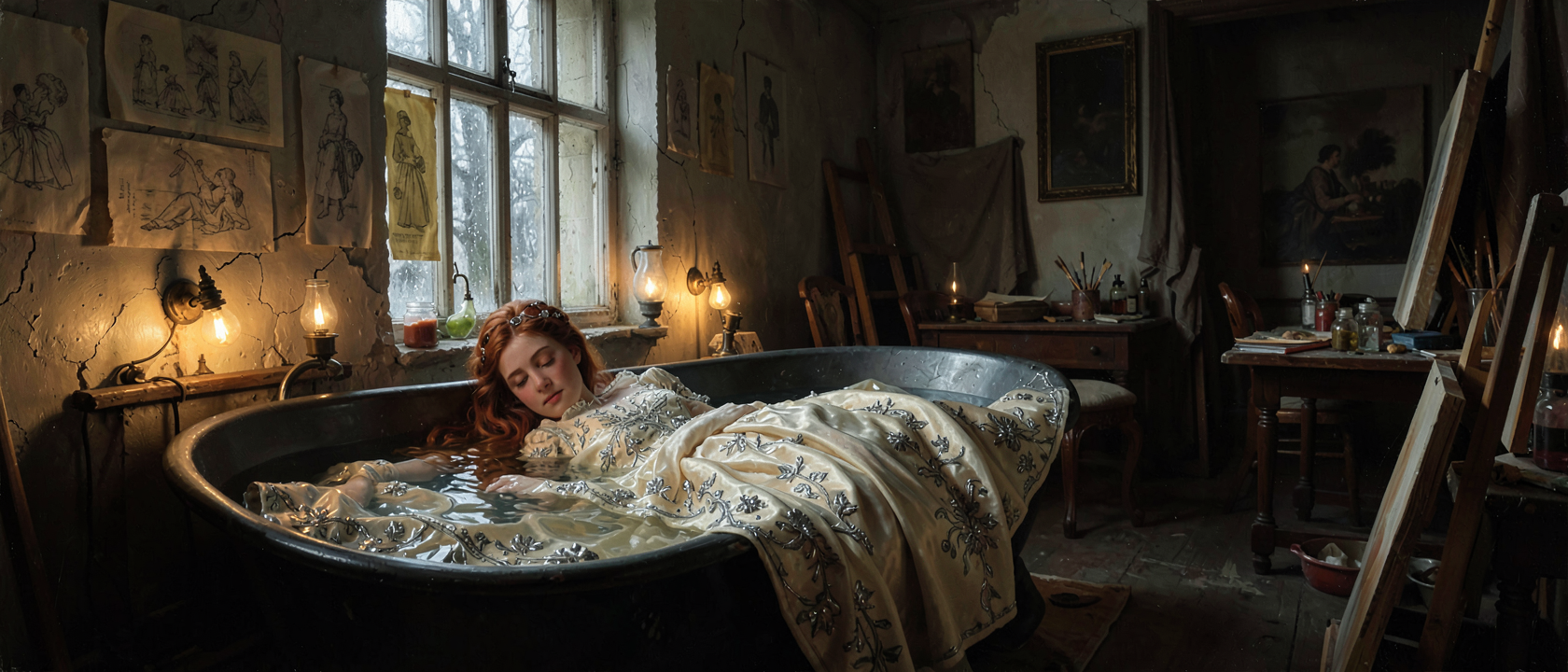
In 1851, John Everett Millais was finishing a painting in his studio at 7 Gower Street in London. He had spent months on the banks of the Hogsmill River in Surrey, painting reeds, willows, and running water exactly as they grew, for a scene from Shakespeare’s “Hamlet” that the play itself never actually shows. Gertrude only reports Ophelia’s drowning secondhand. Millais wanted to paint it as though he had watched it happen. Sources differ on how long the outdoor work took him, somewhere between four and five months, but the figure of Ophelia herself he saved for later, in his studio, in winter.
For that figure, he needed a woman to lie in a bathtub full of water, indoors, in a heavy antique gown he had bought for four pounds, “flowered over in silver embroidery,” as he described it in a letter. He hired Elizabeth Eleanor Siddall, then 22, who by 1853 had begun spelling her name Siddal. She held the pose of a drowning woman, arms out, lips parted, for hours at a stretch, session after session. To keep the water from turning cold on her, Millais set oil lamps underneath the tub.
How Siddal Got to That Tub
Her route there had started some years earlier, when the painter Walter Deverell spotted her working in a milliner’s shop off Leicester Square and asked her to sit for him. She had no family of artists behind her, and only a short stretch at the Sheffield School of Art by way of training. Modeling paid her bills, and it was also, for a working-class woman with no other door into that world, the only way in.
That was still true in 1851. Recognition of her as an artist in her own right came later, when the critic John Ruskin began backing her, from 1855, with a stipend reportedly around £150, sources differ on whether that sum was paid yearly or quarterly, aimed not at posing but at her own drawing and painting. At the time she climbed into Millais’s bathtub, none of that had happened yet.
The Candles Go Out
At some point during the sitting, the lamps warming the water underneath the tub burned low and went out. The water went cold. Siddal, following Millais’s instructions and raising no complaint, stayed in position rather than break the pose. No record fixes the exact day this happened within 1851, or how long she lay in the cold water before anyone noticed.
Afterward she fell seriously ill. Accounts from the time describe a severe chill; some medical historians reading the case now think it was closer to pneumonia, though no formal diagnosis survives. Her family had to send for a doctor.
The Bill
Siddal’s father wrote to Millais demanding £50 for the medical costs and threatening him with legal action over his carelessness. According to Millais’s own son, the painter eventually settled for less. Among what the doctor prescribed was laudanum, a tincture of opium used routinely at the time for pain and for lung trouble. Historians treat this illness as the probable starting point of Siddal’s dependence on the drug, though the exact causal line is not documented with certainty.
She married the painter and poet Dante Gabriel Rossetti on May 23, 1860. On February 11, 1862, eleven years after that sitting on Gower Street, Elizabeth Siddal died of a laudanum overdose. She was 32. A coroner ruled the death accidental.
What Survived
“Ophelia” went on public view at the Royal Academy in 1852, and the response was mixed rather than the triumph it is remembered as now. It is held in the Tate collection in London.
Siddal herself left a smaller record: drawings, watercolors, poems. In 1857, she was the only woman to exhibit in a Pre-Raphaelite show. None of it carries anything like the weight of the painting she nearly died posing for, or of her later identity as Rossetti’s wife. That gap, between the work she made and the way she is remembered, is worth sitting with.
Cinderella or Strategist?
Historians read that gap in opposite ways. Jan Marsh’s account treats Siddal largely as a discovery: a woman found in a shop, painted, and married, whose fame was decided for her by the men around her. Laurel Bradley argues the opposite, that Siddal used modeling on purpose, as the only entry point into a world she meant to work in herself, not just be looked at in. Neither case is settled.
What isn’t in dispute is the dress. The four-pound gown, tarnished and antique when Millais bought it in 1851, still survives at the Tate, alongside the painting it was made for. What Siddal made afterward, however much smaller that pile of work is, is what the argument is actually about.