
The Frenchman on the Riverbank
In the winter of 1831, Alexis de Tocqueville stood on the bank of the Mississippi River at Memphis and watched a crowd of Choctaw men, women, and children cross the water on ice. He had come to the United States to study American prisons and, more broadly, American democracy, the project that would become his most famous book. The crossing at Memphis was not on his itinerary. He simply happened to be there.
What he recorded was plain. Among the crowd were the sick, the very old, and newborn infants. People carried almost nothing with them. Tocqueville noted no protest, no complaint, in what he wrote down. He had not gone looking for a scene like this, and that is part of why his account has carried weight ever since: he was not there to make a point. He was there by accident, and he wrote what he saw.
He did not know, and did not record, the legal machinery that had put these people on that riverbank in the middle of winter. That machinery had been years in the making.
The Ground Was Already Gone
By the time Tocqueville reached Memphis, the Cherokee had already lost most of what they had. Between 1684 and 1819, they signed 28 treaties with colonial and then U.S. authorities, ceding more than 90 percent of their original territory. No single dramatic seizure did this; it came apart treaty by treaty, over more than a century.
By 1830, Georgia and Alabama had gone further, asserting state legal jurisdiction over Native land within their borders. Mississippi and Tennessee followed soon after, with President Andrew Jackson’s backing. On paper, this stripped tribal governments of authority over their own people and land before a single soldier had marched anywhere. Five nations stood to lose their homelands: the Cherokee, the Chickasaw, the Choctaw, the Creek, and the Seminole. What came next was not a sudden decision but the last step in a process that had been running for generations.
May 28, 1830
On May 28, 1830, Andrew Jackson signed the Indian Removal Act into law. The bill had passed the Senate 28 to 19 on April 24 and the House by a narrower margin on May 26, a count some sources give as 101 to 97 and others as 102 to 97. The law authorized the federal government to negotiate the exchange of tribal land in the southeastern states for land west of the Mississippi River, in what is now Oklahoma, a distance most sources place at roughly 1,200 miles (1,930 km), though some accounts give a shorter figure closer to 800 miles (1,290 km).
The text spoke the language of exchange and consent. Enforcement did not. Historians note that gap directly: what the Act described as voluntary, the government carried out by force, largely under Jackson’s successor, Martin Van Buren, whose administration oversaw most of the actual removals between 1837 and 1841.
What Removal Looked Like
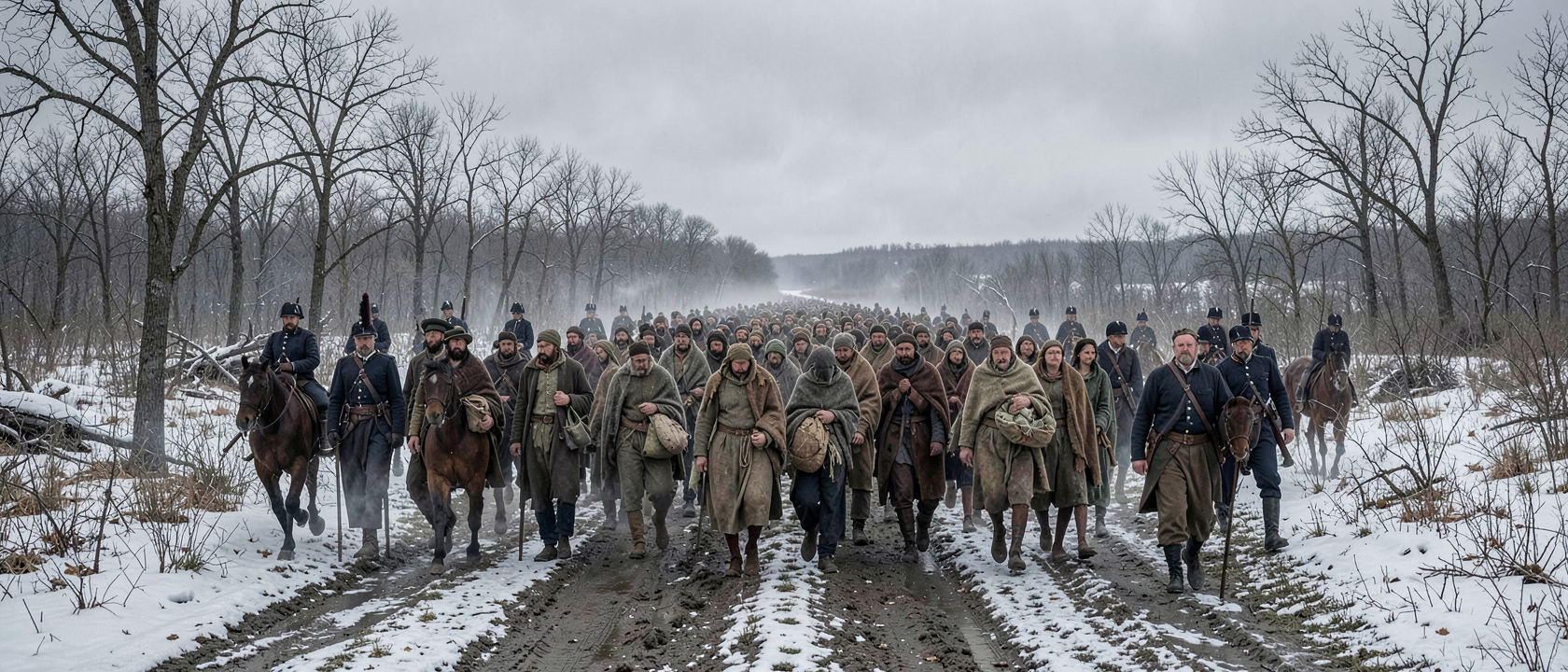
For the Cherokee, that force arrived in 1838. Roundups began in Georgia on May 26 of that year; ten days later, troops moved into Tennessee, North Carolina, and Alabama. Families were taken from their homes at gunpoint and held in stockades, where disease spread fast in crowded, unsanitary conditions. Behind them, houses were looted and burned. Graves were opened and disturbed.
One soldier who took part in the roundups later served as a Confederate colonel during the Civil War. According to his own later account, the Cherokee removal was the cruelest work he had ever taken part in, worse, he said, than anything he saw on a battlefield.
Four Thousand, Maybe Eight
An estimated 16,000 Cherokee were forced onto the road west, with some counts running as high as 17,000. Of those, roughly 4,000 died, from disease, exposure, and violence, in the stockades or along the march itself. Some historians place the toll as high as 8,000, twice the more commonly cited figure. Either number sits on top of what the Cherokee had already lost: land ceded across 28 treaties, homes burned, graves left disturbed. This was not a separate tragedy stacked on the first. It was the same one, still unfolding.
This figure covers the Cherokee alone. The Chickasaw, Choctaw, Creek, and Seminole endured their own removals in these same years, and no comparably detailed count of their dead survives.
What Congress Was Told
In December 1838, as the Cherokee removal was still underway or had only just ended, President Martin Van Buren reported to Congress that the operation had proceeded, in his words, with the happiest effects. According to that report, the Cherokee had emigrated without apparent resistance. The last group of Cherokee to make the journey did not reach Indian Territory until March 24, 1839.
Set beside the stockades, the burned homes, and the soldier’s own account of what he witnessed, Van Buren’s report describes the same event in an entirely different register. This was not a claim made decades later, softened by distance and memory. It was made while the suffering was current, or barely over.
What the Record Doesn’t Say
Even the Cherokee death toll, the most documented of the five removals, remains an estimate rather than a confirmed count. No agency tracked deaths systematically at the time, so historians have had to reconstruct the number from missionary accounts, tribal records, and military reports, which is why the range still runs from about 4,000 to 8,000. For the Chickasaw, Choctaw, Creek, and Seminole, no comparable count was ever assembled at all.
That gap in the record is not a footnote. An undercounted death toll is easy to describe as a peaceful and successful operation, and for a long time, that is exactly how it was described. The full bill for what happened between 1830 and the last Cherokee arrivals in 1839 was never actually added up. It still hasn’t been.