
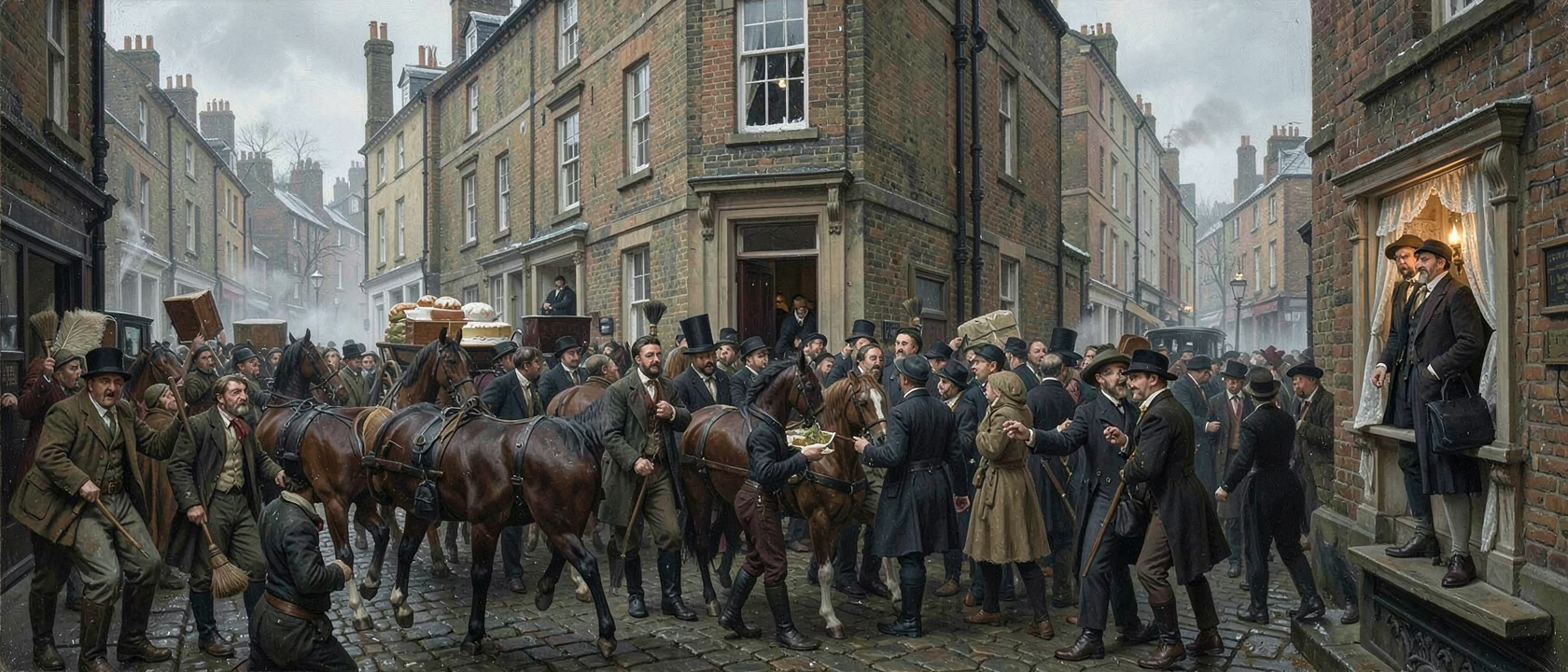
Before Dawn on Berners Street
At five o’clock on the morning of November 27, 1810, a chimney sweep knocked at the door of 54 Berners Street, a house in Westminster just north of Oxford Street. He told the maid he had been sent for. She said no one in the house had placed such an order and sent him away. Within the hour another sweep appeared with the same claim, then another. By the time she had turned away the twelfth, something was clearly wrong, though nobody inside the house yet knew what it was.
The house belonged to a widow recorded in almost every account as Mrs. Tottenham. She kept a modest household: herself, her maid, and whatever staff a widow of her standing would have employed. Neither of them had asked a single sweep to come. Both were about to find out that the morning had only started.
The Wager Behind the Door
The knocking traced back to a bet. Theodore Edward Hook, a writer known around London for his practical jokes, had wagered his friend Samuel Beazley, a playwright who later trained as an architect, that he could turn any house in the city into its most talked-about address within a week. The stake was a single guinea.
According to historians who have examined the episode, Hook spent roughly six weeks preparing before he made what looked like a spontaneous bet. In that time he sent out somewhere between 1,000 and 4,000 letters and orders, the higher figure being the one most commonly cited, all written in Mrs. Tottenham’s name, all instructing tradesmen, professionals, and assorted dignitaries to present themselves at 54 Berners Street at specific times on November 27. No surviving account explains exactly how one man produced and mailed that volume of correspondence without drawing notice beforehand. That part of the operation simply isn’t documented.
The Street Fills Up
The sweeps were only the opening act. Coal carts arrived next, each claiming a large delivery that Mrs. Tottenham said she had never ordered. Cake makers followed, carrying wedding cakes priced at 10 guineas apiece. Then came doctors, apothecaries, surgeons, and lawyers, and behind them vicars and priests, summoned to attend to someone inside who was said to be dying. Undertakers waited outside with coffins already built.
Fishmongers, bootmakers, shoemakers, haberdashers, hatmakers, and butchers’ boys added to the crowd, along with a line of pianos waiting to be delivered. A contemporary account in the Annual Register that year also lists wagons of coal from the Paddington wharves, cartloads of upholstery, organs, linen, and jewelry, all converging on the same address within hours of each other. Wedding cakes and coffins arriving at the same door on the same afternoon was the kind of contradiction that made the scene hard for anyone standing in it to make sense of, let alone stop.
The Grandees Arrive
By midday the commotion had grown large enough to pull in some of the city’s most prominent men. The Governor of the Bank of England came to see it. So did the Lord Mayor of London, the chairman of the East India Company, and the Duke of Gloucester. One account of Beazley’s life adds the Duke of York and the Archbishop of Canterbury to the crowd, though that detail rests on fewer sources than the rest.
The Lord Mayor’s visit is the best documented of these. He arrived by carriage with two liveried servants and tried to reach No. 54, telling the police on the scene that he had received a letter from Mrs. Tottenham saying she had been summoned to appear before him but was confined to her room by illness. Realizing the letter was a fake, he left. Traffic in the surrounding streets was reportedly snarled for hours. Police were called in to manage the crowd, but they could not clear the street until five in the evening, after one last wave of visitors: domestic servants who believed they had come for job interviews.
Who Paid
Hook and Beazley had watched the whole day unfold from a rented room in a house directly across the street. That evening Beazley handed Hook the guinea. Hook had won his bet, and he left London for the countryside shortly afterward to avoid retribution from tradespeople who had lost a day’s income chasing an order that didn’t exist.
What he left behind was the bill. Cake makers were holding 10-guinea cakes nobody would buy. Coal carts, coffins, pianos, and deliveries of every kind had converged and dispersed with nothing to show for the trip. Mrs. Tottenham and her maid had spent the day fielding strangers at their own front door. Angry tradesmen who had lost time and money pushed hard to identify and punish whoever was behind it, and Hook was widely suspected even though he was never formally named at the time. No source gives a total figure for what the day cost in money, and none records that Hook ever faced a formal penalty for it.
What the Record Doesn’t Say
The outline of the Berners Street hoax is well attested. The Morning Post reported it on November 28, 1810, and the Annual Register recorded it that same year, which rules out pure legend. But the outline has gaps a modern reader would want filled.
Nobody has explained how Hook wrote and dispatched thousands of individual letters over six weeks without being caught in the act. Nobody has recorded whether he faced anything beyond popular suspicion; his role wasn’t publicly confirmed until he admitted it himself, in a semi-autobiographical novel published a quarter century later. And the record says little about what happened to the people left holding the loss. Genealogical research has since suggested the widow’s actual surname may have been Tottingham rather than Tottenham, a claim resting on a single source. What is better documented is that she stayed at the address until her death in 1833, after which her three unmarried daughters remained in the house until at least 1841. Whether she or any tradesman was ever compensated for that day is not recorded anywhere.
Even the date has been unsettled. The hoax is sometimes given as 1809, sometimes as 1812, and modern historians have settled on November 27, 1810, based on the contemporary press record. The broader outline is clear; the finer details are not.