The Roads to London
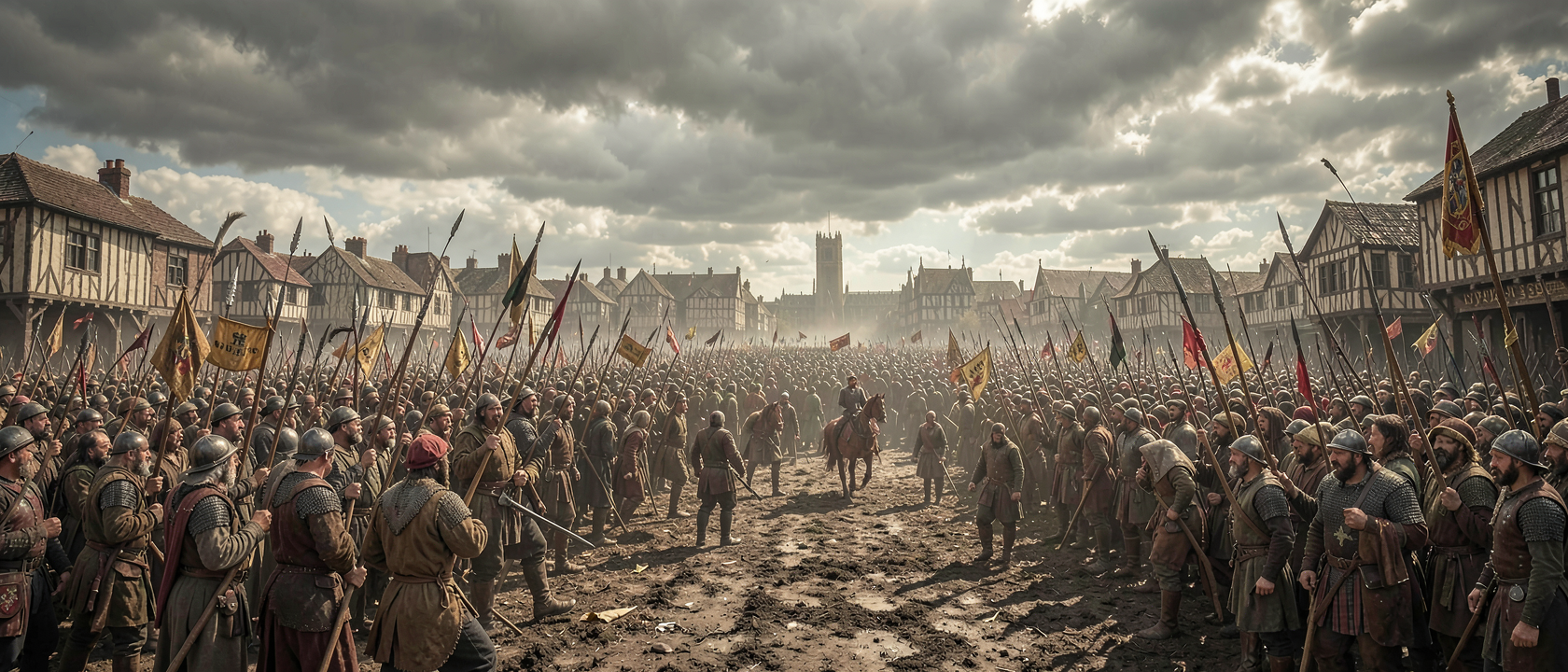
In the spring of 1381, people in the county of Essex refused to pay a new poll tax, and the refusal did not stay local. Bands of rebels formed in Essex and, separately, in Kent, encouraged by the preaching of a priest named John Ball, and both began marching toward London. The two columns, led in part by Wat Tyler and Jack Straw, converged at Blackheath, on the edge of the city. By some estimates, as many as 30,000 people had gathered under Tyler alone.
London’s walls had stood for centuries against the threat of foreign armies. They had never been breached from within, by the kingdom’s own common people. That changed on June 13, 1381, when the rebels entered the city, joined by some of its own residents, and made for the centers of royal and noble power.
A Boy King and a Nervous Council
Richard II had been king since 1377. By 1381 he was fourteen years old, ruling under a minority government already resented for the poll tax and for the taxes that had come before it. A revolt of common people, in that setting, was not a local grievance the crown could absorb quietly. It reached straight at the government’s own center: the men who collected the taxes and ran the courts in the king’s name.
The nervousness in government circles was not new. In 1378, three years before the revolt, the poet John Gower had already written of his fear that the common people might rise against their rulers.
Inside the Walls
Once inside London, the rebels burned the Savoy Palace, home to John of Gaunt, who was widely blamed for the poll tax. They set fire to law books and buildings at the Temple, killed men attached to the royal government, and opened the city’s jails. On one point the sources agree: the Savoy was destroyed, not looted.
On June 14, the king rode out from the Tower of London to meet the rebels at Mile End, promising an end to serfdom, cheap land and free trade. While he was away, around 400 rebels stormed the Tower itself, where the royal court had taken shelter, and captured Simon Sudbury, Archbishop of Canterbury and the king’s Lord Chancellor, along with Robert Hales, the Lord High Treasurer, and John Legge, a royal serjeant and legal officer of the crown. All three were beheaded on Tower Hill.
The unrest did not stay in the capital. Rioting reached as far south as Bridgwater in Somerset and as far north as York, Beverley and Scarborough.
What Was Lost
By the time the worst of it had passed, an archbishop, a treasurer and a royal legal officer were dead, and unnamed men attached to the royal government had been killed in London’s streets in numbers no surviving document tallies. A royal palace on the Thames had burned to nothing. Nothing puts a price on the Savoy or the rest of what was destroyed, and nothing gives a total for the dead in the city that June. What survives is a list of who died and what burned, not a ledger.
The crackdown that followed is easier to measure. Richard’s government mobilized roughly 4,000 soldiers to restore order, and by the time the king issued a general pardon in November 1381, at least 1,500 rebels, by one minimum estimate, had been killed suppressing the revolt.
The Gaps in the Record
Much of that summer resists a clean timeline. Beyond a few fixed points, June 13, 14 and 15, the sources do not sequence the London invasion, the Tower assault, the burning of the Savoy and the spread of rioting into Somerset and Yorkshire against one another with any precision. They simply place it all somewhere in the window between May and August 1381. The Archbishop, the Treasurer and the men who died with them mostly go unnamed, and no account gives a number for how many died in London that June, on either side.
Even the leadership of the Tower assault is disputed: some accounts name a rebel called John Starling, others name a woman, Johanna Ferrour. And the idea that the revolt’s anger runs down through later centuries of protest, and even into the present, is a suggestion historians make, not a claim anyone has proven.
Those Who Wrote It Down
What keeps the revolt so vivid, despite all these gaps, is who wrote about it close to the time. Geoffrey Chaucer set it down as a poet who had lived through it. Thomas Walsingham, a monk chronicling events at St Albans, wrote of it from inside the church’s own establishment. Jean Froissart wrote of it from across the Channel, piecing together reports of an English crisis as a continental observer. All three describe the summer of 1381 with something close to horror.
None of them counted the dead. What survives from 1381 is testimony more than record: a poet, a monk and a foreign chronicler, writing independently, all reaching for the same sense that something in England had come apart. That is how this revolt is remembered at all: not in numbers, but in the fact that three men with little reason to agree on anything else agreed on that.