
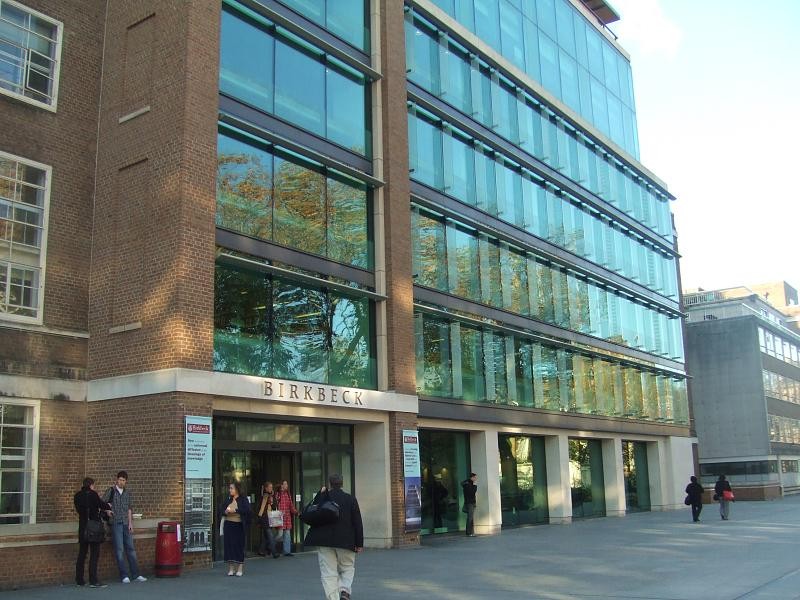
Birkbeck, University of London is a public research university located in Bloomsbury, London, and a constituent college of the University of London. Founded in 1823 by George Birkbeck as the London Mechanics’ Institute, it was built on the principle that working people deserved access to higher education, and it has organised its teaching around evening study ever since. In the 2021 Research Excellence Framework, 83% of its research was rated world-leading or internationally excellent, placing it among the UK’s leading research-intensive universities.
Key facts
- Country: United Kingdom
- Founded: 1823
- Headquarters: London
- Founder: George Birkbeck
- Type: public research university; constituent college; higher education institution; educational organization
- Parent organisation: University of London
- Website: https://bbk.ac.uk
Origins and early history
George Birkbeck convened the founding meeting of the London Mechanics’ Institute on 11 November 1823. Approximately 2,000 people attended, a figure that reflected the scale of unmet demand for education among working people in the capital. From its first days, the institution was designed to put formal learning within reach of those who could not attend conventional day colleges.
By 1920 the college had grown sufficiently to join the University of London, but it did so on an explicit condition: it would retain its commitment to evening teaching. That stipulation was not a formality. It encoded the college’s founding purpose into its relationship with the wider university, and it has shaped every aspect of how Birkbeck operates, a defining commitment for more than a century.
Research and scholarship
Birkbeck has built a substantial research profile across the sciences and humanities. In March 1953, Rosalind Franklin transferred from King’s College London to Birkbeck’s crystallography research laboratory at the invitation of Professor J. D. Bernal. At Birkbeck she led investigations into the molecular structures of viruses, including the tobacco mosaic virus, working in the final years of her life alongside Aaron Klug, who later received the Nobel Prize.
The college’s Centre for Brain and Cognitive Development was founded in 1998 under Professor Mark Johnson. In 2005 the centre received the Queen’s Anniversary Prize for Higher Education for its neuropsychological work with very young children. In the 2021 Research Excellence Framework, 83% of Birkbeck’s submitted research was rated world-leading or internationally excellent. For the 2025 to 2026 academic year, UK Research and Innovation awarded Birkbeck a combined Quality-Related research and Higher Education Innovation Funding grant of £10,850,204.
Financial position
Birkbeck’s accounts over recent years record a deteriorating financial position. A deficit of £550,000 in 2021–22 widened to £2.2 million in 2022–23. A further deficit of £7 million was recorded in the financial year covered by the 2024–25 annual accounts cycle.
Did you know
- Birkbeck’s founding meeting as the London Mechanics’ Institute on 11 November 1823 was attended by approximately 2,000 people, an extraordinary turnout that signalled strong public demand for working-class higher education. (studyguides.com)
- Rosalind Franklin, the pioneering X-ray crystallographer whose images contributed to understanding of DNA’s double-helix structure, spent the last five years of her life at Birkbeck College from 1953, studying virus structures alongside future Nobel laureate Aaron Klug. (chuarchivestories.uk)
- When Birkbeck officially joined the University of London in 1920, it did so on the specific condition that it would continue to provide evening teaching, a stipulation that has defined its identity for more than a century. (artsandculture.google.com)
Data sources
- Wikidata
- bbk.ac.uk
- staars.org
- chuarchivestories.uk
- timeshighereducation.com
- funding.re.ukri.org
- handwiki.org
Where it appears
- Mental Deficiency Act of 1913: Britain’s 46-Year License to Confine November 5, 2026
Data updated: 2026-11-02