
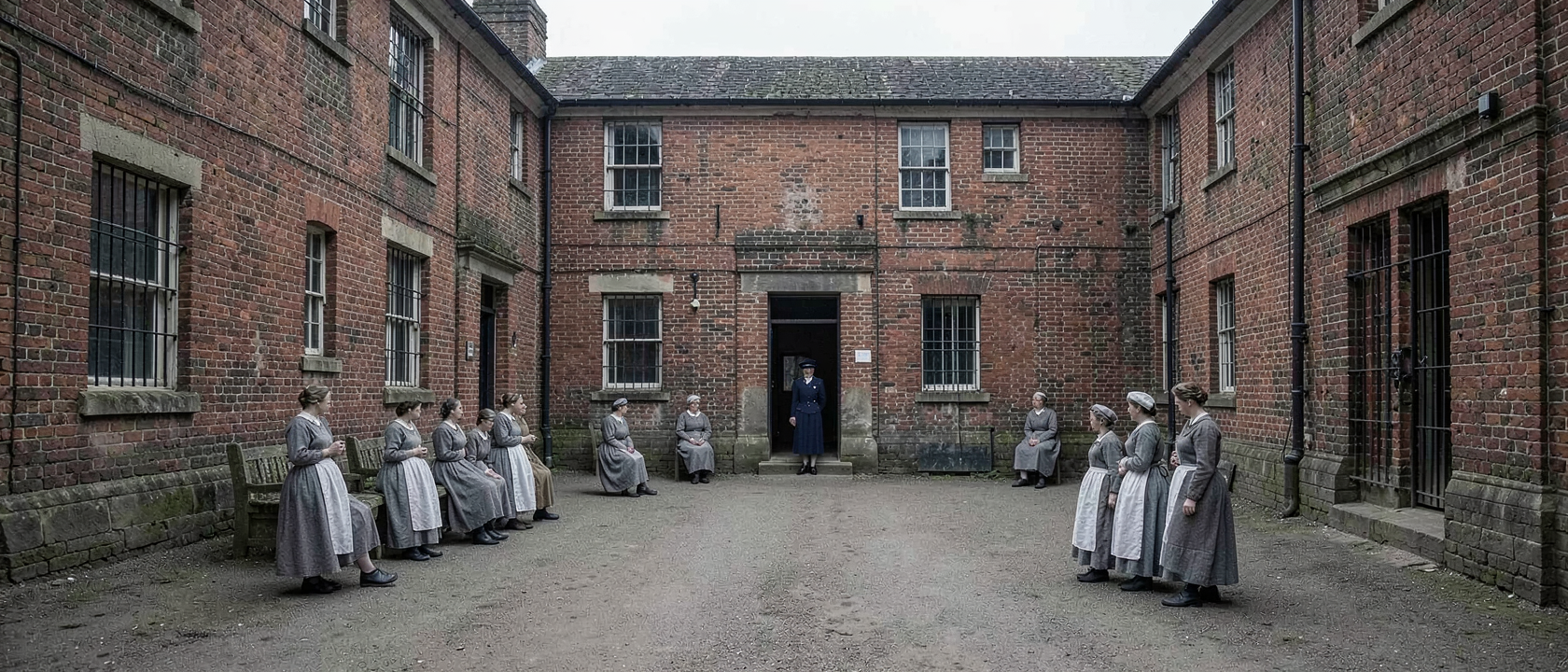
A woman could be declared a “moral imbecile” by a workhouse doctor and held for years, not for any sign of mental impairment but for a diagnosis of syphilis and a certificate that needed no court’s approval. That is where Sarah Wise’s book, “The Undesirables: The Law that Locked Away a Generation” (Oneworld, 352 pages, £22), begins. Reviewed by Louise Hide, a Wellcome Trust Fellow in Medical Humanities at Birkbeck, University of London, the book reconstructs what Britain’s Mental Deficiency Act did to the people caught under it for 46 years, from 1913 until its repeal in 1959.
Abingdon, 1919
In 1919, a 24-year-old woman recorded only as Bessie B. was admitted to Abingdon Workhouse, known locally as “the Grubber.” A workhouse medical officer certified her a “moral imbecile” under the Mental Deficiency Act of 1913, a decision that needed no court hearing and no psychiatrist, only his own signature.
The surviving case notes say little else: Bessie B. had been diagnosed with syphilis, and the officer who committed her recorded that he acted “in her own interest.” Nothing in the file suggests the intellectual impairment the law was meant to catch. What follows is a reconstruction built from that single file, not a transcript of anything she said; most of what happened to her inside went unrecorded, or has not survived.
Why Parliament Acted, 1904-1914
The law that held Bessie B. had been building since the late nineteenth century, when hereditary theory held that character traits and poverty ran in families as a fixed “taint.” The idea gained force after the Second Boer War of 1899 to 1902, when many men offering for army service were rejected as unfit, read by officials as proof of imperial decline alongside falling birth rates among the middle and artisan classes.
These anxieties shaped the Royal Commission on the Care and Control of the Feeble-Minded, whose findings became the Mental Deficiency Act. The Act received royal assent on August 15, 1913, with only three members of Parliament voting against it, Josiah Wedgwood among them. According to the parliamentary record, Wedgwood tried to filibuster the bill and called it the work of “the Horrible Eugenic Society.” Most provisions took force on April 1, 1914, with the stated aim of protecting the national stock. Historians still debate how much came from eugenic conviction and how much from cheaper poor-law management; in practice the Act did both.
Who Got Certified, and On What Grounds
The Act defined four categories: idiots, imbeciles, the feeble-minded, and moral imbeciles, running from most to least clinically defined. In practice the labels covered almost anyone a local authority wanted removed: a woman with a child outside marriage, a teenager caught shoplifting, a man picked up for drunkenness or vagrancy, a child with epilepsy or a hearing impairment who had struggled at school, or someone simply judged “different.”
Certification was decided by workhouse and asylum medical officers, not psychiatrists in any modern sense, often on behavior rather than clinical assessment. Those certified were confined by sex in colonies, workhouses, and asylums built for labor and containment as much as care. Britain did not follow some American states into compulsory sterilization under the same logic; the idea surfaced in British debates too but never won majority support, and confinement remained the method instead.
Release, and a Reckoning Elsewhere
Bessie B. was released around 1924, after five years, and moved to Hove, on the Sussex coast, working as a servant under the supervision of the Brighton Guardianship Society. That meant she could live outside an institution but remained monitored by a body with the standing to recommit her: a success story, by the Act’s own measure.
Through the 1930s and 1940s, the hereditary theory behind her certification came under different pressure. Nazi Germany built forced sterilization programs, then killing programs, on the same claim underpinning the British Act: that moral and intellectual traits were fixed and heritable. That discredited the science in the eyes of many British doctors and officials, though it did not by itself dismantle the machinery already built at home.
Fifty Thousand Still Inside
By 1951, the National Council for Civil Liberties estimated that roughly 50,000 people labeled “mentally defective” remained institutionalized under the Act, many with no criminal record and testing within the normal range on contemporary intelligence tests. That estimate roughly matched an earlier figure cited by the book’s publisher for 1950, though the two counts come from different sources and should be read as approximations rather than an official tally. Release only picked up pace near the end: almost 2,000 people were discharged in 1957 and 1958 alone.
Parliament repealed the Act in 1959, replacing it with the Mental Health Act 1959; sources differ on whether it stopped applying that year or took formal legal effect on November 1, 1960, a gap of bookkeeping rather than substance. For most of the estimated 50,000 people still inside, repeal did not mean the door opening.
Dulcie and Bertha
Louise Hide met two of them herself. Working on a psychogeriatric ward in the late 1970s, she came to know Dulcie, institutionalized originally for being blind, and Bertha, committed as a teenager for having a child outside marriage and later living with Parkinson’s disease. Both had entered the system decades earlier, under a law already off the books for close to twenty years.
Dulcie and Bertha were not finally discharged until the 1980s and 1990s. The gap between repeal in 1959 and their actual release ran to thirty years or more.
What the Record Can’t Tell Us
Much of the paperwork behind this story is gone. Institutional files were lost, destroyed, or sealed under the standard hundred-year confidentiality rule, which is why Wise and historians like her work from partial archives and reconstructed cases such as Bessie B.’s. No one can say exactly how many people were detained under the Act across its 46 years in force, only that the number ran into the tens of thousands.
The bill here was never counted in money. It was counted in years: five for Bessie B., decades for Dulcie and Bertha, and an unknown number for everyone whose file did not survive.