
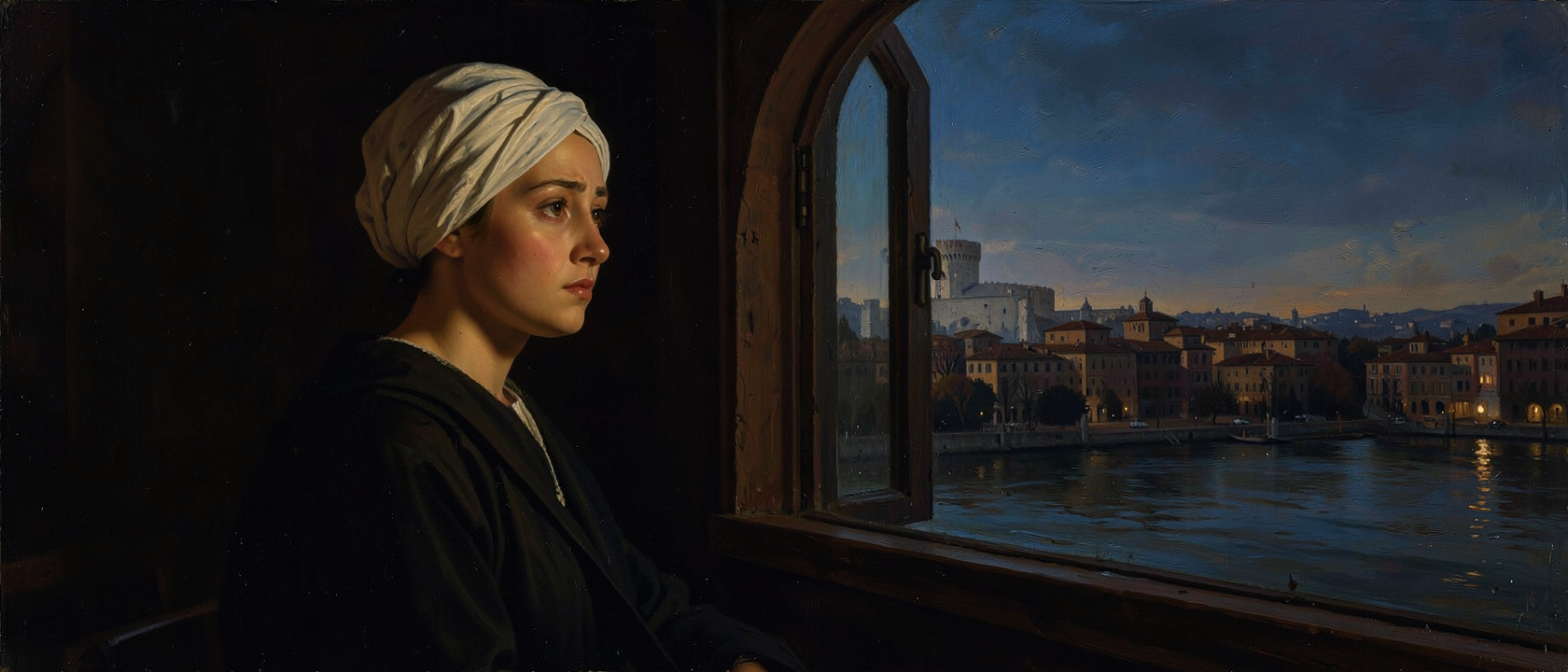
The Bridge at Sant’Angelo
Before dawn on September 11, 1599, guards led three prisoners across the bridge at Sant’Angelo, in front of the castle of the same name in Rome. Beatrice Cenci was twenty-two years old. She was beheaded with a small axe, and beside her, her stepmother, Lucrezia Petroni, was beheaded as well. Her brother Giacomo had his skull crushed with a mallet before his body was quartered. A younger brother, Bernardo, twelve years old, was spared execution but forced to watch, then returned to prison and later sentenced to spend his life as a galley slave.
The charge was the murder of Francesco Cenci, Beatrice’s father, a wealthy Roman nobleman whom the records of the time describe as violent and dissolute. At her trial, Beatrice said her father had raped her. The court never stated whether it believed her. Pope Clement VIII, who could have granted clemency, let the executions go ahead. They were carried out in public, on a scaffold built to be seen, before a crowd gathered to witness it.
A Story With No One Left to Tell It
By midmorning, the three people who knew most about what had happened inside the Cenci household were dead. Beatrice, Lucrezia, and Giacomo could no longer confirm or deny anything. Only Bernardo remained, a boy of twelve, and no account attributed to him survives. Whatever attached itself to Beatrice Cenci’s name afterward, sympathy or suspicion or art, would have to be built without a single living witness to correct it.
Historians still argue over how far to trust her account. There is no real dispute that Francesco Cenci had a documented pattern of violence toward his household; whether he went as far as she claimed at trial has never been settled either way. That gap sat open for close to a century and a half, until the 1740s, when the historian Ludovico Antonio Muratori revived the case in his Annals of Italy (Annali d’Italia), published in 1749. He put Beatrice back into public conversation after generations of near-silence, and left the story open for whoever came next to finish.
A Face Becomes a Legend
What came next was a painting. Sometime in the late 1700s, a portrait of a young woman in a white turban, glancing back over her shoulder, began circulating in Rome under Beatrice Cenci’s name. Tradition credited it to Guido Reni, the Bolognese painter, and supplied a story to explain it: that Reni had slipped into her cell the night before the execution, or caught sight of her on the way to the scaffold, and painted her from that single look. No document puts Reni at that scene. Some accounts of his life place him outside Rome entirely at the relevant date. None of that stopped the story from settling into Roman guidebooks and private collections, repeated by visitors who wanted a face to put to the name they already knew.
Rome, Early 1845
Charles Dickens saw the painting in Rome early in 1845 and wrote about it in Pictures from Italy. He called it almost impossible to forget: a young woman in a white turban, looking back over her shoulder at the painter, her expression carrying what he described as celestial hope, a beautiful sorrow, and a desolate earthly helplessness.
He was not the first to be moved by it. Twenty-six years earlier, in 1819, Percy Bysshe Shelley had written a five-act tragedy called The Cenci, and later said that the image of Beatrice had haunted him ever since he saw her portrait. Stendhal, too, drew on the painting and the legend around it. All three wrote about the woman in the turban as though her identity were beyond question.
Two Kinds of Cost
The first cost is easy to total. Three people died on the morning of September 11, 1599: Beatrice Cenci, her stepmother, and her brother. A fourth, a boy of twelve, lost the rest of his youth to a galley bench. That toll was fixed by midmorning.
The second cost took two centuries to add up, and it never touched a scaffold. Current scholarship holds that the painting Dickens, Shelley, and Stendhal responded to was not the work of Guido Reni at all, but of Ginevra Cantofoli, a painter active in Bologna, born around 1608 or 1618 and dead in 1672. Cantofoli trained under Giovanni Andrea Sirani, whose daughter Elisabetta Sirani was also, at various points, credited with this same picture. Bologna supported a number of women working as professional painters in the Baroque period; Cantofoli was one of them, and her documented body of work has largely stayed outside the standard art-historical canon. For roughly two hundred years, a painting she is now believed to have made traveled under a famous man’s name, because that name carried more weight with collectors and guidebook writers than hers ever did. No one was executed over it. It simply cost her the credit for her own work, paid out slowly, one collection and one caption at a time.
Neither Face Nor Hand Confirmed
Two separate questions are still open, and settling one does not settle the other. The case for Cantofoli rests on stylistic analysis and archival research by museum scholars, not on a signature or a contract, so it stands as a strong scholarly view rather than a proven fact. Separately, the sitter’s identity has come under its own doubt: no portrait of Beatrice Cenci made during her lifetime is confirmed to exist, and a young woman in a turban glancing back at the viewer was a pose common enough in that period to stand for almost anyone, named or invented.
The painting now hangs in the Galleria Nazionale d’Arte Antica, in the Palazzo Barberini in Rome, still generally known by Beatrice Cenci’s name. It still draws people who come to look into the face that undid Dickens. Whether it is her face, or anyone’s documented face at all, is a different question from whether it moved him. It did. What the picture actually shows, and whose hand actually painted it, are questions the record still has not closed.