
On the Newsstand, 1957
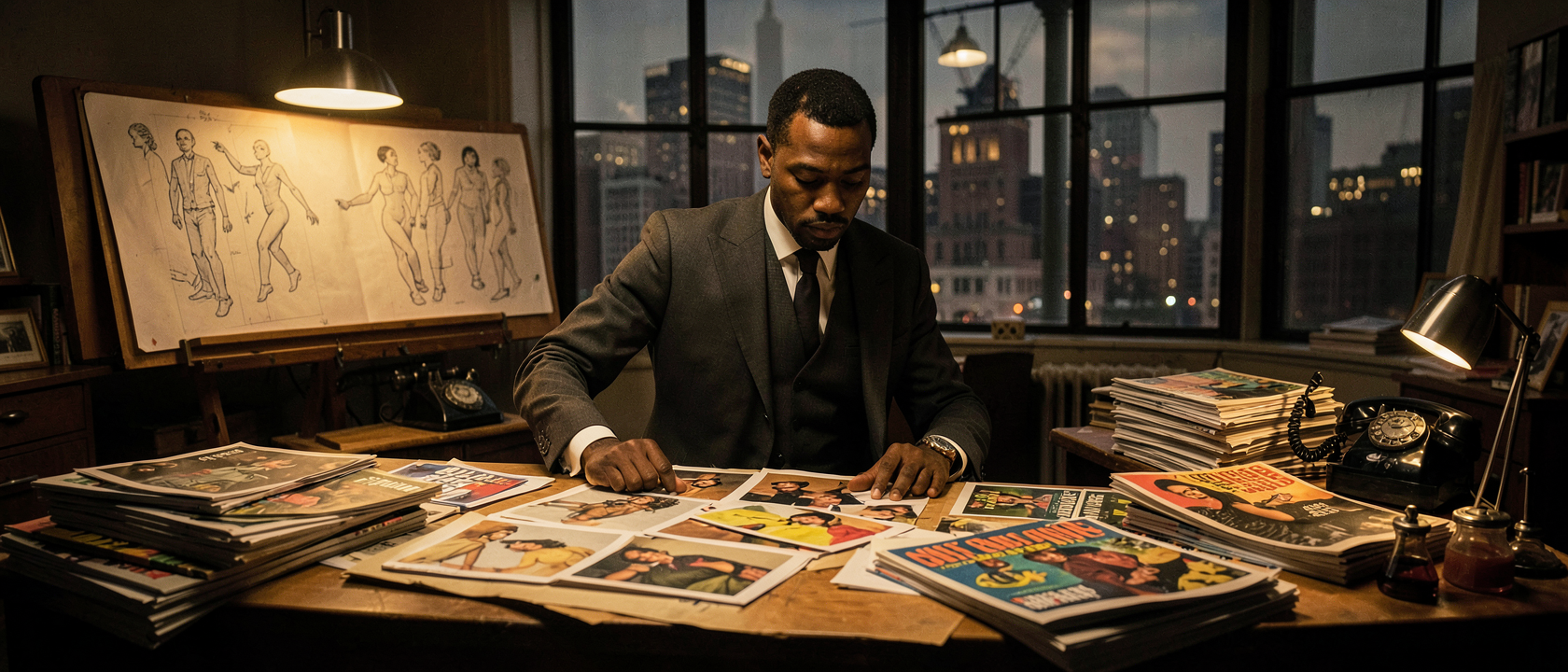
In June 1957, a fifty-cent magazine called Duke, positioned from the start as a “Black Playboy,” went on sale in Chicago, published by the newly formed Duke Publishing Co. Set beside a copy of Playboy on the same rack, the resemblance was immediate: black-and-white pages broken by a color cover, and inside, a color centerfold built around one feature, the “Duchess of the Month.” The first Duchess, Eleanor Crews, had already appeared that year as the October pin-up in a 1957 calendar bundled with Jet’s New Year issue. Unlike Playboy’s playmates, the Duchess was never photographed topless or fully nude.
The masthead named Dan Burley, a journalist and jazz musician who had worked at the Amsterdam News, Jet, and Ebony, as editor. Alongside him ran fiction from Langston Hughes, Chester Himes, Erskine Caldwell, and George S. Schuyler, plus a Ray Bradbury story, “The Last White Man,” in the debut issue. Duke’s editors described their mission as offering moments of pleasure, with no causes attached: not a civil-rights magazine, but a leisure title for Black readers with money and time to spend. No circulation figures survive for the first issue or any other.
The Market Nobody Had Served
The case for Duke had been building since World War I. Black purchasing power in the United States had grown steadily across four decades, driven by migration out of the rural South and into cities where wages, however unequal, ran higher than sharecropping. By the 1950s that growth had produced a Black middle class large enough to support its own press, and, publishers believed, hungry for leisure titles rather than struggle. Playboy had already shown one model for selling that leisure: historian Kathy Peiss notes its founders sold it not as a girlie magazine but as a “men’s magazine,” built around clothes, drinks, and the right car.
Duke’s real publisher was Ben Burns, born Benjamin Bernstein in Chicago in 1913, though his name never appeared on the masthead. White and Jewish, Burns had held senior editorial posts at the Chicago Defender, Ebony, and Jet before leaving to start Duke with several former Johnson Publishing Company staffers. He had also edited the men’s magazine Modern Man and had been prosecuted for obscenity in that job. Yet by most accounts Burns went into Duke doubting that a sex-oriented magazine could really work for a Black readership. Duke was the bet he made anyway.
The Turn
What actually filled Duke’s pages told a different story than the one on its cover. Instead of celebrating the tastes of the Black middle class it claimed to speak for, its writers mocked them: one piece ridiculed barbershop culture, a social mainstay; a profile painted a popular disc jockey as unsophisticated despite his following; other pieces needled readers over their jazz knowledge and their food choices.
Across all six issues, Duke ran no advertising at all, and no source explains why the pages stayed empty. Meanwhile, at least one reader on record said what he had actually wanted from a magazine modeled on Playboy: sports cars, furs, jewelry, fine furnishings, the aspirational goods Playboy itself specialized in. Duke’s writers spent their pages correcting their own audience’s taste instead of flattering it.
Six Issues
Duke published six times, roughly monthly, from June through November of 1957, and then stopped. A fifty-cent cover price, no ads in any issue, and no circulation or financial figures survive to show how badly, or how fast, the magazine lost money. Historians who link the empty ad pages and the mocking articles to the closure are reading a pattern into thin documentation, not a balance sheet. No source records what became of Burns, Burley, or art director LeRoy Winbush, who received the AIGA Medal posthumously in 2008 for a design career that included his work on Duke. The magazine simply stopped appearing after its sixth issue.
Respectability, and Its Limits
Literature scholar Kinohi Nishikawa offers the fullest account of why. His reading: Duke’s writers, eager to prove the magazine belonged beside Playboy, grew preoccupied with respectability, drawing a line between an imagined, polished ideal reader and the actual habits of the Black middle class around them. That anxiety, he argues, curdled into contempt for the audience Duke needed to keep buying it. It is the dominant explanation in the record, not the only conceivable one, and it leaves real gaps: no source names which editor wrote the barbershop piece or the DJ profile, and none gives exact dates for individual issues beyond the year.
One question the record raises but never answers is how much of Duke’s direction came from Dan Burley, its Black editor of record, and how much from Ben Burns, the white publisher working behind him. Some historians have suggested Burley was largely a credibility hire, put in front of a magazine Burns actually ran. That, too, is interpretation, not settled fact.
What stays clear is the shape of the mistake. Duke was built to sell a class of readers a flattering picture of their own leisure, and it kept handing that picture back with the frame broken. Six issues is a short run for a magazine that had Langston Hughes and Chester Himes on its pages and Playboy’s exact format to copy. What it lacked was the one thing its readers were actually paying for: the sense that someone believed they already had good taste.