
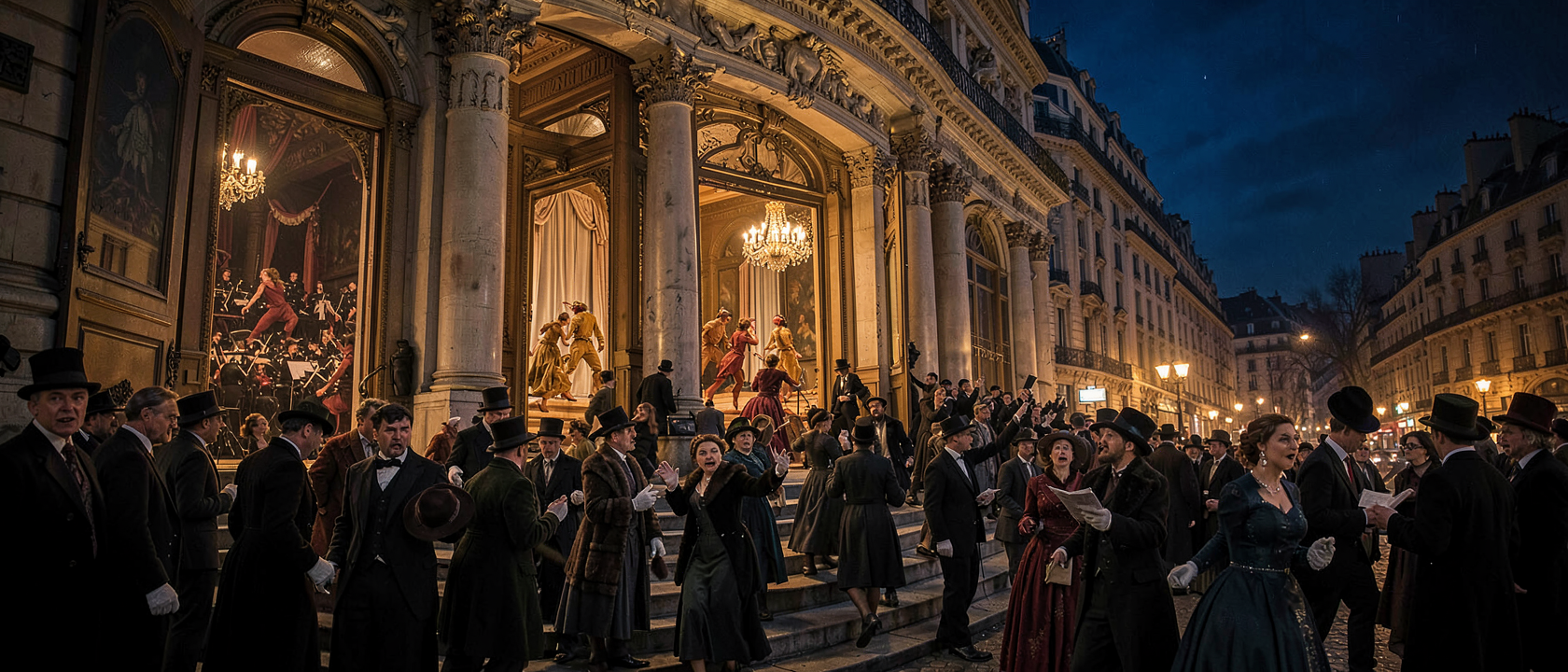
A New Theater, a Full House
On May 29, 1913, the Théâtre des Champs-Élysées in Paris opened its doors for a performance meant to crown its first season. The hall itself was new that year, built for exactly this kind of evening, and it was full.
Sergei Diaghilev’s Ballets Russes had brought Paris something new nearly every season since he founded it in 1909, including two earlier Stravinsky scores staged by the company, The Firebird in 1910 and Petrushka in 1911. The audience arriving on May 29 knew the company’s reputation for testing what Parisian taste would accept, and they had come dressed for the occasion.
On stage that night: a score by Igor Stravinsky, still in his early thirties; choreography and the lead role by Vaslav Nijinsky, the company’s biggest star; sets and costumes by the painter Nicholas Roerich; and Pierre Monteux conducting. The orchestra took its seats. The house lights were still up. The performance had not yet begun.
Months of Rehearsal, Called “Arithmetic Classes”
Stravinsky finished the score on March 29, 1913, exactly two months before the premiere. By his own later count, the dancers had gone through an estimated 120 rehearsals, though he offered that only as an approximation. The orchestra needed 17 sessions of its own just to learn the parts before rehearsals with the dancers even began, and it was larger than any ensemble Stravinsky had written for up to that point, with sources putting the total near ninety to ninety-nine musicians.
The difficulty was arithmetic, in a literal sense. Nijinsky had built the choreography on shifting, irregular counts that ran against the beats a trained dancer expected. To hold the group together he called the rhythms aloud in Russian, and because Russian numbers tend to run long and multi-syllabic, the counting itself struggled to keep up with the music’s fastest passages. The dancers took to calling these sessions “arithmetic classes.” At one rehearsal, trying to find where a passage lined up, Nijinsky proposed simply counting to 40 and seeing if the steps and the score met in the same place.
The Music Starts, the Room Turns
The disturbance did not wait for the dancing. Reactions began with the opening bars, before a single dancer had appeared, a sign that the score itself, not only the choreography, struck part of the room as wrong. Once the curtain rose, the noise grew louder and split in several directions at once.
Jean Cocteau, in the audience that night, later described a crowd doing several things at once: some trying to listen, others laughing, booing, hissing, or imitating animal calls to mock what they were hearing. The mixture spilled into open scuffling among spectators. Diaghilev, watching from the house, tried flicking the lights on and off to settle the room, a detail Stravinsky himself recalled years afterward. It did not settle anything for long.
Backstage, the din from the hall had grown loud enough to drown the orchestra. With the dancers unable to hear the music clearly, Nijinsky climbed onto a chair in the wings and shouted the counts in Russian, the same method from rehearsal, now keeping time for dancers who could no longer hear the pit.
What the Sources Don’t Agree On
What exactly happened in that hall is harder to pin down than the standard version suggests. There is no surviving police report from May 29, 1913, no box-office record of a night cut short, and no contemporary newspaper account that puts a number on the disorder. What survives instead is memoir, written years and sometimes decades later by people who had been in the room.
The Paris press the next morning offers a narrower picture than legend does. Reviewing the premiere in the Echo de Paris, critic Adolphe Boschot complained mainly about the audience’s foot-stamping, writing that they stamped, and stamped, and stamped again, not about brawling in the aisles. Other, later accounts go much further, describing fistfights, a woman drawing a hatpin against the man seated beside her, police clearing roughly forty disruptive spectators from the hall at intermission, and a duel fought the following day. Other researchers examining the same episode argue the opposite: that there is no solid evidence any physical altercation occurred at all, or that police were ever called. Even the word “riot,” now permanently attached to this premiere, does not appear to have been used at the time; it surfaces in reviews of a 1924 revival, more than a decade on. What seems certain is that people in the hall disagreed loudly about whether the trouble was Stravinsky’s score or Nijinsky’s steps. How far that disagreement actually went is not.
The Run Went On
Whatever happened inside the theater that night, it did not end the production. The Ballets Russes completed its scheduled run: two further performances in Paris, then three more in London, carrying the ballet into July 1913. No injuries, arrests, or box-office losses from opening night survive in the record.
The Choreography That Disappeared
The real cost showed up later, and it fell on the choreography, not the music. Nijinsky’s original staging of The Rite of Spring was never revived after that 1913 run. It survived only in fragments, sketches, and the secondhand memory of people who had seen it, until later dancers and scholars attempted reconstructions decades on, working from whatever evidence remained.
Even Stravinsky never fully vouched for what audiences had actually watched that night. Years afterward he described the choreography as little more than a jumping match and questioned whether Nijinsky’s steps had ever properly matched the music he had written, despite the months both men had spent trying to align them. The score found its vindication sooner: at a concert performance in April 1914, again under Monteux, with no dancers and no unruly hall to distract from it, the music was received, in Monteux’s own words, as a triumph such as composers rarely enjoy. Nijinsky’s steps got no equivalent second chance. What is now called a landmark of modern ballet was, in its one outing in its original form, a pairing of music and movement its own composer never fully signed off on, and one that nobody has seen again since.