A Meeting Dressed as a Teatime
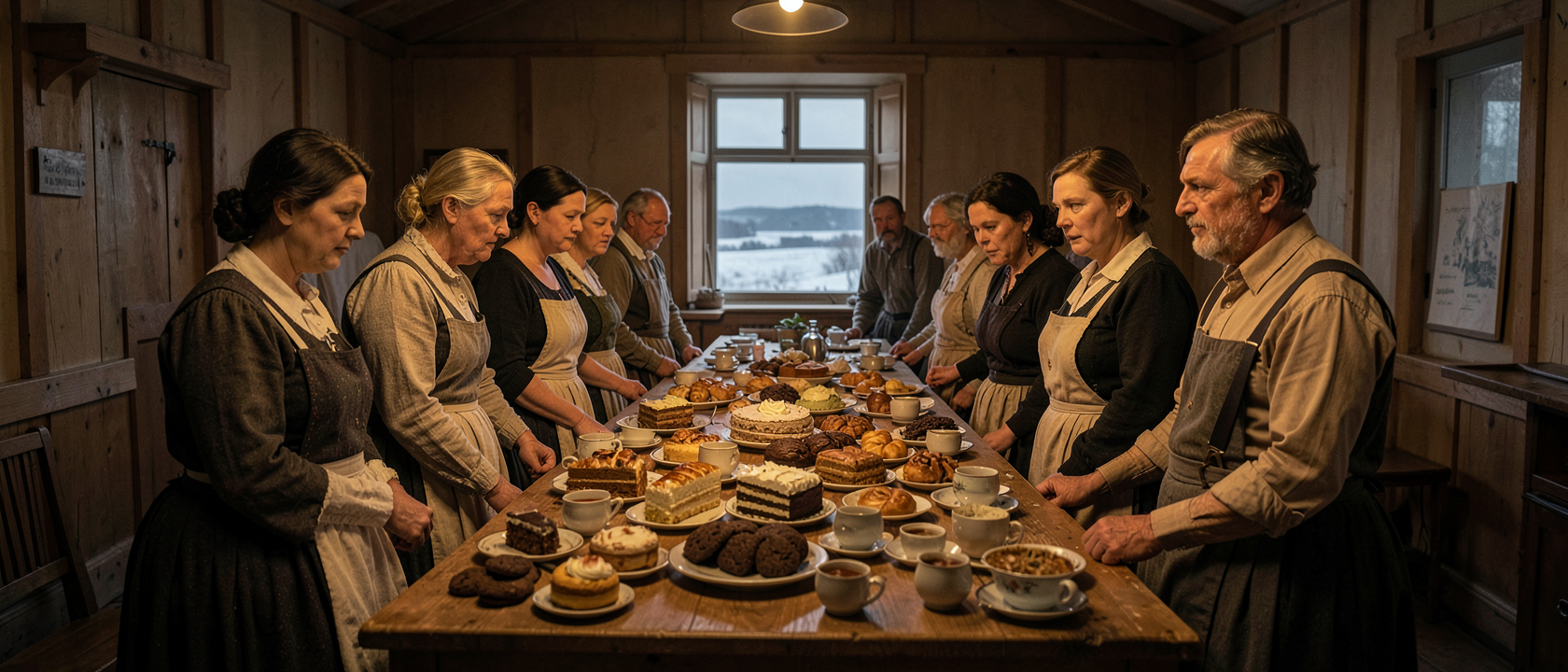
A community hall in North Schleswig, the name Prussian administrators used for the district after 1864, hosted gatherings like this one. Danes there called it Southern Jutland, the name the region has carried officially since 1920. Coffee is poured, but the coffee is not really the point. The table is: rows of cookies and cakes, enough of each kind that a guest could count them, more than the room could finish in one sitting. Between servings come Danish songs and short speeches. On paper it is a social afternoon. In practice it is a meeting that cannot be called a meeting.
A Law That Left No Room for Song
The Second Schleswig War ran from February 1 to October 30, 1864, Denmark against the allied forces of Prussia and Austria. Denmark lost, and the Treaty of Vienna, signed on the last day of the war, forced it to hand over the duchies of Schleswig and Holstein. The Danish monarchy gave up an estimated 40 percent of its land and about a million people, among them the Danish-speaking population of North Schleswig. A further war between Austria and Prussia in 1866 settled full administrative control of the district on Prussia alone.
Local Danes kept meeting the way they always had, filling village halls to sing Danish songs and hear lectures on Danish history. Under Danish rule these gatherings had needed no one’s permission. Under Prussian rule the meetings themselves were tolerated, but the German administration would not license alcohol on the premises, and Danish village halls in particular were refused liquor licenses. A gathering with beer or spirits on the table was now a licensing violation, one the state could act on without ever having to call it political.
Seven and Seven
The workaround was to take the alcohol off the table and put coffee there instead. Every guest brought a cake, and together they built what became known as the kaffebord, the coffee table. It worked the way a British teatime works, where the tea is almost beside the point and the food carries the occasion. Here the food carried something more specific: a full table was said to require seven kinds of hard baked goods, cookies and the like, and seven kinds of soft ones, cakes and sweet rolls, turning an ordinary visit into an event with its own standard to meet. In Danish, the word for cake covers any sweet baked good, not only the layered kind, which made the seven-and-seven rule harder to satisfy than it sounds in English.
The custom took hold hardest on self-sufficient farms, where eggs, sugar, flour, and cream were on hand and daily life otherwise meant long labor and plain meals. A kaffebord for a wedding or holiday was expected to be generous enough to feed twice the guests actually present, with what was left over sent home with people or offered to new arrivals over the following days.
What the Law Enforced, and What It Didn’t
Much of this is not pinned down. No record fixes when hosts began holding each other to the seven-and-seven standard, how far beyond North Schleswig it traveled, or how consistently Prussian officials enforced the liquor ban rather than looking past it. The historian Inge Adriansen examined the coffee table’s connection to Danish national politics in a 1998 study, the source usually cited for linking cake tables to quiet resistance, though her specific findings on how widespread or how strictly enforced the practice was are not laid out in the accounts available here.
There is also a real dispute over how much of the story is later polish. Research from Denmark’s Royal Library notes that heavy coffee spreads with many kinds of cake were common on both sides of the border, among Germans as well as Danes, and across Jutland generally, not only in the North Schleswig districts under Prussian rule. By that account, the idea of the kaffebord as a distinctly Danish act of resistance grew largest in Danish newspapers after 1920, once reunification made the story safe and useful to tell.
1920
The Allied powers put the border to a vote. On February 10, 1920, Northern Schleswig chose Denmark, 75 percent to 25 percent. Central Schleswig went the other way five weeks later, voting 80 percent for Germany against 20 percent for Denmark. Northern Schleswig was formally reunited with Denmark on June 15, 1920, though the Allies held sovereignty a little longer before handing it over on July 5, backdated to the June date. King Christian X signed the legislation bringing the district, now officially Southern Jutland again, into the Danish kingdom. The main reunification festival was held on the plateau at Dybbøl Banke, the site of a major battle in the same war that had put the region under German rule fifty-six years earlier.
With reunification, the licensing law that had made a Danish meeting risky no longer applied. Danes in the reunited district could sing, speak, and organize openly, with or without alcohol on the table.
What Was Left on the Table
The record is split here, and it is worth holding both sides rather than picking a winner. One account holds that the coffee table tradition largely died out once its political reason for existing disappeared after 1920. Another holds that the special serving style persisted in private homes well into the twentieth century, and that it saw a second life during the German occupation of Denmark from 1940 to 1945, when public meetings were again illegal and a coffee table, once more, was not. Either way, the practice as a cover for political gathering had no further use once the border question was settled.
What is left now is smaller: a handful of restaurants in the region still lay out the seven-and-seven spread, kept as a regional dish rather than a legal loophole. No count exists of how many keep the full format, or how closely. What survives is the table itself, emptied of the reason it was once built that large.