
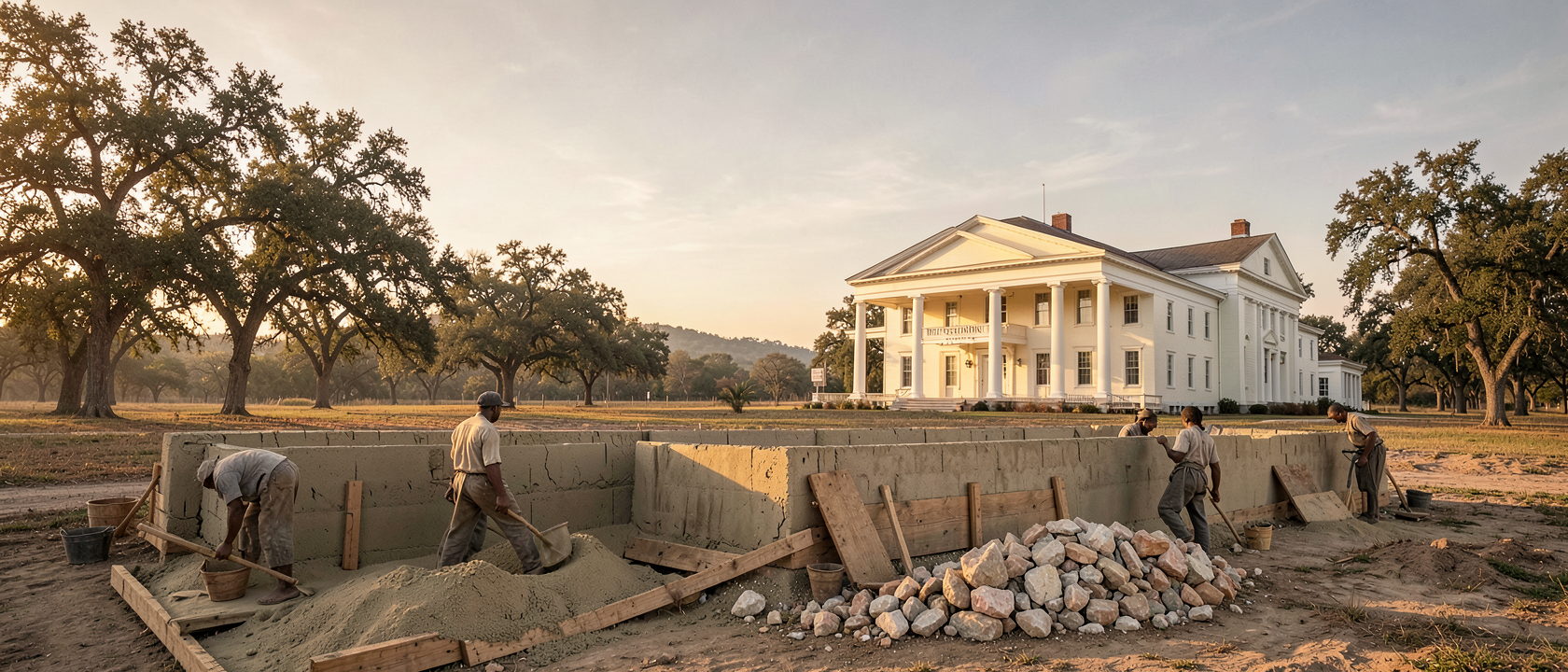
In Seguin, Texas, a house at 704 Zorn Street is built from a material almost nobody else in the area was using at the time. It gave the town a nickname, carries a labor history that was never fully written down, and now holds a museum run by descendants of people once enslaved nearby. The two histories occupy the same rooms.
The Mix
Between 1854 and 1856, Joshua W. Young raised the house in Seguin, Texas, for his sister, Catherine LeGette. Most buildings around Guadalupe County were wood-framed or built of brick at the time; this one was poured, layer by layer, out of limecrete, a mix of local caliche, sand, lime burned from nearby limestone, and gravel, bound with straw or horsehair. Workers built wooden forms, filled them with the wet mix, let each layer harden, then raised the forms and poured again, a method now called slip form casting. Young named the finished house Sebastopol, after a Russian naval base under siege in the Crimean War, according to local tradition.
The people who mixed the limecrete and poured it are not named anywhere in the record. What survives is a description of the work itself: skilled, forced labor, applied to a building method almost nobody in the area had tried before.
A Building That Could Have Failed
Limecrete was untested in that stretch of Texas. Nobody could say how the walls would hold up against years of heat, rain, and settling ground, and each layer depended on the one poured beneath it. A bad batch, or a weak bond between pours, would be locked into the wall with no way to fix it later. The appeal was practical: it could be made largely from what was already on the property, lime from local stone, gravel and caliche dug on site. If the walls held, the method had a future in Seguin. If they didn’t, someone had spent labor and material on a house that might not last. Nobody working on Sebastopol in the 1850s was building toward a town nickname. They were building a house that needed to still be standing the next year.
City of Concrete
The walls held. In the years that followed, Seguin filled out with more limecrete buildings using the same method: local material poured in place of fired brick or milled wood. Later surveys put the number of limecrete structures in town, at their peak, at more than 100. Seguin took on a nickname because of it, the Concrete City, sometimes given as the City of Concrete. No date survives for when the name caught on. What can be said is what happened after: most of those buildings did not survive into the twentieth century. Only two of them are still standing, and Sebastopol is one.
No Names, No Numbers
Everyone else connected to Sebastopol’s early history comes with a name and a date. Joshua W. Young built it for Catherine LeGette between 1854 and 1856; Joseph Zorn Jr., later Seguin’s mayor from 1890 to 1910, bought the property in 1874. The people who mixed the limecrete and poured it are described in the site’s own records only as skilled slaves, with no names, no count of how many worked there, and no account of what became of them once the house was finished. That absence is not something this piece is filling in. It is part of what the record says, as plainly as the walls themselves.
The Wilsons’ Pottery
A few miles away, in the community of Capote, a different history was taking shape, and it starts with the same word. From 1860 to 1866, Rev. John McKamey Wilson ran a pottery there worked by men he held enslaved, among them Hiram, James, and Wallace Wilson, who had reached Texas as enslaved men around 1856. After emancipation, Hiram, James, and Wallace took the Wilson name. Together with two more former Wilson slaves, George and Andrew, they opened a pottery of their own, H. Wilson & Co., running from about 1869 until Hiram’s death in 1884. It is thought to be the first Black-owned business in Texas. Aided by the missionary Rev. Leonard Isley, Hiram also bought land for the settlement of Capote, setting aside 10 acres for a church, school, and cemetery.
One Roof, Two Histories
Descendants of Hiram and James Wilson incorporated the Wilson Pottery Foundation in 1999 to preserve that history. In 2013, the Foundation opened the Wilson Pottery Museum inside Sebastopol House itself, at 704 Zorn Street, the same building raised by enslaved labor more than a century and a half before. The record does not explain why that particular house became home to that particular collection, only that it did. A structure built without consent, by people never named, now displays the pots made by men who had once been enslaved themselves and who built something of their own once they were free.
What the Walls Hold Now
When Atlas Obscura profiled Sebastopol House on July 13, 2022, as part of a series on outsized Texas stories, the building was already doing both jobs at once. “Hiram was more than just a potter,” Robert Gray, a site guide at Sebastopol House, has said of the man whose work now sits inside it. “He was an industrialist. He used salt glaze to turn out a great deal of pots at a time.”
The house does not settle the two histories into a single lesson. It holds them in the same rooms: forced labor that left no names behind, and a family business that turned its own name into something worth remembering.