
—
**HEADLINE:**
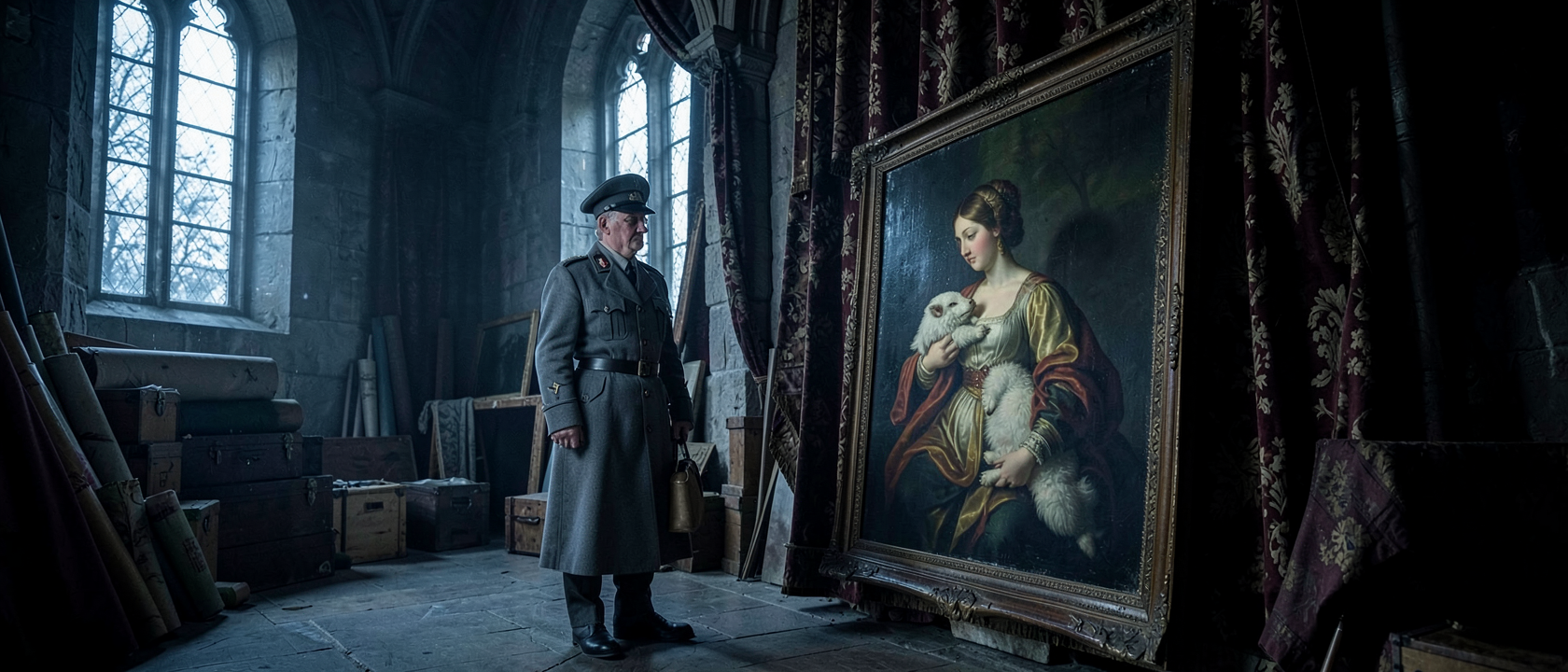
Lady with an Ermine hung in Hans Frank’s Wawel office after 1939
**ARTICLE:**
A Court Commission in Milan
Sometime between 1489 and 1491, in Milan, Leonardo da Vinci painted a young woman holding a white ermine. He was working at the time as court painter to Ludovico Sforza, known as “Il Moro,” Duke of Milan, and the sitter is generally identified as Cecilia Gallerani, the duke’s mistress. Leonardo worked the panel from a single piece of walnut, a wood he favored though other painters in the region rarely used it. It is one of only four portraits of women that survive by his hand, alongside Ginevra de’ Benci, La Belle Ferronnière, and the Mona Lisa.
The painting eventually entered the collection of the Czartoryski family. After the November Uprising of 1830–31, when Russian troops moved against Warsaw, Princess Izabela Czartoryska sent it to Paris for safekeeping, where it hung in the family’s Hôtel Lambert. It returned to Poland in 1876 and went on display in the newly opened Czartoryski Museum in Kraków. By the twentieth century it was, and remained, the only painting by Leonardo da Vinci on Polish soil.
Hiding the Ermine
In September 1939, as German forces crossed into Poland, the Czartoryski family moved much of its art collection out of Kraków. The Leonardo went with other major pieces, including a Raphael, to country estates, among them Sieniawa. The plan was to keep the paintings out of reach before anyone could catalog and claim them. It did not work. The Gestapo tracked down the hidden collection and set aside 85 works, the Leonardo among them, for a museum Adolf Hitler intended to build in Linz.
Into Frank’s Hands
The Leonardo never reached Linz. It passed instead into the personal possession of Hans Frank, the German lawyer Hitler had made Governor-General of occupied Poland after the invasion, and who had previously served as Hitler’s own attorney. Frank favored this painting over the rest of what had been seized and ordered it hung in his office at Wawel Castle in Kraków, which the German administration called Krakau, the seat of his government. It stayed there for about a year. The record does not say exactly when it arrived on his wall or how the transfer from Nazi custody to Frank’s private office was arranged. What is certain is that for roughly twelve months, a portrait painted for a Renaissance court hung above the desk of an occupying governor.
The Administration Next Door
In that same building, Frank ran the government that made him one of the most infamous officials of the German occupation. As Governor-General he presided over the forced confinement of Poland’s Jewish population into ghettos, the conscription of Polish workers for labor in Germany, and four extermination camps that fell under his jurisdiction. By 1942, more than 85 percent of Poland’s Jewish population, an estimated figure, had been transported to those camps. Historians put the number of people killed under Frank’s authority at over 4 million, itself an estimate given how much documentation the war destroyed. None of that happened because a painting hung nearby. But it happened in the same room, at the same desk, during the same months the Leonardo was there.
Frank’s Reckoning
American troops found Frank in May 1945 at a lakeside villa in Bavaria. Accounts differ on whether he had first moved the painting to a villa in Silesia before it reached him there, but by the time Allied soldiers arrived, it was among the small number of looted works still in his possession. On October 18, 1945, he was indicted, one of 24 senior German officials named in the first charges brought by the International Military Tribunal at Nuremberg. The trial lasted eleven months, during which Frank converted to Catholicism. On October 1, 1946, the tribunal convicted him of war crimes and crimes against humanity and sentenced him to death. He was hanged at Nuremberg prison on October 16, 1946, fifteen days later, at the age of 46.
Recovery and a Postwar Circuit
The painting outlived him. American forces recovered it among the looted works at Frank’s Bavarian residence, and by most accounts it was cataloged through the Allied program known informally as the Monuments Men, set up to trace and return stolen art. What happened next is harder to pin down. One account has the painting passing through the Soviet Union, the United States, Sweden, and Italy before it reached Poland again, though no source gives a clear date or order for that route. Not everything taken alongside it made it back. A portrait attributed to Raphael, seized from the same collection in 1939, was, by most accounts, never recovered.
The Czartoryski Museum, Kraków
The painting now hangs in the Czartoryski Museum in Kraków, a short walk from Wawel Castle. The office where it once hung above Hans Frank’s desk is part of a castle now open to visitors as a historical site. The painting itself is on permanent public display, a few streets from where it spent a year as the property of a man later convicted of crimes against humanity.