A Letter From Madagascar, March 1894
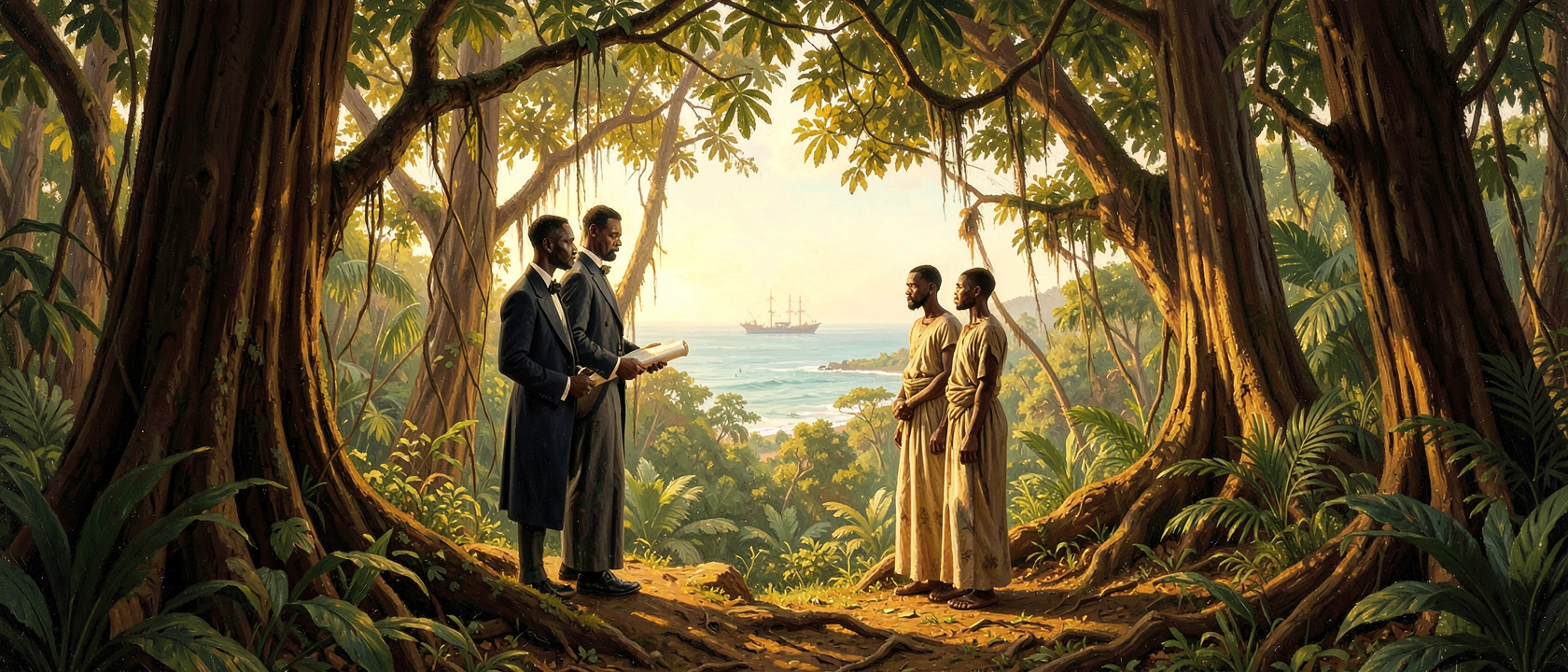
In March 1894, John Lewis Waller wrote to John Mercer Langston with news worth putting on paper. Langston was a veteran Black statesman and diplomat, one of the most senior Black political figures in the United States at the time, and Waller had reason to want him informed. Queen Ranavalona III of Madagascar, Waller reported, had signed off on a lease giving him control of nearly 225 square miles (about 583 square kilometers) of land on the island’s southern end, roughly the size of a small American county.
Waller was not a newcomer to Madagascar. Born into slavery in New Madrid County, Missouri, in 1850, he was freed with his family after the Civil War and raised on a farm in Tama County, Iowa. Admitted to the Iowa bar in 1877, he was named United States consul at Tamatave (Toamasina) in 1891 by President Benjamin Harrison, and he used the post to back Queen Ranavalona III against French pressure. When Grover Cleveland took office and replaced him with Edward Telfair Wetter, Waller stayed in Madagascar anyway. Three years after his appointment, the queen granted him the concession he now described to Langston.
What Waller Saw in the Land
Waller had worked out, at least on paper, what nearly 225 square miles could hold. In his letter to Langston he described land “covered with valuable rubber, the finest of timbers, plenty water and grass for grazing purposes.” He also suspected there was more underground: gold, silver, lead, iron and copper, though this was his own speculation, not anything he had proven.
His plan was to work the concession with laborers brought from the neighboring island of Mauritius, using the rubber, timber and grazing land as the base of something larger. He wanted African Americans to settle there too, on ground he had personally secured from a reigning monarch, in a place he called “Wallerland.” For a man born enslaved in Missouri who had built a legal and diplomatic career from nothing, a concession this size, carrying his own name, marked a considerable ambition.
A Continent Being Divided
Waller’s concession did not exist in isolation. By the 1890s, European governments were dividing Africa and the islands around it into colonies and protectorates, a process later called the Scramble for Africa. Madagascar, ruled for decades by the Merina monarchy, was one of the last sizable independent territories left on the continent’s doorstep, and France had been pressing its claim to the island for years before Waller arrived. Historians differ on what drove French policy there, naval strategy, commercial interest or plain prestige, but by 1894 the pressure on Queen Ranavalona III’s government was steady, and it came from one direction.
Waller had spent his consulship helping the queen resist that pressure. The lease he received in March 1894 looked, on its face, like an ordinary commercial arrangement between a monarch and a private citizen. It was signed, however, in a kingdom France had already marked as its own.
Collision
The concession did not go unnoticed. In a sworn statement later given to the U.S. State Department, the French resident in Madagascar was said to have called on the Malagasy prime minister the day after the lease was signed, protesting that the grant to Waller worked against French interests. That protest was only the start. At some point in 1895, French authorities arrested Waller, accusing him of passing military information to the Malagasy government. He was tried, though sources disagree on whether the proceeding was a colonial court or a military tribunal, and he was sentenced to twenty years’ imprisonment. His son was expelled from Madagascar as well and sent to France.
What turned a land dispute into an espionage charge is not spelled out in the surviving record. State Department dispatches note only that French officers said they had found “compromising papers” in Waller’s possession. Whether those papers were what the French claimed is not something the available documents settle.
The Bill Left Unwritten
Waller was sent to France and imprisoned at Marseille. He does not appear to have served the full twenty years: President Grover Cleveland intervened, threatening to sever diplomatic relations between the United States and France, and secured his release, an outcome BlackPast dates to 1895. Past that point the record thins fast. No source puts a figure on what Waller spent building or defending the concession, or on what, if anything, he recovered. There is no account of a single Mauritian laborer or African American settler ever reaching “Wallerland.” What became of the concession itself, whether France voided it or it simply lapsed, is not stated anywhere in the sources available.
Some family history survived where the business history did not. In 1895, Waller’s daughter Jennie married Henri Razafinkarefo, a nephew of the queen. The Second Franco-Hova War, fought in the same period, ended with the queen deposed and several members of the royal family killed, Waller’s young son-in-law among them. Waller himself died in 1907; no source gives the exact date.
Why an Unfinished Story Still Counts
Nothing in the record says what became of Wallerland after 1895. That is not a gap in the research so much as a fact about the period: colonial land ventures by private individuals, especially by African Americans working outside official channels, rarely generated paperwork that survives. Waller had a former consul’s connections, a queen’s signature, and a plan detailed enough to name specific timber and minerals, and none of it was enough to hold ground that a European power had already decided belonged to it.
What the silence shows is not that Waller’s ambition was unusual for its size. It is that ambitions this size, coming from Black Americans in this period, often left behind only a fragment, a letter, a court record, a name on a lease, before the trail runs out. In this case, one fragment kept going. Jennie Waller and Henri Razafinkarefo’s son was born after the family returned to the United States as the war closed in on Madagascar. He grew up to become Andy Razaf, a poet, composer and lyricist, and an editor at Negro World. Wallerland left no settlers and no maps behind. It left a grandson.