
Fire Across the Water
In 1073, smoke rose over Chrysopolis, a town on the Asian shore of the Bosporus, the strait that separates Europe from Asia. The site is now part of Üsküdar, a district of modern Istanbul, but in the eleventh century it sat directly opposite Constantinople, close enough that residents of the Byzantine capital could watch the fire from their own walls.
The natural assumption was that Turkic raiders had broken through. Turkic forces had been active across Byzantine Asia Minor for years, and a raid reaching the edge of the capital would have fit a pattern already underway. It was the wrong explanation. The man leading the force that burned Chrysopolis was Roussel de Bailleul, a Norman commander who had spent years in Byzantine pay, serving the same empire he was now attacking.
The Normans Byzantium Hired
Roussel was not an unusual hire. By the mid-eleventh century, Norman soldiers had a reputation across the Mediterranean as effective, well-equipped heavy cavalry, and Byzantium paid for that skill alongside soldiers of other backgrounds, including the emperor’s own Varangian Guard. Raising native troops for every campaign was slow and uncertain; buying trained outsiders was the empire’s regular solution, not a last resort.
Born in Bailleul, near Argentan in southern Normandy, Roussel first appears in the record in 1063, fighting in Sicily under Roger de Hauteville (one account instead places this campaign in 1069). He later entered Byzantine service and worked his way up its command structure. When a rival Norman officer, Robert Crispin, died suddenly and mysteriously in 1073, Roussel became the undisputed leader of the Normans fighting for the empire, proof of how far a hired soldier could climb inside the system that paid him.
Asia Minor Already Slipping
The decade before Chrysopolis burned had already gone badly for Byzantium in Asia Minor. In 1071, Emperor Romanos IV Diogenes led an army east to recover ground the empire had already lost to Turkic forces, and suffered a major defeat at the Battle of Manzikert. Roussel’s own contingent, 500 Franks and Normans riding within that larger army, escaped the rout, but the defeat left Byzantine authority over the region more exposed than before. By 1073, imperial troops were still fighting Seljuk raiders farther into the interior, in Cappadocia.
This was not peripheral territory. Asia Minor supplied much of the empire’s tax income and most of its soldiers. Constantinople’s margin for another setback was already thin, especially one that came from its own hired ranks rather than from an outside enemy.
Roussel Turns
That campaign against the Seljuk raiders in Cappadocia, in the spring of 1073, was handed to Roussel. Emperor Michael VII, who had succeeded Romanos IV, sent him east with his Norman and French cavalry to push the raiders back. Roussel pushed them back, then kept the territory for himself, setting up an independent Norman holding near Ancyra (modern Ankara) and answering to no one in Constantinople.
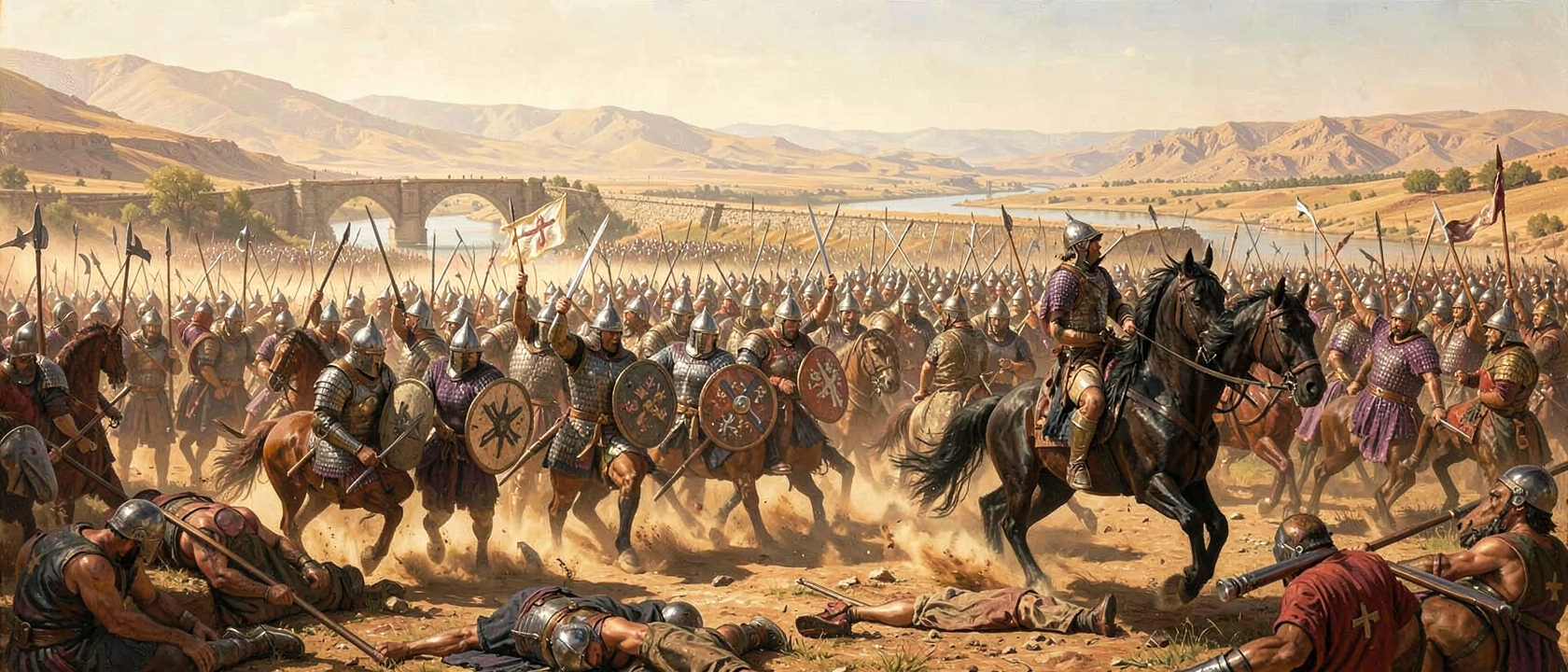
Later that year he led roughly 3,000 Franco-Norman cavalry west across Bithynia, a province of northwestern Asia Minor, until he reached the shore of the Bosporus facing the capital. There his men burned Chrysopolis. For anyone watching from Constantinople, the fire closed off the easy explanation. This was not a Turkic raiding party that had pushed unusually far. It was a Norman force that the empire itself had trained, armed, and paid, now acting entirely on its own terms.
What the Fire Actually Cost
No surviving account gives a casualty figure or a property total for what burned at Chrysopolis. The material cost was not recorded, or was never large enough to record. What the episode did leave behind was a different kind of damage, the kind that does not show up in a ledger: the realization, inside a capital that could see the smoke from its own walls, that paying for an army was not the same as controlling it. A policy built up over decades, hiring Normans, Varangians, and other outsiders to guard the empire’s frontiers, had just shown what happened when one of those hired forces stopped taking orders.
What the Sources Don’t Say
The record here has real gaps. Roussel’s reasons for turning on the empire that had promoted him are not stated; the sources describe what he did, not why he chose to do it. Some retellings also compress the timeline, placing the Chrysopolis fire itself in 1074. In fact the town burned in 1073; it was only in the months that followed, after Roussel’s cavalry routed a much larger Byzantine army at the Battle of Zompos Bridge, that his Normans put forward their own candidate for the imperial throne, in the spring of 1074.
What became of Roussel afterward survives only in outline. Seljuk Turks allied with Michael VII eventually captured him; his wife raised the ransom that won his release, and he returned to Amaseia (modern Amasya). He briefly submitted to the Byzantine general Alexios Komnenos, the future emperor, but was operating independently again by 1076 and kept working as a mercenary commander until his death, dated by different sources to either 1077 or 1078, at Herakleia Perinthos. How Byzantine authorities worked to restore order after Chrysopolis is not detailed at all.
One point is not in doubt. An empire that had come to depend on hired loyalty could not be certain which direction that loyalty would face in a crisis. In 1073, for a few hours, it faced the capital itself.