
Roger of Salerno, born around 1100 in Salerno, was a Norman crusader who governed the Principality of Antioch as regent from 1112 until his death on 28 June 1119. A military leader and governor by occupation, he operated across the Duchy of Apulia and Calabria and the Principality of Antioch. His reign ended at the Battle of Ager Sanguinis near Sarmada, where his refusal to await reinforcements cost him his life, the destruction of his army, and the loss of Antioch’s relic of the True Cross.
Key facts
- Born: 1100
- Birthplace: Salerno
- Died: 28 June 1119
- Place of death: Sarmada
- Country: Duchy of Apulia and Calabria; Principality of Antioch
- Occupation: military leader; governor; regent
Regency and governance
Roger held power in Antioch from 1112 to 1119, a span of just under seven years. During that period he governed as regent rather than as a sovereign prince in his own right, steering the principality through the volatile politics of the early Latin settlements in the region.
His sister Maria’s marriage to Joscelin I of Edessa contributed to easing a long-running territorial dispute between Antioch and Edessa, a conflict that had strained relations between the two crusader states since the time of Tancred. The dynastic connection reduced one source of friction on Antioch’s northern frontier.
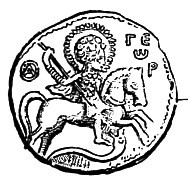
Roger’s administration also extended to coinage. Between 1112 and 1119 he issued three distinct types of copper follis at Antioch, each carrying a different religious image: Christ Pantokrator, the Virgin Mary Orans, and Saint George slaying the dragon. The use of copper reflected the continuing influence of Byzantine monetary practice on the principality’s economy.
The Battle of Ager Sanguinis, 1119
In 1119, Ilghazi mounted a major offensive against the principality. Bernard of Valence, the Latin Patriarch of Antioch, urged Roger to hold his position and wait for King Baldwin II of Jerusalem to arrive with reinforcements. Roger rejected that counsel and advanced alone against Ilghazi’s forces.
The encounter, fought at a site later called Ager Sanguinis (Field of Blood) near Sarmada, ended in the destruction of the Antiochene army. Roger was killed in the battle on 28 June 1119. The principality’s relic of the True Cross, carried into the engagement, was also lost. The bulk of the Antiochene forces were either killed or taken into captivity.
The elimination of Roger and the near-total loss of the northern Frankish field army produced a political vacuum in the principality that placed the entire Latin political structure of northern Syria in jeopardy.
Coinage
Roger’s coins are among the more distinctive numismatic products of the early crusader states. Despite being a Norman French ruler, he issued coins with legends written in Greek, because Byzantine monetary conventions continued to govern Antiochene coinage in the early twelfth century.
On the reverse of his first coin type, the inscription reads ‘DNE SAL FT RO’, an abbreviation of the Latin phrase ‘Domine Salvum Fac Tuum Rogerium’, which translates as ‘Lord, save your Roger’. The phrase gives his copper follis an unusually personal character among crusader-era coins.
Primary sources
The most detailed contemporary account of Roger’s tenure comes from the Bella Antiochena, written by Walter the Chancellor, whose work is regarded as a valuable eyewitness account of Antiochene affairs. The work covers Roger’s campaigns in detail, including the Battle of Tell Danith in 1115, and is regarded as a key source for the principality during the early period of Latin settlement. Walter’s account is valued precisely because it records events from inside the Antiochene court.
Did you know
- Although Roger ruled Antioch for less than seven years (1112–1119), he had two or three distinct types of coin minted in his name, an unusual numismatic output for a reign of that length. (wiki2.org)
- Roger’s coins carried Greek-language legends even though he was a Norman French ruler. Byzantine monetary conventions still governed the coinage of Antioch in the early twelfth century, and his mints followed that tradition. (augustuscoins.com)
- The reverse inscription on his first coin type reads ‘DNE SAL FT RO’, short for the Latin ‘Domine Salvum Fac Tuum Rogerium’, meaning ‘Lord, save your Roger’. (augustuscoins.com)
- His sister Maria’s marriage to Joscelin I of Edessa helped settle a long-running territorial dispute between Antioch and Edessa, a conflict that had persisted between the two crusader states since the time of Tancred. (worldhistoryedu.com)
Data sources
- Wikidata
- history-reads.blogspot.com
- cambridge.org
- augustuscoins.com
- wiki2.org
- cristoraul.org
- dokumen.pub
Data updated: 2026-10-28