
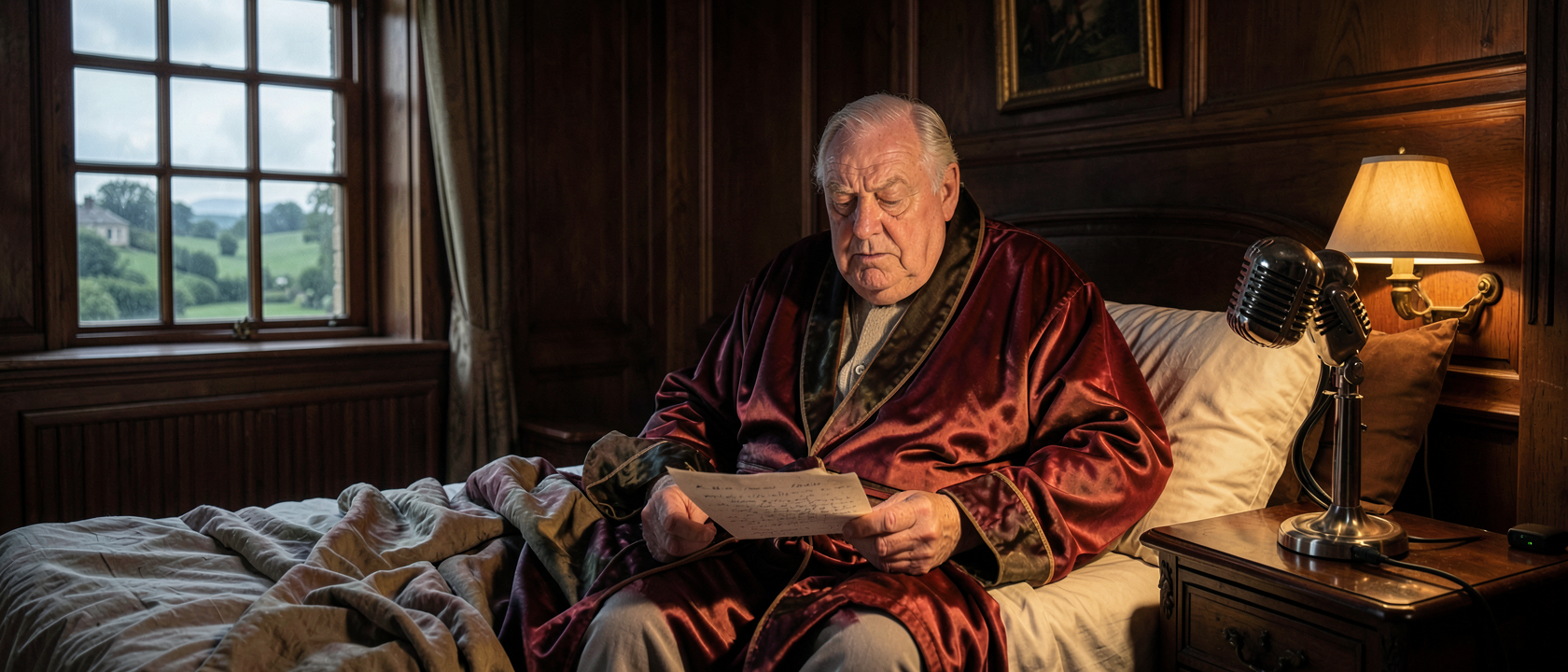
Winston Churchill built his wartime reputation on speeches most people have never actually heard him deliver live. The recording that plays on television every anniversary, the one promising that Britain will fight on the beaches and never surrender, was not made in the middle of the crisis it describes. Churchill made it years later, out of office, reading his own words back into a microphone as a kind of second performance.
The Microphone in the Bedroom
The year was 1949. Churchill was at Chartwell, his country home, with a microphone set up in front of him at the insistence of Decca Records, the British label chasing speeches it had never managed to capture the first time around. By one account he worked from bed, propped against the pillows. That detail comes from a single telling of the morning and has not turned up elsewhere, but the larger fact holds up: this was a private re-recording arranged after the war was already won, not a broadcast carried live to a waiting country.
This also closes off an old rumor that an actor, Norman Shelley, secretly voiced some of Churchill’s wartime broadcasts for the BBC. Shelley did stand in a handful of times when Churchill was unwell or traveling, but researchers agree he was not behind “Fight on the Beaches.” Churchill’s private secretary, Sir John Colville, said he would have known if someone else had delivered the speech, because he was there. The voice on the Chartwell recording is Churchill’s own, just captured nine years later than most listeners assume.
That gap is the point. Aside from the members who sat in the House of Commons in 1940, most Britons and Americans did not hear Churchill speak those words in his own voice until Decca finally released the recordings, in 1964. For fifteen years, the label simply sat on them.
What the Words Had Once Cost
Nine years before that microphone was set up at Chartwell, in the spring and summer of 1940, the same words carried a different weight. British troops were being lifted off the beaches at Dunkirk while the French Army collapsed around them, and German forces were gathering in Channel ports for an invasion that looked, to most people watching, entirely plausible. On June 4, 1940, Churchill stood in the House of Commons and delivered the speech later known as “We Shall Fight on the Beaches.” Nobody in that chamber, Churchill included, knew yet how the war would end. The line about fighting on the landing grounds and never surrendering was not a flourish added for effect. It was the only plan left if Britain ended up fighting alone.
Two Speeches, One Session
At Chartwell, Churchill moved from one speech to the next as if turning a page. He read the Dunkirk and invasion material first, then went straight into a shorter speech, only a few minutes long, about being summoned to form a new government. That speech dated to May 1940, and in it he recalled the call to take office as coming “on Friday evening last.” The two speeches had been delivered weeks apart, under different circumstances, to different audiences. Spliced into one recording session nine years later, they ended up as separate tracks on the same release: Decca’s 1964 box set, “Winston S. Churchill: His Memoirs and His Speeches,” a twelve-LP collection that filed “Fall of the Government” and “Prime Minister” alongside “Fight on the Beaches” and “Dunkirk Evacuation,” each one numbered and catalogued like any other record in a shop.
No Invoice Survives
What Decca paid Churchill for the sessions, or whether one fee covered the lot, does not appear in the sources available. What is documented is that Decca pushed him to go back and record speeches it had never captured live, then did not release the results until 1964. One account of that morning frames his purpose as double: managing how the war would be remembered, and earning money from telling it. That reading cannot be checked against a contract or a receipt. No figure for what Churchill earned from the sessions has surfaced, and none should be invented here.
What the Record Doesn’t Say
Even the date of that morning at Chartwell is fixed no closer than the year, 1949. Whether Churchill worked through his back catalogue of unrecorded wartime speeches in one sitting, or returned to the microphone across several, is not stated anywhere. Nor is it clear whether Decca meant the results purely as a commercial release, as material for Churchill’s memoirs, or simply as an archive of his voice reading his own words while that was still possible. What can be said plainly is this: a man who had once spoken those words under a real and unresolved threat went back to them in 1949, at his own pace, and the public did not hear the result until 1964, nineteen years after the war that produced them had ended.