
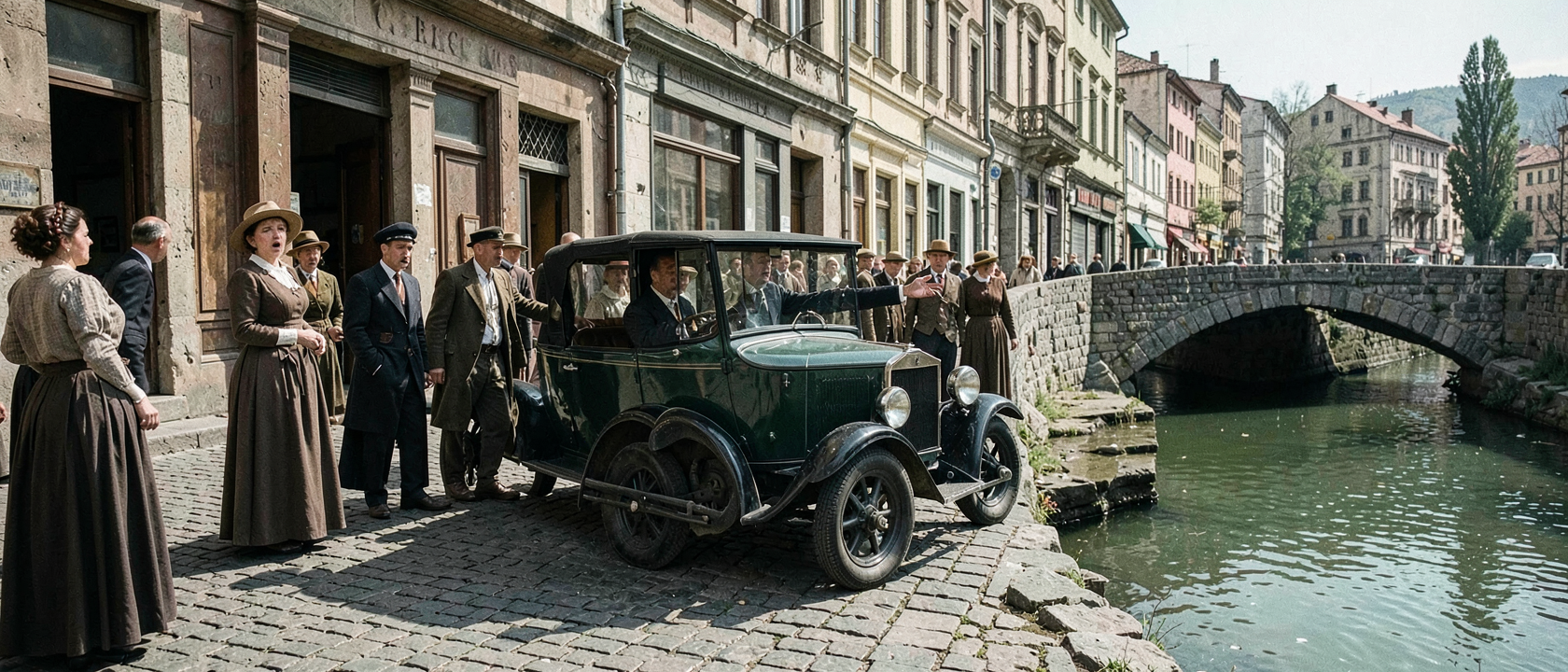
On the morning of June 28, 1914, a stalled car on a Sarajevo street corner turned a regional killing into grounds for a continental war. The documented record is specific and well established. The popular version that followed, including retellings published around the war’s 2014 centenary, is not. A sandwich, a missing reverse gear, a wedding anniversary, a caught grenade: details that were never actually there.
Sarajevo, Sunday Morning
That Sunday, Archduke Franz Ferdinand, heir to the Austro-Hungarian throne, and his wife Sophie, Duchess of Hohenberg, were touring Sarajevo, then part of Austria-Hungary’s Bosnia and Herzegovina. Sophie, born in Stuttgart in 1868, was 46; Franz Ferdinand, born in 1863, was 51. Riding with them was Oskar Potiorek, the province’s military governor.
Earlier that morning, a conspirator threw a grenade at the archduke’s car along the river road. It missed the couple but injured an estimated 16 to 20 bystanders and officers. The bomber was a different conspirator from Gavrilo Princip, a 19-year-old Bosnian Serb student stationed separately along the route, one of several young nationalists opposed to Austro-Hungarian rule and armed for his own chance. The couple was unhurt, and the motorcade went on.
Why a Shot in the Balkans Could Move Berlin
The killing alone did not make a wider war certain. What made it dangerous was the web of commitments already binding Europe’s governments: Austria-Hungary tied to Germany by treaty, Serbia looking to Russia for protection, Russia allied with France, Britain carrying obligations tied to Belgium’s neutrality. A dispute between Vienna and Belgrade had, through those alliances, a route to Berlin, Saint Petersburg, Paris, and London.
Austria-Hungary already suspected Serbia of fueling unrest in Bosnia, and the assassination gave Vienna a reason to act. In early July 1914, Germany assured Austria-Hungary it would back whatever Vienna chose to do about Serbia, an assurance historians call the “blank cheque.” It removed the one restraint that might have kept the dispute regional.
The Decision to Go On
After the grenade attack, Franz Ferdinand had reason to cut the day short, but chose instead to keep to the schedule, including a stop to see the wounded officers.
That choice changed the route: the convoy was now meant to follow the river road straight to the hospital, skipping a planned stop in the old town. The change never reached the driver of the archduke’s car, who took the original route and, at the Latin Bridge, turned off the river road into the old town. Governor Potiorek, riding beside him, shouted that he had gone the wrong way. It was an administrative failure, not a conspiracy: a message that never traveled from one official to one driver.
The Wrong Turn
The driver tried to reverse out of the street. The engine jammed, and the car stalled directly in front of Moritz Schiller’s delicatessen, a building that today houses the Museum of Sarajevo 1878-1918. Princip happened to be standing on that same corner.
He stepped toward the stalled car and fired two shots from the street with an FN Model 1910 pistol, at close range, with no leap onto a running board. One bullet struck Sophie, the other Franz Ferdinand. Sophie died first; the archduke died shortly after.
The Bill: From a Street Corner to a Continent
Austria-Hungary delivered an ultimatum to Serbia on July 23, 1914, with terms written to be hard to accept in full. Serbia agreed to most, not all. On July 28, exactly one month after the shooting outside Schiller’s delicatessen, Austria-Hungary declared war.
The alliances did the rest. Russia mobilized in support of Serbia. Germany mobilized against Russia and, under its existing war plan, moved against France as well. Britain entered after Germany invaded Belgium. By early August 1914, a dispute between Vienna and Belgrade had become a war among the continent’s major powers.
The war that followed is estimated to have killed between 15 million and 20 million people, soldiers and civilians combined, a measure of what a month of diplomacy produced after two shots on a street corner, not of what one gunman intended.
What the Story Added Later
Much of what people believe about that morning is not in the record. Writer Tim Butcher, in a piece for History Today, lists six claims that keep reappearing in retellings, including several published around the 2014 centenary, and calls each one a myth.
Princip did not jump onto a running board; he fired from the street. Sophie was not pregnant: she was 46, and the pregnancy claim traces to a single wartime account that is otherwise unconfirmed. June 28 was not the couple’s wedding anniversary, they had married on July 1, 1900; the date instead carried a different weight as St. Vitus’s Day, the anniversary of the 1389 Battle of Kosovo, already loaded with meaning for Serbian nationalists. The getaway car did have a reverse gear; it simply took time to engage while the engine was jammed and Potiorek was shouting directions. No source confirms that Franz Ferdinand caught the morning’s grenade and threw it aside himself. And Princip did not stop for a sandwich before firing: that detail comes from a historical novel published in 2001 by a Brazilian author, picked up a few years later by a BBC documentary, and repeated since as fact.
Butcher’s piece corrects what didn’t happen; it does not claim to settle every detail of what did, including how the pregnancy story began or who first put the sandwich into the script. Even a well-documented morning like this one picked up invented color along the way.
What isn’t disputed is what happened to the man who fired the shots. Austro-Hungarian authorities arrested Princip at the scene. He was tried with 24 others, all Bosnian subjects of the empire, and sentenced to 20 years, at 19, he was too young under the law for a death sentence. He died in a prison at Theresienstadt, in Bohemia, known today as Terezín in the Czech Republic, on April 28, 1918, of tuberculosis, at 23.