
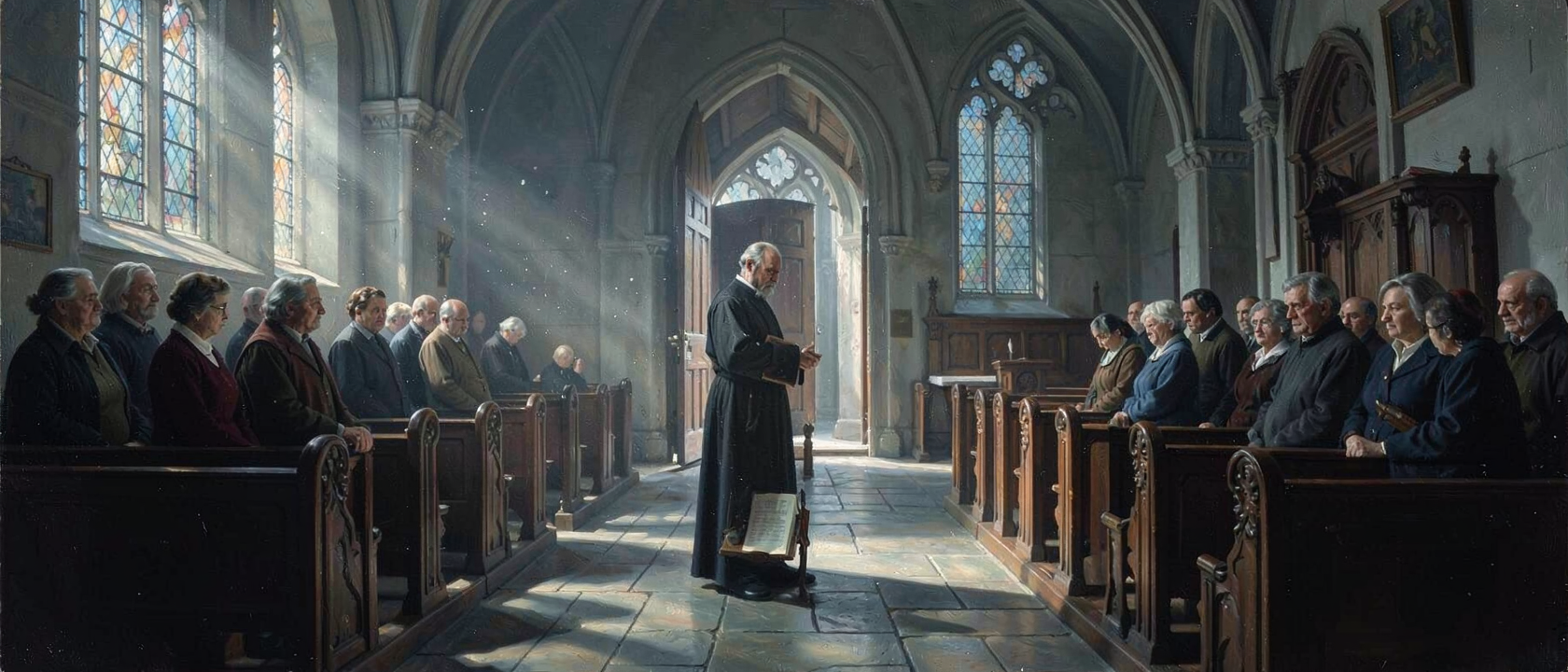
The Printers Deliver, Eighteen Days Too Late
In the summer of 1662, London printers raced a deadline fixed by Parliament: every parish in England and Wales had to adopt a newly revised Book of Common Prayer by August 24, St Bartholomew’s Day. The first printed copies came off the press on August 6, 1662, leaving eighteen days for copies to reach thousands of clergy, be read, and be formally accepted before a magistrate or in open church. In Middlesex, some parishes had not received their copies by the deadline, with delivery reportedly arriving anywhere from a week to a month late. This was, at root, a distribution problem rather than a doctrinal dispute, but it would matter greatly when the law came to count its casualties, since the Act made no allowance for a book that simply had not arrived.
A Promise Made, A Promise Narrowed
Two years earlier, the terms had looked different. On April 4, 1660, shortly before his return to the throne, Charles II issued the Declaration of Breda, promising “liberty to tender consciences” and that no one would be disturbed over religious differences that did not threaten the kingdom’s peace. For clergy who had served through roughly two decades of Commonwealth worship without bishops or the old prayer book, that language suggested room to keep their pulpits under a restored monarchy.
Charles’s first parliament, the Cavalier Parliament convened in 1661, took a narrower view. In May 1662 it passed the Act of Uniformity, receiving royal assent on May 19. The act required every clergyman to accept the revised prayer book and hold episcopal ordination, ordination by a bishop, a requirement reintroduced because the Puritans had abolished it during the Civil War. Refusal meant immediate loss of the living. For many Presbyterian and non-conformist ministers, the objection was not a phrase in the liturgy but the bishops themselves and the whole system of church government they had spent a generation dismantling.
August 24, 1662
When St Bartholomew’s Day arrived, the law did its work without asking why any particular man had failed to subscribe. Clergy who had not formally accepted the prayer book by that date lost their livings, the position, house, and income tied to a parish post. Some had refused on principle, unwilling to accept episcopal authority or the new liturgy. Others appear to have simply run out of time, caught by the same delivery delays recorded in Middlesex, still waiting on a book they had never had the chance to read. The Act drew no distinction between the two: a missing prayer book and a refused one produced the same result.
What It Cost, and What It Didn’t
The Act of Uniformity took something specific and left something else untouched. It cost positions inside the Church of England, the parsonage houses and incomes attached to them, and the right to preach from a particular pulpit. No one was executed under the law, and it confiscated no property beyond the living itself. Yet non-conformists who lived through it gave the day a name that has outlasted the details: Black Bartholomew’s Day, echoing the far bloodier 1572 St Bartholomew’s Day massacre of French Protestants on the same calendar date ninety years earlier. The name stuck not because the two events matched in violence but because losing a living, a house, and a calling on one legally fixed day left a mark that outlived the men it happened to.
Calamy’s List
The first attempt to count that purge came from a man with family history inside it. Edmund Calamy’s father and grandfather had both lost their livings in 1662, and between 1702 and 1713 he published a list naming 1,897 clergy he identified as victims of the Act. This was not disinterested scholarship, Calamy was recovering his own family’s record along with everyone else’s, and his figure settled into non-conformist memory as the scale of what had happened, standing largely unchallenged for nearly a century.
Walker’s Answer
John Walker, a high-church clergyman who objected to Calamy’s picture, spent roughly ten years assembling a rival account, published in 1714. His conclusion ran the opposite direction: only around 50 non-conformists, he argued, had actually lost livings under the Act, and he said he could personally vouch for just one case beyond dispute. The distance between Calamy’s 1,897 and Walker’s roughly 50 is not a rounding error but two opposing accounts of the same event, written from opposite sides of the same religious divide.
Matthews Checks the Arithmetic
The dispute sat unresolved for two centuries until A.G. Matthews, a twentieth-century editor, went back through Calamy’s names one by one. What he found looked less like fraud than sloppy bookkeeping compounded by family loyalty. Forty-seven names belonged to men already dead before the 1662 deadline. Forty-one were duplicates. A further 113 carried no supporting evidence at all. And 695 cases had nothing to do with 1662 at all: clergy removed in 1660, when Royalist ministers reclaimed livings taken from them during the Civil War and Commonwealth period. Calamy had merged an earlier, separate purge into his count of the later one.
936, and Still Not Settled
Once Matthews stripped out the dead, the duplicates, the unverifiable names, and the 1660 cases, he arrived at a corrected figure: 936 clergy specifically ejected under the Act of Uniformity in 1662, a number sitting between Walker’s near-denial and Calamy’s inflated claim, closer to Calamy’s picture of a real purge but far smaller than the figure non-conformists had repeated for generations. It narrows the argument rather than ending it. Why Walker pushed his figure down to almost nothing remains unclear beyond his evident hostility to Calamy’s account, and whether the Middlesex delivery delays were typical of the whole country or a local exception is not something the record settles. Three numbers, 1,897, 936, and 50, still stand side by side, each a different claim about how many men lost their parish on the same August day.