
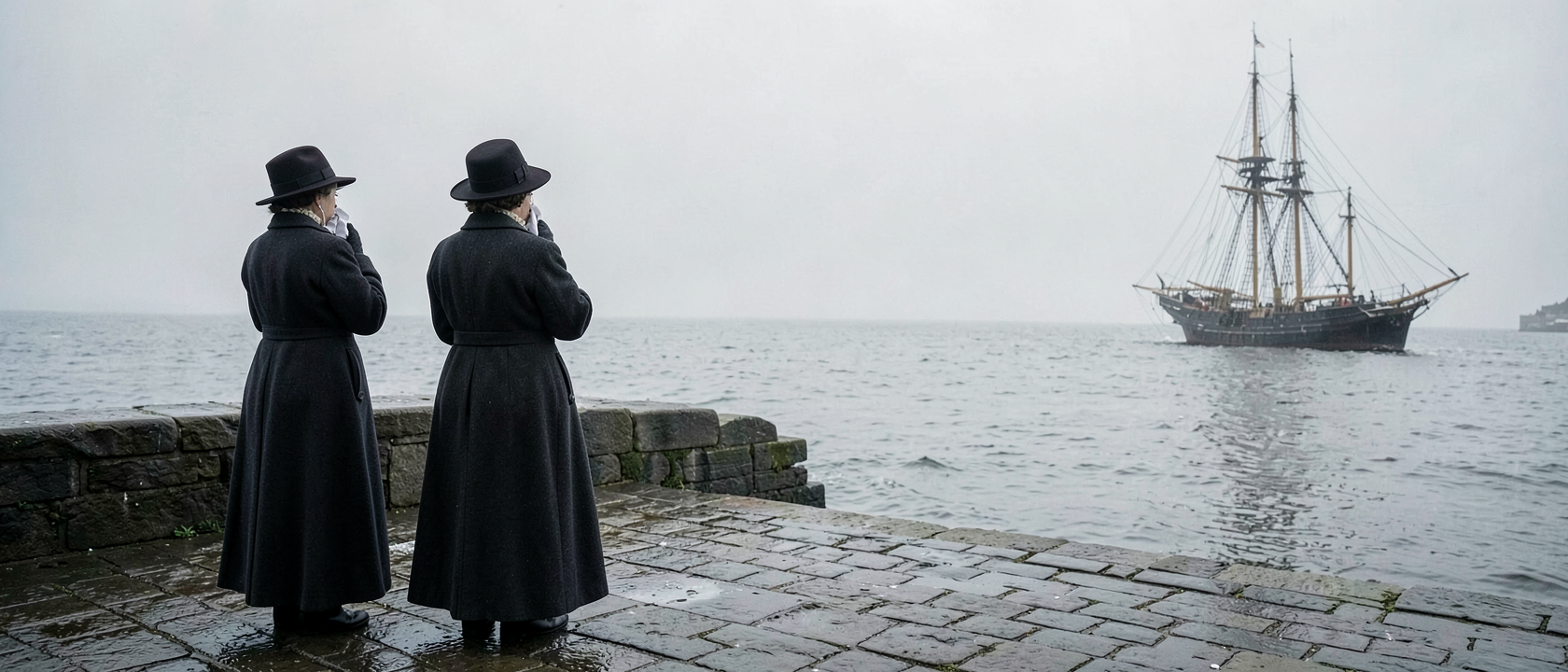
In February 1913, three women in three different places each learned that their husbands had died in Antarctica nearly a year earlier, and none of them heard it the same way. That gap, and what followed for each of them, is the subject of “Widows of the Ice: The Women That Scott’s Antarctic Expedition Left Behind,” a 2022 book by historian Anne Fletcher.
A Meeting in London
Kathleen Bruce met Robert Falcon Scott in October 1907, at a tea party in London, an encounter she recorded in her own diary, later quoted by Fletcher. She was already an established sculptor, trained in Paris under Auguste Rodin. The courtship moved fast: they married in 1908, and Kathleen was pregnant within about four months. Their son, Peter Scott, was born soon after, named for Peter Pan; James Barrie, the play’s author, became his godfather.
None of it reads like the start of a tragedy. It reads like an independent professional woman living an ordinary life, before the label “Scott’s widow” took over her name.
Three Marriages, One Expedition
Kathleen was not the only wife involved. Oriana Wilson had married Edward “Ted” Wilson shortly before Scott’s earlier Discovery Expedition (1901-1904) and reunited with him in New Zealand once it ended. Lois Evans, raised in Swansea, Wales, before moving to the Gower Peninsula, had married her cousin Edgar Evans, a career Navy man who joined the service at age 15. She and Edgar had three children, Norman, Muriel, and Ralph, in quick succession; somewhere in that span Edgar had an affair that produced twins, and the marriage survived it.
The Terra Nova left Cardiff, Wales, on June 15, 1910, carrying Scott, Wilson, and Evans, along with Lawrence “Titus” Oates and Henry Bowers, neither of whom was married. More than a year later, on November 1, 1911, the five men set out from the expedition’s base at Cape Evans for the Pole.
The Pole, and the Return
The party reached the South Pole around January 17 or 18, 1912 (sources differ on the exact day) and found that a Norwegian team led by Amundsen had beaten them there by roughly 34 days. The wider stakes of that race, the national rivalries and competing funding behind it, sit outside what Fletcher’s book covers; her focus is the men’s wives, not the politics of the contest.
The return trek killed all five. Edgar Evans died on February 17, 1912, after a fall near the Beardmore Glacier left him concussed and frostbitten. Oates died on March 17, his own birthday, by walking into a blizzard, an act long described as self-sacrifice. Scott, Wilson, and Bowers died around March 29, in their tent, about 11 miles (18 km) south of a supply point called One Ton Depot and roughly 148 miles (238 km) from base camp. Scott’s last written words read: “For God’s sake look after our people.” The deaths came about three years after Scott and Kathleen’s wedding.
A Year Not Knowing
None of the three women learned any of this for close to a year. The Terra Nova had already reached New Zealand once, on April 1, 1912, with word that Amundsen’s team had won the race to the Pole, but it had sailed before the polar party reached base camp, so no one aboard knew if Scott’s group had survived the return. A search party found the bodies of Scott, Wilson, and Bowers on November 12, 1912. The full account did not reach the wider world until the Terra Nova sailed back to New Zealand again, in early February 1913.
For most of that year, each woman carried on not knowing her husband was already dead. Fletcher treats that stretch of ignorance as its own cost, separate from how the news eventually broke.
Three Different Telegrams
When the news arrived, in February 1913, it reached each woman differently. Oriana Wilson had traveled to New Zealand expecting to meet Ted and learned of his death from a newspaper vendor as she stepped off a train in Christchurch. Kathleen Scott was at sea, on her way to meet her husband, when a ship’s captain told her he was dead, with no further detail about how. Lois Evans was still at home in Wales; by the time an official telegram reached her, reporters had already gathered outside her house, and the story had already broken in print.
A stranger’s remark on a railway platform, a captain’s bare statement at sea, a telegram that arrived last, where each woman happened to be standing shaped how her bad news arrived.
What Came After: Three Afterlives
Public attention did not treat the three widows equally, or at the same pace. Kathleen Scott became a fixture of public mourning, expected, in Fletcher’s reading, to embody grief indefinitely, a role she compares to the one later placed on Jacqueline Kennedy. By one account, Kathleen, who kept working as a sculptor, later made the statue of Scott erected in Christchurch, the same city where Oriana had learned the news; it was toppled in the 2011 earthquakes there and has since been restored to its original site.
Lois Evans’s moment in the press passed quickly. Fletcher reads that as a matter of class: a working-class Welsh widow did not hold public attention the way a celebrated expedition leader’s wife did. Oriana Wilson’s name resurfaced now and then in the decades that followed, but mostly in connection with preserving Ted’s work as the expedition’s chief scientist, rather than with her own loss.
What the Record Doesn’t Say
Fletcher, who read history at Oxford and has worked at heritage sites including Hampton Court Palace and Bletchley Park, is candid about what the record can’t settle. The exact dates of the Wilson and Evans marriages survive only in rough sequence against the two expeditions, not as fixed dates. The identity of the woman Edgar Evans had an affair with, and exactly when it happened, go unrecorded. And the comparisons Fletcher draws, Kathleen Scott to Jacqueline Kennedy chief among them, are her own reading of the material, not settled fact.
What is settled is plainer than any interpretation built on top of it. Five men died returning from the Pole in 1912. Three of them left wives. Each of those three women spent most of a year not knowing it, then learned of it in a way shaped less by grief than by where she happened to be standing when the news finally reached her.