
The Pyramid in the Piazza
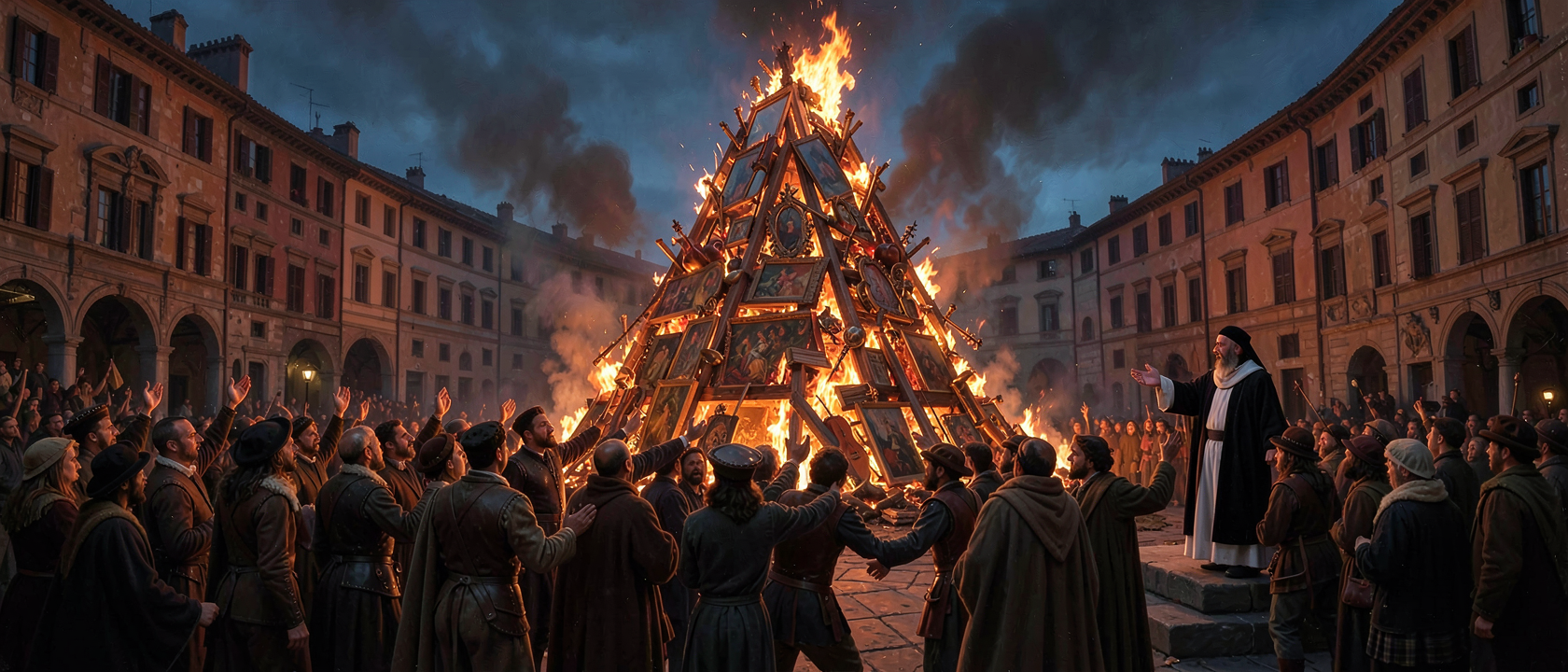
In early February 1497, workers raised a tiered wooden structure in Florence’s Piazza della Signoria, the city’s central civic square. It was built up like a pyramid, layer stacked above layer, and packed inside with brushwood and broom so the whole mass would catch fast once lit. At its peak stood a carved figure of Satan. Around its base stood smaller figures of demons. For several days it sat there finished and empty, waiting for Carnival to arrive.
Savonarola’s Florence
By the 1490s, the Dominican friar Girolamo Savonarola held an authority in Florence that went well past his pulpit. He preached as a man who believed he spoke directly for God, and thousands of Florentines had come to accept that claim. His followers were known as the Piagnoni, “the weepers,” a name that stuck from the tears his sermons produced. Critics had their own word for the same crowd: pinzocheroni, roughly “bigots,” a reminder that Savonarola had opponents in the city as well as believers. The Piagnoni were mostly middle-class boys and young men. Through the 1490s they patrolled Florence’s streets, shouting abuse at anyone they judged impious, drunks, gamblers, women they considered dressed with too much vanity. In the weeks before Carnival in 1497, these same bands went door to door, demanding that households hand over anything judged sinful.
What Went Into the Fire
By February 7, 1497, the pyramid was no longer empty. An eyewitness later set down what households had given up: lewd pictures, women’s hats, mirrors, wigs, dolls, perfumes, inlaid wood panels known as intarsia, sculptures, images of cupids, playing cards, dice boards, chess pieces, lutes and other instruments, and books by assorted poets. None of this was abstract. A week earlier it had been furniture, keepsakes, and instruments sitting in ordinary Florentine homes, carried out piece by piece and added to the pile.
The Burning
February 7, 1497, was Shrove Tuesday, martedì grasso, the last day of Carnival before the fasting of Lent began, ordinarily the day Florence gave itself over most freely to feasting and license. Instead, trumpets sounded across the piazza, torches were carried to the base of the pyramid, and the packed brushwood caught quickly. An eyewitness recorded the mood: the crowd burned everything with the greatest happiness, nearly every citizen in Florence turned out, and the windows around the square were full of women watching. The ritual built to end Carnival’s excess drew its biggest crowd of the year using Carnival’s own tools, trumpets, spectacle, a packed square.
What Was Lost, What Wasn’t Recorded
No source claims anyone died that day, and none puts a price on what burned. What is certain is that paintings, books, instruments, and crafted objects, made and paid for by Florentine households and the artisans who supplied them, went into the fire and did not come back. Tradition holds that Sandro Botticelli threw some of his own mythological paintings onto the pile, but his biographer Giorgio Vasari never mentioned it, so historians treat the story as unconfirmed rather than settled. How many objects burned in total, and whether every surrender was willing or forced from households wary of the Piagnoni at their door, the record does not say. Popular accounts speak of thousands of items destroyed; no contemporary tally survives to confirm a number of that size.
Savonarola staged a second bonfire of the vanities the following Carnival, in 1498, though the 1497 fire is the one that was remembered. He did not have much longer himself. Pope Alexander VI excommunicated him on May 13, 1497. On May 23, 1498, Savonarola and two fellow friars were hanged in the same Piazza della Signoria, and their bodies were then burned on a platform rigged with gunpowder, so that the fire cracked and threw sparks, an eyewitness wrote. Even the gallows went into the flames. A marble marker is said to stand in the piazza, in front of the Fountain of Neptune, marking the traditional site.
—
**Issues flagged and fixed:**
1. **Relative-to-today reference (hard rule violation):** “A marble marker is said to stand in the piazza today”, removed “today,” since this phrasing ties the marker’s existence to the publication date rather than stating it as an ongoing/timeless fact.