
A Queen’s Birthday, 870 Miles from Anywhere
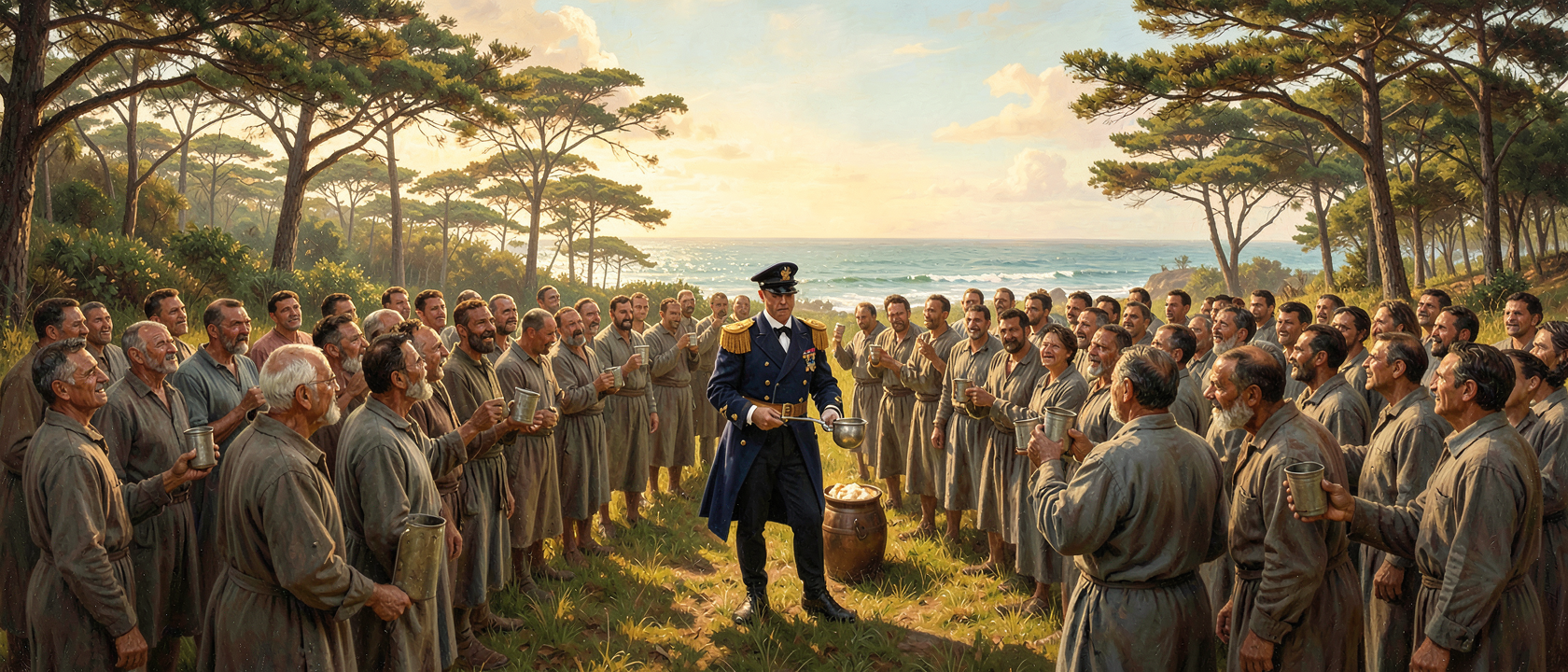
On Monday, May 25, 1840, 1,800 convicts on Norfolk Island gathered for an organized celebration of Queen Victoria‘s birthday. The order came from the settlement’s newly arrived superintendent.
Norfolk Island sat 870 miles (1,400 km) east of the Australian colony of New South Wales, far enough out that there was no quick appeal and no easy escape, only ocean in every direction. It functioned as a place of secondary punishment: men sent there had already been transported once and had reoffended, so the island was meant to be a harder sentence layered on top of the first.
A staged celebration, with rations and drink set aside for the occasion, was not how the island usually ran. Discipline there meant the lash and solitary confinement, not an afternoon arranged for the men being punished. That alone made the gathering worth noticing before anyone explains who arranged it.
A Geographer Sent to Run a Prison
The man behind it was Captain Alexander Maconochie, 53, a retired Royal Navy officer who had also served as the founding secretary of the Royal Geographical Society and as Britain’s first professor of geography. Nothing in that record suggested a career running prisons.
He had the post because Lord Normanby, the Secretary of State for the Colonies, had argued for a different kind of appointment: a superintendent chosen for his interest in the moral condition of convicts rather than for experience extracting obedience through force. Maconochie fit that description, and he was recommended for the job on that basis.
He arrived on Norfolk Island in early March 1840, roughly eighty days before the birthday gathering, bringing with him the first group of what was meant to be a cohort of 600 convicts sent specifically to test the system he planned to apply. To colonial officials watching from Sydney, placing a geographer in charge of one of the empire’s harshest penal stations looked, at the very least, like an unusual bet.
A Wager on Human Nature
Within months of taking command, Maconochie staged the celebration as an early, visible demonstration of what he believed: that even men convicted twice over could be moved by incentive and by the restoration of some measure of dignity, not by fear and flogging alone.
That argument ran against the island’s own reputation. Before Maconochie, convicts there had been treated with open brutality and generally written off as beyond reform, and Norfolk Island was held up elsewhere in the penal system as proof that severity was the only method that worked. A birthday party for 1,800 prisoners challenged that model directly, and it did so in front of the officials who had built their careers on it.
What Maconochie risked was concrete. He was staking his authority over men who had already shown that ordinary punishment did not deter them, his standing with a colonial administration looking for the experiment to fail, and the credibility of a reform argument that had, up to that point, almost no practical trial at this scale behind it.
From Appointment to Spectacle
The sequence the record supports is straightforward. Lord Normanby called for a superintendent concerned with the moral welfare of convicts rather than discipline alone, and Maconochie was recommended for the post. He arrived on Norfolk Island in early March 1840 with the first portion of the planned 600-convict reform cohort. Eighty days later, on Monday, May 25, 1840, he organized the celebration of Queen Victoria’s birthday for the 1,800 convicts on the island, the first public test of his methods in front of the colonial establishment. Some popular accounts place the event a day earlier, on May 24, which was Victoria’s actual birth date, but the fuller academic record places the celebration on the Monday that followed. That is as far as the documented timeline goes with confidence.
The Gaps in the Story
A good deal is missing from this account, and it is worth saying so plainly rather than filling the space with guesswork. The mechanics of Maconochie’s incentive system, the credits and classes he would later build his reforms around, are not detailed here. How the day itself actually unfolded, what the convicts did, how they behaved, and how officials reacted to watching 1,800 prisoners celebrate rather than labor under guard, is not specified in the record this account draws on.
Nor does this account resolve how the larger argument between punishment and reform played out, either during Maconochie’s own years on the island or afterward. Answering that would mean following his tenure past this one afternoon and tracing what happened to the island’s experiment once it was tested over years rather than a single day.
What the Experiment Cost, and Who Paid
What stood behind the celebration was not entertainment. It was 1,800 men whose daily treatment depended on whether one superintendent’s theory about human nature held up. It was Maconochie, staking an authority built in geography and naval service on a single afternoon’s gathering. And it was the colonial administrations in Sydney and London, watching to see whether reform was a workable alternative to deterrence or simply an indulgence that would get someone hurt.
Judging an 1840 penal experiment against modern correctional standards is a lens this record does not apply to itself, and it is worth saying so directly rather than smuggling that judgment in. What the sources do establish is narrower and, in its way, more useful: a party was staged on a prison island built for punishment, and it was meant to settle a question nobody in that room could yet answer, whether treating convicted men with some trust would reform them or simply hand them an opening.