
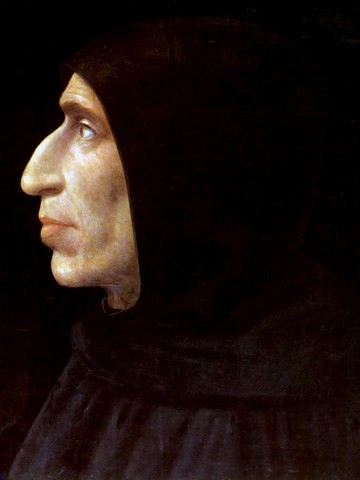
Girolamo Savonarola (21 September 1452 – 23 May 1498) was an Italian Dominican friar, preacher, philosopher, and writer whose fiery sermons brought him from the pulpit of Florence’s Convent of San Marco to effective control of the Florentine republic between November 1494 and 18 March 1498. Born in Ferrara and educated at its university, he combined theological rigour with a talent for political agitation that made him simultaneously an object of devotion to thousands of Florentines and an enemy of Pope Alexander VI. His de facto rule ended on the same public square where his most notorious act, the Bonfire of the Vanities on 7 February 1497, had taken place: on 23 May 1498 he was hanged and burned in the Piazza della Signoria, and his ashes were thrown into the Arno River so that no relic could be gathered.
Key facts
- Born: 21 September 1452
- Birthplace: Ferrara
- Died: 23 May 1498
- Place of death: piazza della Signoria
- Country: Duchy of Ferrara; Republic of Florence
- Occupation: politician; philosopher; religious; writer
- Field: philosophy; theology; homiletics; politics
- Employer: University of Ferrara
- Education: University of Ferrara
Early Life and Education
Savonarola was born on 21 September 1452 in Ferrara, at the time the seat of the Duchy of Ferrara. He studied at the University of Ferrara, where he completed an advanced Arts degree before moving toward medicine, following a family tradition. The pull toward religious life proved stronger. In 1475 he left Ferrara and entered the Dominican monastery of San Domenico in Bologna, where he studied theology until 1479 and was ordained a priest.
His formation years kept him close to the Dominican network. In 1478 he was sent back to Ferrara, to the priory of Santa Maria degli Angeli, to serve as assistant master of novices. By 1487 he had risen to Master of Studies at the Studium Generale of San Domenico in Bologna — the same institution where he had first trained — a position that placed him among the order’s senior educators.
Arrival in Florence and Rise to Power
Savonarola returned to Florence in 1490 at the request of Lorenzo de’ Medici, prompted by the scholar Giovanni Pico della Mirandola, who was a documented admirer of the friar. The following year, in 1491, Savonarola was elected prior of the Convent of San Marco, where he set about restoring strict observance of the Dominican rule.
His preaching drew large crowds and shaped the religious and political atmosphere of the city. Among those documented as admirers were Sandro Botticelli, Michelangelo, and Pico della Mirandola. When Piero de’ Medici fled Florence in November 1494, Savonarola stepped into a position of de facto political authority, which he would hold until 18 March 1498.
Rule of Florence
During his period of authority Savonarola pressed for a reformed, austerely governed Florentine republic and preached against what he regarded as the moral corruption of the age. He also wrote prolifically: his Compendium of Revelations appeared in 1495, and he produced a political treatise on the government of Florence, in addition to numerous sermons, most of which were collected by his follower Lorenzo Violi.
The most famous expression of his programme against luxury came on 7 February 1497, when his followers gathered in the Piazza della Signoria for the Bonfire of the Vanities. The pyre consumed luxury goods, cosmetics, mirrors, books, musical instruments, and artworks judged to be sinful. The Venetian ambassador present reportedly offered to purchase the entire pile for a vast sum; Savonarola refused, and the fire was lit.
Savonarola’s relationship with Rome deteriorated as his authority in Florence grew. On 13 May 1497 Pope Alexander VI excommunicated him, citing Florence’s refusal to join the papal Holy League against France and Savonarola’s own refusal to obey a summons to Rome. Savonarola continued to preach, treating the excommunication as illegitimate.
Fall, Trial, and Execution
In April 1498 a rival Dominican friar proposed a trial by fire to settle whether Savonarola held a genuine divine mandate. Neither side entered the fire, and the fiasco turned public opinion decisively against him. The shift in sentiment was swift. On 8 April 1498, a crowd attacked the Convent of San Marco, and Savonarola surrendered together with his two closest associates, Fra Domenico da Pescia and Fra Silvestro.
The trial for heresy that followed produced confessions extracted under torture. On 22 May 1498 Savonarola and his two companions were condemned to death. The sentence was carried out on 23 May 1498: Church and civil authorities hanged and burned all three in the Piazza della Signoria. To prevent devotees from collecting relics, the remains were broken apart and the ashes of all three friars were thrown into the Arno River beside the Ponte Vecchio. Piero Soderini succeeded Savonarola as the leading figure in Florence.
Legacy and Commemoration
Savonarola left no grave, but devotees continued to visit the site of his execution in the Piazza della Signoria. Anonymously, they left flowers there on 23 May every year well into the 19th century. A granite and bronze plaque now marks the spot.
In Ferrara, his birthplace, a bronze monument by sculptor Stefano Galletti was erected in 1875 in Piazza Savonarola. The statue has attracted a local superstition: one should never look it directly in the eyes, or risk bad luck.
Savonarola’s use of the printing press to circulate his sermons in the Florentine vernacular anticipated a technique that Martin Luther would employ around 30 years later during the Protestant Reformation. His writings, including the Compendium of Revelations and the sermons assembled by Lorenzo Violi, continued to be read and debated long after his execution.
Did you know
- Savonarola wrote his earliest known poem, “De Ruina Mundi” (On the Ruin of the World), in 1472 when he was only 20 years old. Written in Petrarchan verse, it attacked the moral corruption of the age. (italianrenaissanceresources.com)
- After Savonarola’s execution, devotees anonymously left flowers at the spot of his death in the Piazza della Signoria every May 23 well into the 19th century. A granite and bronze plaque now marks the site, as he has no grave. (ebsco.com)
- The Venetian ambassador attending the 1497 Bonfire of the Vanities reportedly offered to buy the enormous pyre of confiscated objects for a vast sum. Savonarola refused, and the fire was lit. (chrisfieldblog.com)
- At the Ferrara monument to Savonarola, a local superstition holds that one should never look the statue directly in the eyes, or risk bad luck. (inferrara.it)
- Savonarola used the printing press to disseminate his sermons in the Florentine vernacular, a technique Martin Luther would replicate some 30 years later during the Protestant Reformation. (trucepodcast.com)
Data sources
- Wikidata
- newworldencyclopedia.org
- italianrenaissanceresources.com
- thefamouspeople.com
- ebsco.com
- savonarola.net
- foliamagazine.it
- newadvent.org
- inferrara.it
Data updated: 2026-10-30