
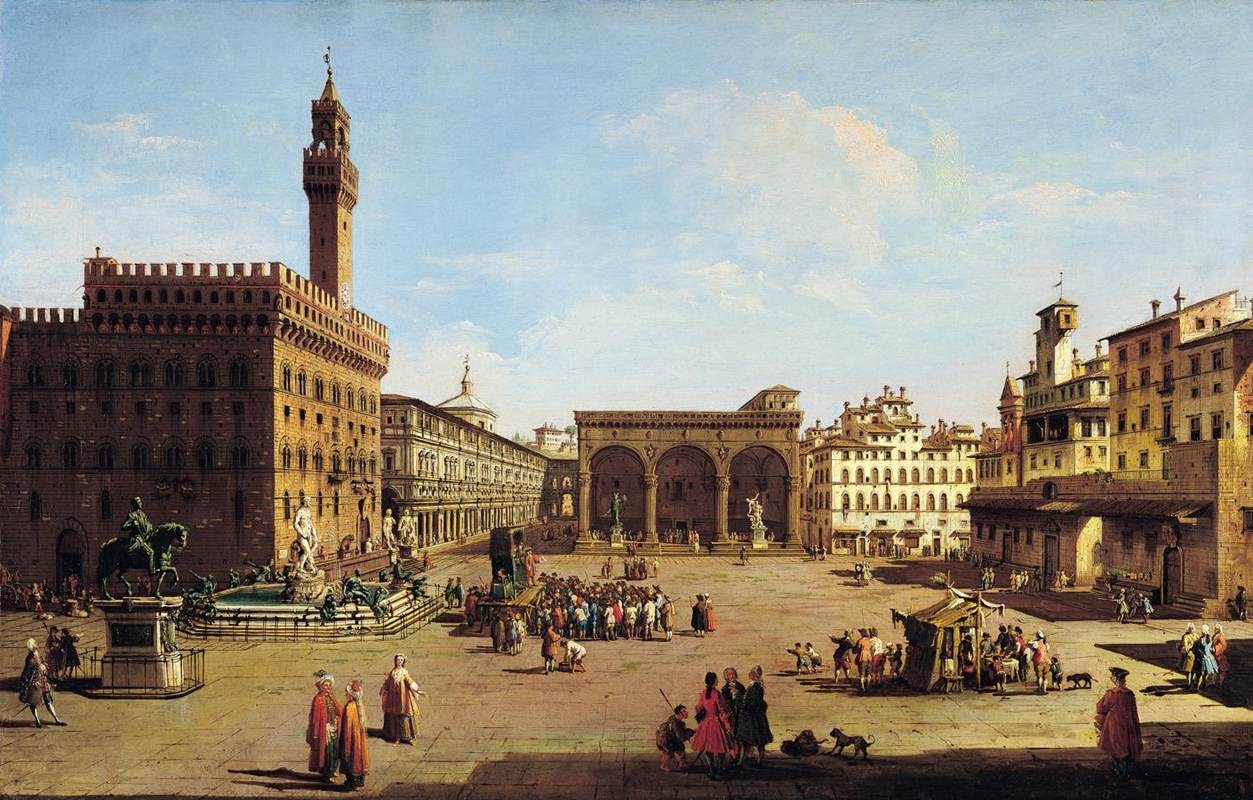
Piazza della Signoria is a public square in central Florence, Italy, occupying 300 square metres in the city’s historic core. Its irregular L-shape is the direct consequence of a political act: in 1268, the victorious Guelph faction demolished the houses of their Ghibelline enemies, and the cleared land was decreed never to be built upon again. From that moment, the square became the fixed stage on which Florence’s civic and political life was conducted, and it has remained so ever since. The buildings and sculptures gathered around it span more than seven centuries, making it one of the most compressed accumulations of Italian political and artistic history in a single outdoor space.
Key facts
- Country: Italy
- Type: square
- Located in: Florence
- Coordinates: 43.7697, 11.2556
- Area: 300 m²
Origins and shape
The square’s formation began in 1268 when the Guelphs, having defeated the Ghibelline faction, razed the properties of their rivals to the ground. The Uberti family, among the most powerful of the Ghibelline houses, lost their palaces in this clearance, along with 36 houses in total. The ground was then placed under a civic prohibition against any future construction, a restriction that explains why the buildings lining the piazza are not aligned with one another: each was built to face a previous street grid, not a planned square.
The distinctive L-shape that results from this history has never been regularised. The piazza was paved for the first time in 1385, more than a century after it was cleared, giving the open ground its first permanent surface. Repaving work carried out in the 1980s exposed far older layers beneath: a Roman theatre, public baths equipped with hypocaust heating, a textile dyeing workshop from the 1st century AD, and Neolithic remains predating the Roman city of Florentia. Separately, archaeological excavations conducted under the scientific direction of the Superintendence for Archaeological Heritage of Tuscany revealed an ancient Roman amphitheatre beneath the area of the piazza and Palazzo Vecchio, with historical evidence in the area dating to between 30 and 15 BC, the period when Florentia was founded.
Palazzo Vecchio and the Loggia dei Lanzi
The building that defines the square more than any other is Palazzo Vecchio, whose construction began on February 24, 1299. The architect Arnolfo di Cambio designed it to house the city’s ruling body and to protect its magistrates during periods of civil unrest. Its Torre di Arnolfo rises 94 metres above the piazza, the highest civic structure in Florence.
On one side of the square, the Loggia dei Lanzi shelters several major sculptures under its open arches. In 1583, after the Uffizi palace was completed, architect Bernardo Buontalenti converted the roof of the Loggia into a terrace, giving the Medici princes a vantage point from which they could observe ceremonies below. Benvenuto Cellini’s bronze Perseus with the Head of Medusa, commissioned by Cosimo I de’ Medici and finished in 1554, occupies one of the bays and is regarded as one of the defining works of Mannerist sculpture. Alongside it stands Giambologna’s Rape of the Sabine Women, completed in 1583 and considered the first group sculpture in European history designed without a single dominant viewpoint.
Sculptures in the open square
At the entrance to Palazzo Vecchio, a marble copy of Michelangelo’s David was installed in 1910, replacing the original statue that had occupied the spot since 1504. Moving the original to that position had been an undertaking in itself: in 1504 it took four days and forty men to slide the sculpture on a wooden cart, on wooden trunks, the half mile from Michelangelo’s workshop to the piazza.
The Neptune Fountain, built by Bartolomeo Ammannati between 1560 and 1575, occupies another prominent position in the square. Its layout was reportedly based on a drawing by Leonardo da Vinci. The fountain also marks a grimmer historical point: a round marble plaque in front of it identifies the exact spot where Girolamo Savonarola was hanged on May 23, 1498.
Savonarola and the Bonfire of the Vanities
On February 7, 1497, the Dominican friar Girolamo Savonarola led his followers in what became known as the Bonfire of the Vanities. In the piazza, they burned books, gaming tables, fine dresses, and works of art.
On May 23, 1498, Savonarola was executed by hanging in the same piazza, at the same location where his bonfires had burned. The marble plaque in front of the Neptune Fountain still marks the spot.
UNESCO designation and long-term significance
Piazza della Signoria is part of Florence’s Historic Centre, inscribed as a UNESCO World Heritage Site in 1982 at the 6th Session of the World Heritage Committee. The designation covers the accumulated architectural, artistic, and civic fabric of the city centre, of which the piazza is a central element.
The square sits beneath one of the longest sequences of continuous human occupation in Tuscany.
In 2025, Florence recorded 4.8 million tourist arrivals and 11.5 million overnight stays, according to data from ISTAT (Italy’s national statistics office) updated on July 16, 2026. Of those overnight stays, 9.7 million were by international guests, with each arrival averaging 2.4 nights.
Did you know
- It took four days and forty men to move Michelangelo’s David the half mile from his workshop to the Piazza della Signoria in 1504, sliding the statue on a wooden cart through the streets on wooden trunks. (accademia.org)
- When the Neptune Fountain was unveiled in 1565, Florentines famously jeered at sculptor Bartolomeo Ammannati, shouting “Ammannati, Ammannati, what a beautiful marble you have ruined!” — a legend that underscores how demanding Florentine aesthetic taste was at the height of the Renaissance. (florenceinferno.com)
- Giambologna’s Rape of the Sabine Women (completed 1583), displayed in the Loggia dei Lanzi, is considered the first group sculpture in European history conceived without a dominant viewpoint, standing over 4 metres high. (florenceinferno.com)
- The area beneath Piazza della Signoria was populated during the Neolithic period, and in the 4th century AD a large Christian basilica stood here that remained in use until the 7th century, making the piazza one of the longest-continuously-inhabited urban spaces in Tuscany. (italyscapes.com)
Data sources
- Wikidata
- mega.it
- virtualglobetrotting.com
- florenceinferno.com
- italyguides.it
- firenzepatrimoniomondiale.it
- foliamagazine.it
- readtheplaque.com
- thehistoryofart.org
- florence-on-line.com
- thetrainline.com
- italymagazine.com
- cheaperthancars.com
Data updated: 2026-10-30