
A Poet’s Unfinished Psalter
In October 1586, an English soldier-poet named Philip Sidney lay dying in the Netherlands with his most ambitious piece of writing still two-thirds unfinished. He had set out to translate all 150 Psalms into English verse. The 107 he never reached fell to his sister, Mary Sidney, and it would take close to four centuries before literary history credited her properly for what she did with them.
A Courtier’s Private Project
By the mid-1580s, Philip Sidney was one of the most admired writers in England, even though almost nothing he had written had been printed. His sonnet sequence Astrophil and Stella and his prose essay The Defence of Poesy (also known as An Apology for Poetry) circulated in manuscript among friends and courtiers. He came from a family with real standing at court: his father, Sir Henry Sidney, had governed Wales and served twice as Lord Deputy of Ireland, and his mother, Mary Dudley, was the sister of Robert Dudley, Earl of Leicester.
Alongside his poetry, Sidney had been working on a verse translation of the Book of Psalms, drawing on the Geneva Bible of 1560 and earlier English psalters. He aimed for accuracy over elegance, staying close to the original sense even when the English came out stiff. It was private work, not something prepared for a printer. By the time he crossed to the Netherlands to fight for the Dutch against Spain, he had finished 43 of the 150 psalms. The other 107 sat untouched.
Zutphen, September 22, 1586
Sidney went to the Low Countries as part of an English force supporting the Dutch against Spanish rule, serving under his uncle, Robert Dudley. On September 22, 1586, English and Dutch troops clashed with Spanish forces near the town of Zutphen, in Guelders, in what is now the Netherlands. The fighting was costly on both sides: later estimates put combined casualties at roughly 6,000 killed and wounded among the English and Dutch, against an estimated 4,500 on the Spanish side. During the battle, Sidney was struck by a bullet in the thigh.
A thigh wound was not automatically a death sentence, but sixteenth-century medicine had no defense against what usually followed it. There were no antibiotics and no reliable way to clean a deep wound. Infection, not the bullet, was the real threat, and it was infection that took hold.
Thirty-One Years Old, 107 Psalms Short
Sidney was moved to Arnhem, where he died of gangrene on October 17, 1586, about 25 days after he was wounded (some accounts count it as 26). He was 31. His body was brought back to England, and a funeral was held at Old St Paul’s Cathedral in London on February 16, 1587.
What he left behind was not a finished manuscript waiting on a shelf. It was 43 psalms out of 150, a project two-thirds short of its goal, with no instructions for who, if anyone, should finish it.
Mary Sidney Takes the Pen
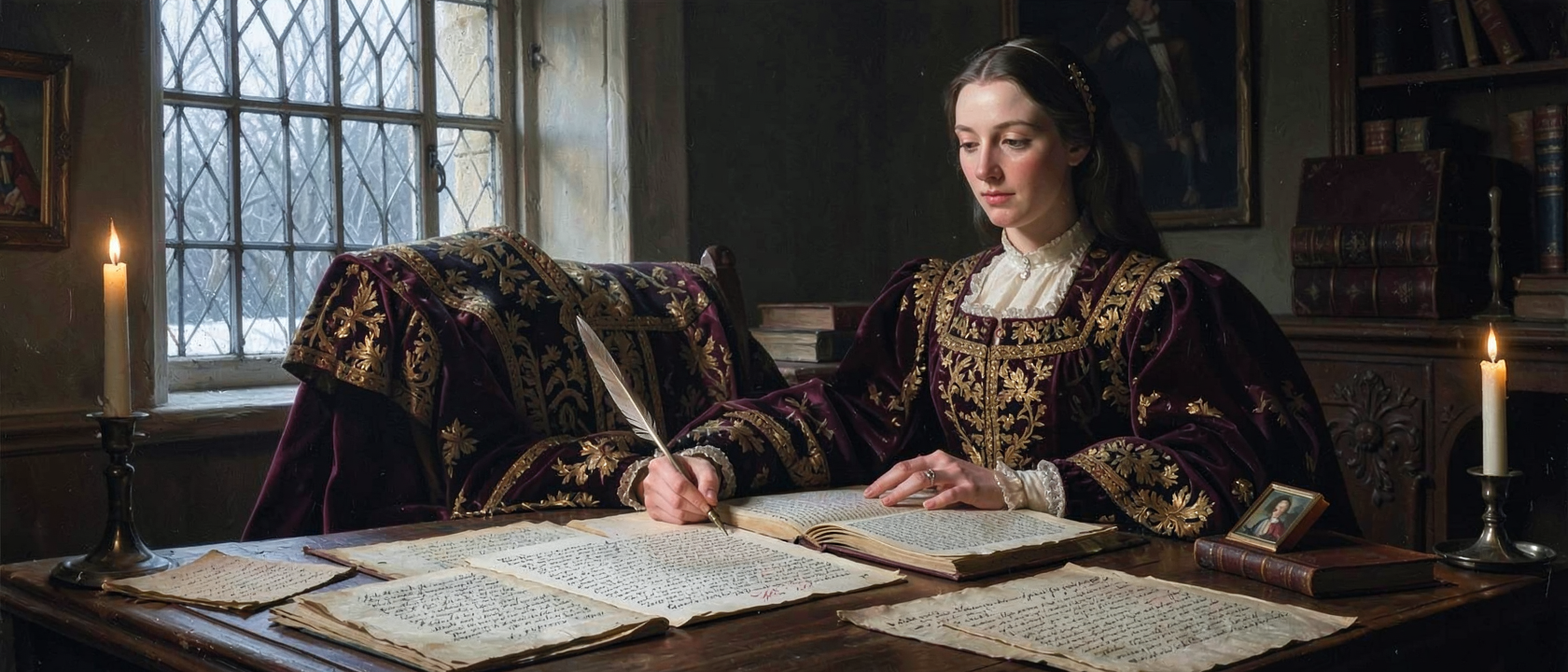
The person who finished it was his sister, Mary Sidney, Countess of Pembroke. Born in 1561 and married at 15 to Henry Herbert, 2nd Earl of Pembroke, she had published nothing of her own before her brother’s death. Afterward, she stepped into public authorship for the first time, editing and promoting his existing works and taking over the Psalter he had left half-done. Most of her documented writing dates from the 1590s.
She completed the remaining 107 psalms and revised a number of his original 43 as well. Across the full collection she used 128 different verse forms, a range her brother’s section never attempts. Where Philip kept close to the literal sense of his sources, sometimes at the cost of smoothness, Mary gave herself more room: she rendered the biblical instruments of the psalms into language a reader of her own day would recognize, translating them as “pipe, tabret, and organ” rather than reaching for older, stranger terms. The critic G. F. Waller, writing in The Review of English Studies, made this comparison explicit, arguing that Philip’s verse stayed literal while Mary’s was more formally inventive and independent in its choices. That is one scholar’s reading of the two halves, not a settled verdict, but it lines up with how later critics have generally described the difference between the two sections.
Read by the Few, Published by Neither
Neither sibling ever saw the Sidney Psalter in print. It survived only in manuscript, copied by hand and passed among a small circle. Copies are reported to have reached Fulke Greville, Sidney’s friend and later biographer, the poet Edmund Spenser, and Queen Elizabeth I, though the evidence for this circulation rests on a single account rather than independent confirmation. John Donne is said to have written in praise of it. If those reports are accurate, a work read by a queen and admired by two of the period’s leading poets would be no minor achievement, yet it was never set in type while either Sidney was alive.
What followed was quieter than the praise. For roughly three centuries, literary history treated the Sidney Psalter largely as Philip’s work, with Mary’s 107 psalms absorbed into his reputation rather than recognized as her own.
A Verdict, and a Long Wait
In the nineteenth century, the critic Alexander B. Grosart reassessed the Psalter and judged Mary’s portion the stronger of the two, more daring in form than her brother’s. The verdict did not change much right away. A fuller reckoning with Mary Sidney as a major poet in her own right came only in the late twentieth century, when feminist literary scholarship began reexamining women’s writing from the period in earnest. From Grosart’s judgment to that reassessment was most of a century. From the Psalter’s completion to any broad acknowledgment of who had written most of it was closer to four hundred years.
What’s Still Unsettled
Some questions about the Sidney Psalter remain open. Scholars disagree about whether Mary Sidney worked directly from the Hebrew text or relied on English and continental intermediary translations, since the surviving evidence does not settle it either way. Where her verse crosses from translation into freer paraphrase is also argued over rather than agreed. No source gives a firm date for when she finished the 107 psalms, only that most of her documented work falls in the 1590s, between her brother’s death in 1586 and her own in 1621. These are gaps the sources themselves leave open, not loose ends smoothed over for the sake of a tidy ending.